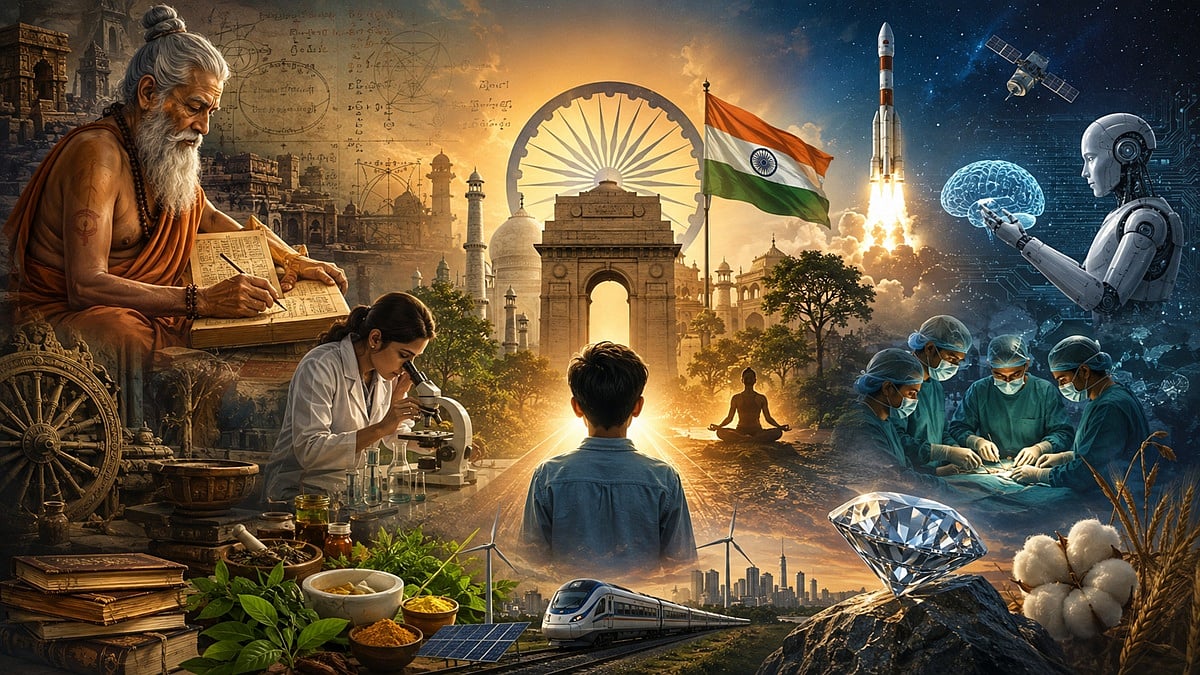
Independent India today, on 15.08.2026, completes 79 years and steps into its 80th year. At this historically significant moment, it is necessary to look back not only at the achievements we have made, but also at the pride we have lost, and the economic value of that pride. This article is being written as an expression of that thought.
Thiruvalluvar’s lines, “Those who possess knowledge possess all,” serve as a key to understanding the intellectual richness of Indian civilization. From mathematics to medicine, from yoga to technology, India’s contribution to humanity’s journey of knowledge has been immense.
But after eight decades of independence, there is an important question we must ask ourselves today:
Have we transformed the knowledge and discoveries that we have given to the world for thousands of years into India’s economic strength and global market value? Seeking the answer to this question, recognizing the opportunities we lost in history, and charting a new path for India’s future have become the need of the hour.
The zero and decimal number system, which changed the course of world mathematics, are among India’s great scientific contributions. From Brahmagupta’s formalization of the mathematical use of zero to the modern computer and digital world, its influence has spread widely. Likewise, Pingala’s ancient mathematical ideas are linked to the early concepts that later developed into the binary system.
This continuity of scientific thought has today laid the foundation for various fields of the modern world, including computer science, banking, artificial intelligence, and space technology.
The Digital Economy: Today, the digital economy has emerged as one of the world’s largest economic powers. However, even though global technology companies turned that foundational idea into a multi-trillion-dollar industry, India, as the owner of that intellectual heritage, has not received economic benefits.
Sushruta’s surgical knowledge, dating back two thousand years, especially nasal reconstruction, reveals the antiquity and advancement of Indian medicine. Today, medicine and cosmetic surgery have grown into multi-billion-dollar global markets.
Yoga is another global gift from India. In 2014, the UN declared June 21 as International Yoga Day. Today, yoga has become part of the global way of life. But is India’s share in its global commercial value commensurate with its civilizational contribution?
This is not just about knowledge; the history of our natural wealth raises the same question. The Kohinoor, obtained from the Golconda mines during British rule in India, is one of the world’s most famous diamonds. Today, it is a valuable possession of the British Crown. It has no official current market price; it is not a market asset for sale.
Although various valuations have been made, its historical and cultural value cannot be measured in money. This is not merely the loss of a diamond; it is a symbol of how India’s commercial power was transferred to the world through colonialism.
Intellectual Property Rights: There is a history of patents being claimed in foreign countries even for our traditional knowledge, such as turmeric, neem, and basmati rice. The Traditional Knowledge Digital Library (TKDL) was created to document and protect India’s traditional knowledge. This is the result of the experience that made us realize the importance of intellectual property rights.
Most of the markets have gone into the hands of other countries. This is the biggest lesson we need to learn from this.
Creating knowledge is the first victory. Documenting it is the second victory. Securing copyright is the third victory. Turning it into a business and a global market is the complete victory.
In the valuation of the world’s leading companies today, the share of intellectual property, copyright, technology, and brand has increased more than land, buildings, and machinery. India must make full use of this change.
Prime Minister Narendra Modi’s emphasis on “Jai Anusandhan” should form the foundation of this new thinking. Discoveries born in laboratories must become intellectual property, intellectual property must become industry, industry must become a global market, and that market must become India’s national wealth.
“Vocal for Local” is not just about buying Indian products; it should also mean valuing Indian knowledge in the global market under an Indian name.
The mandate of the times: India, which gave the world the philosophy of life through “Vasudhaiva Kutumbakam,” also made the world realize the truth that “knowledge is wealth.” But we learned late the art of turning knowledge into economic power.
In the 80th year of independence, let this be the resolve we take: India, which gave knowledge to the world, must now also lead the economy of that knowledge. That will be the true knowledge revolution India undertakes toward Viksit Bharat 2047.
- Author, State President of the BJP’s voluntary organization wing