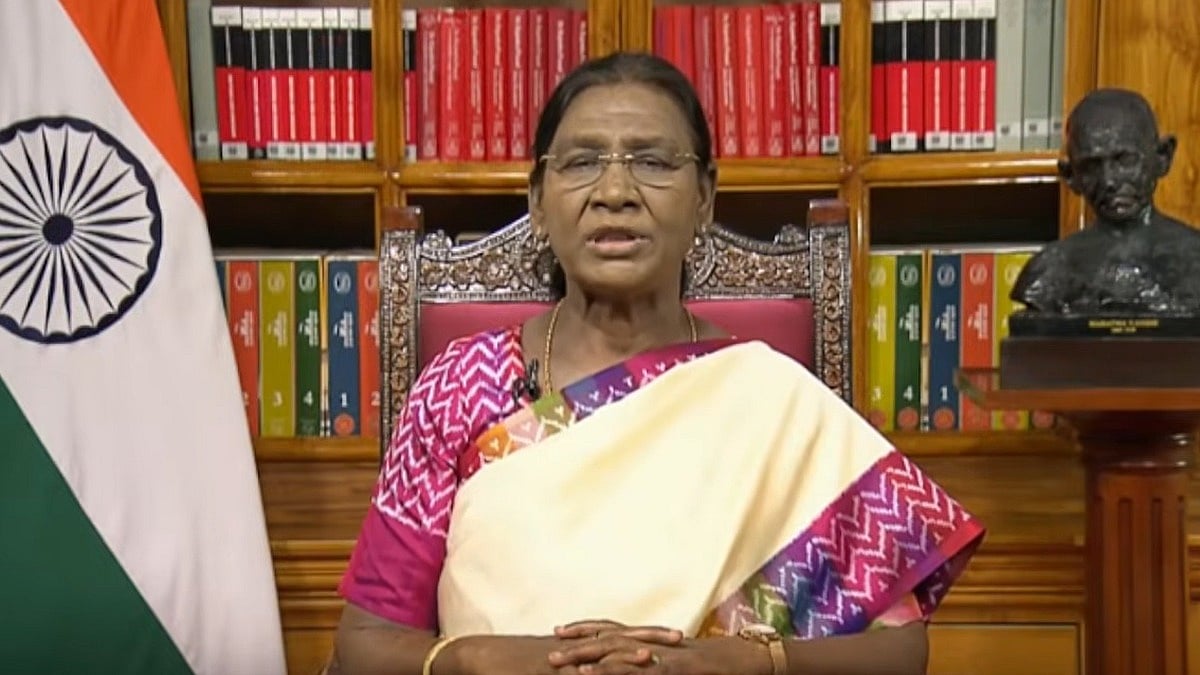
New Delhi: “The objectives of the reforms undertaken by the Central Government are to completely prevent irregular practices in public examinations and to make the examination system much more transparent, secure, and reliable for young people.
Through the government’s initiatives and the growing economic activity, many new opportunities are emerging for young people,” President Droupadi Murmu said in her address to the nation on the occasion of the 80th Independence Day.
The full text of that speech is: “On the occasion of our country’s Independence Day, I extend my heartfelt greetings to all of you. In just a few hours, our nation will celebrate its 80th Independence Day. The people of the country, and Indians all over the world, are celebrating this national festival with great enthusiasm. Our tricolor national flag stands as the symbol of our country’s freedom. We hoist it with immense pride.”
On August 15, 1947, the Indian mother was freed from bondage. The true meaning of freedom lies in ensuring that all citizens make use of the opportunities to fulfill their aspirations and work toward the goal of advancing India into a leading nation in the world.
For the country’s development, students, teachers, scientists, engineers, doctors who provide healthcare services, healthcare workers, hard workers, and farmers who feed us are all contributing to building the nation through their efforts.
Skilled sportspersons, artisans, artists, visionary scholars, hardworking employees in the private and public sectors, people’s representatives dedicated to serving the people, judicial officers, conscientious government employees, large and small investors contributing to our economy, selfless social workers, and all sanitation workers who are the frontline workers of the Swachh Bharat Mission are playing an important role in the progress of the nation.
The countless citizens engaged in various tasks, and every citizen who diligently fulfills the fundamental duties defined in our Constitution, are active contributors to the work of building our nation. I wholeheartedly commend each and every one of them.
I especially commend the unwavering sense of duty and dedication of our soldiers and personnel in the armed forces, the armed police forces, and all police departments. I also commend the Indians living abroad who enhance India’s pride and dignity on the world stage, as well as the officers serving in our embassies.
As the nation approaches the completion of 100 years of independence in 2047, we are moving forward with the aim of building a developed India. Our commitment is to ensure that the benefits of development initiatives, guided by the progress of the poor, reach everyone. Drawing on our rich heritage and the ideals of the freedom movement, we are advancing on the path of modern development. The Vedic saying “Vayam Rashtraye Jagrayam,” which means “Let us protect the nation with awareness and vitality,” inspires us to always be ready to serve the nation.
During our freedom struggle, people with diverse ideologies united for the single common goal of “Indian independence.” During the Swadeshi movement, the song “Vande Mataram” became the song of the people. Under the leadership of the Father of the Nation, Mahatma Gandhi, countless Indians devoted themselves fully to our freedom struggle.
Babasaheb Dr. B. R. Ambedkar stood as a symbol of the highest ideals of social reform and patriotism. I salute the great sons and daughters of Mother India who belonged to the ideals that sowed the seeds for our nation’s freedom and progress.
Today, August 14, we observe the ‘Partition Horrors Remembrance Day.’ We respectfully remember the millions of Indians who lost their lives in the violence that followed Partition, or who were forced to endure the tragedy of displacement. Due to communal violence, millions of people were compelled to become refugees and had to suffer the horrors of Partition. However, they never gave up their identity.
At the time of the country’s independence, along with the terrible consequences of Partition, there also arose the immense challenge of integrating more than 550 princely states into the new independent India. Sardar Patel brought an end to the princely system and integrated those states into our free democratic framework. On behalf of the grateful people of the nation, I pay my respects to Sardar Vallabhbhai Patel, the “Iron Man” who shaped the unity of modern India.
The Constitution, created by the people of India, is built on the foundation of public participation. In our country, which is the cradle of democracy, a sense of contribution has always naturally existed among the people. This tradition is now being carried forward by our citizens with renewed enthusiasm. Nationwide movements are being implemented with the active participation of the public. This is a remarkable and inspiring achievement of our democracy.
Along with equality of status and opportunity, human dignity is among the cherished principles of our Constitution. Today, people from ordinary backgrounds are making admirable contributions in various fields. This strengthens my belief that in today’s India, anyone can dream big and also make those dreams come true.
Our Constitution clearly defines the responsibilities of the executive, legislature, and judiciary. It is the duty of their representatives in the legislature to voice the people’s wishes and expectations. It is the responsibility of the executive branch to implement policies that protect the interests of the nation’s people.
It is the duty of everyone in the judiciary to ensure that no one is denied justice because of a lack of adequate resources. Equal opportunity must be provided to all citizens, especially those from marginalized or disadvantaged sections of society, to obtain justice that is dignified and delivered in a timely manner.
Over the course of about a decade, our country has experienced rapid, inclusive growth; priority given to creating harmony between tradition and development; and the removal of various development bottlenecks that had persisted for decades.
Our country is celebrating the 200th birth anniversary of Mahatma Jyotiba Phule. Mahatma Phule and Kranti-Jyoti Savitribai Phule made historically significant contributions to social justice, education, women’s empowerment, and equality. Following their principles, over the past few years, priority has been given at the national level to the advancement of marginalized sections of society. New benchmarks have been set in the field of women’s education.
More than 25 crore people have been lifted out of poverty. Under the world’s largest financial inclusion program, the “Prime Minister’s People’s Bank Account Scheme,” around 59 crore people have been brought into the banking system. Of these, more than 32 crore are women. Through the scheme providing free food grains, food security has been ensured for more than 80 crore people.
Under the ‘Ayushman Bharat Pradhan Mantri Jan Arogya Yojana,’ free medical insurance coverage of up to Rs. 5 lakh per year has been provided to 60 crore people. ‘Farmer Honor Fund’ and ‘Farmer Credit Cards’ have supported farmers engaged in agriculture, dairy, poultry farming, fisheries, beekeeping, and similar activities.
World history bears witness to the fact that development based on a strong cultural identity is both rapid and sustainable. Awareness is growing in our country today that a sense of cultural pride strengthens the nation’s inner resolve. Our ancestors have left us a rich heritage encompassing education, science, art, culture, spirituality, and a life rooted in moral values. We are moving forward by integrating our tradition with our development.
India has built the world’s largest and most advanced digital infrastructure. Today, digital payments are widely used even at small shops and roadside vendors in rural areas. More than 50 percent of the world’s real-time digital transactions take place in India. Together, the people of the country and the government have set an example of a digital revolution for the world to see. By using technology, the government has delivered the benefits of welfare schemes to the people in a transparent manner.
Modern infrastructure facilities in the sectors of highways, waterways, railways, and air transport have expanded in our country like never before. This not only creates opportunities for new industrial ventures but also increases employment opportunities and boosts investors’ confidence.
Wars and instability in various parts of the world affect every country. Even in such a challenging environment, our economy continues to advance as one of the world’s fastest-growing major economies. According to economic forecasts, India’s growth rate is expected to be more than twice the global average growth rate. The ‘Self-Reliant India Mission’ has further strengthened the foundation of our economic progress and the nation’s security.
While moving forward on the path of modern development, India is also taking the lead globally in environmental protection. Our country has achieved some of the 'Sustainable Development Goals for 2030' ahead of the set deadline. In recent years, the renewable energy sector has experienced growth at an unprecedented pace.
The nation’s welfare is the foundation of our foreign policy. Peace, cooperation, dialogue, and the philosophy of Vasudhaiva Kutumbakam (the world is one family) stand as the pillars of our foreign policy. We have entered into free trade agreements with many countries to promote economic cooperation and strengthen mutual relations.
We are playing a significant role in the group of countries in the Global South, or developing countries. Our country’s standing on the world stage has risen. We believe in a rules-based international order. Our effort is to ensure that the major communities of the world receive appropriate representation in the UN and other multilateral organizations. This initiative of our country has been receiving strong support from many countries.
Future generations have an equal right to natural resources, just as we do. We must ensure that our actions do not create any obstacles to future generations in exercising this right. We must make every effort to leave behind richer natural resources for them. Our belief in protecting the environment is an important part of our heritage. A simple song in the Santali language carries a profound message in this regard.
Some lines from that song written by Pandit Raghunath Murmu are as follows:
"Dare gujuk khan nyel de
Miru sene raak payaha daya haya ke.
“Gujuk Khan appovak jathi tharam thare
“Sedhak babon raag payaha apo ana nyel the.”
That is the song. In this poem, the poet describes a parrot weeping in unbearable sorrow upon seeing a tree completely withered away.
He says: “My dear brothers! That parrot is crying at the sight of a dying tree. My brothers! When the tree that is part of human culture is destroyed, why do we, as human beings, not grieve?”
The message of this song is that everyone should be firmly committed to protecting nature and human values. A lush, green tree is a symbol of the moral values and well-being of human society. With the spirit of initiatives such as a movement to plant a sapling in the mother’s name and a movement for an eco-friendly lifestyle, we must undertake both individual and collective efforts to protect the environment.
It gives me great joy to see our girl children performing exceptionally well in the field of education. From the Drone Sisters initiative, which helps improve agricultural productivity, to those serving as fighter jet leaders in the Air Force, women’s contributions are increasing across various fields.
In the recent Commonwealth Games held in Glasgow, women won 8 of the total 13 gold medals won by India. Our women are becoming economically self-reliant. More than 10 crore women are members of self-help groups. A target was set to create 3 crore “Lakhpati Didis,” and it was successfully achieved. Currently, our country is moving toward the goal of creating 3 crore more new “Lakhpati Didis.” Two-thirds of the entrepreneurs who received financial assistance under the Mudra Bank loan scheme are women.
Along with efforts toward women’s economic self-reliance, we also see them taking on leadership roles in many fields. The increasing number of women exercising their right to vote is a notable achievement of our democracy. With the aim of providing 33 percent reservation for women in the Lok Sabha and Legislative Assemblies, the Women’s Reservation Act, known as the “Nari Shakti Vandan Adhiniyam,” was enacted in 2023. Implementing the objectives of this law will not only increase women’s role in leadership but also make our democracy more inclusive.
65 percent of our country’s population is under the age of 35. This younger generation is our most valuable asset. The youth of our country are talented, dedicated, and capable. I have seen the innovative, practical solutions that young people create to address various challenges at the grassroots level. This reflects our youth’s commitment to society and to the nation. A new chapter in space exploration has been opened by a youth team with an average age of just 28, which recently launched a rocket successfully.
Many of our young people are choosing the path of self-employment, thereby promoting a culture of job creation. The participation of young entrepreneurs has helped create a strong startup ecosystem in our country. Major global companies, inspired by the talent and dedication of Indian youth, are entrusting them with leadership responsibilities. Such young achievers have further enhanced the reputation of Indian youth power across the world. Our younger generation strengthens my confidence in India’s bright and prosperous future.
Our students are the ones who shape India’s future. Just as the government and society must work together to ensure the nation’s security, everyone must contribute through coordinated, collective efforts to protect our students’ present and future.
Public examinations serve as gateways to opportunities for our students. The government is taking extensive measures to bring reforms to these examinations. The aims of these reforms are to completely prevent irregular practices in public examinations and to make the examination system more transparent, secure, and reliable for young people.
Through government initiatives and growing economic activities, many new opportunities are emerging for young people. By making use of such new opportunities, our youth can travel along new paths toward success.
The physical and mental well-being of our youth form the foundation of the nation’s future. Families and society have a responsibility to encourage young people to move forward with enthusiasm.
Sports are used as a medium to promote the development of youth and to build the nation. Under the 'Khelo India' scheme, an excellent ecosystem for sports is being created across the country, from the local grassroots level to the national level. The government is making unprecedented investments to promote sports. These efforts are yielding good results.
There has been significant progress in the performance and achievements of our athletes in international sporting competitions. Although our country stands as the nation with the largest number of young people in the world, the number of elderly people is also increasing. The government has taken various measures to improve the quality of life of the elderly.
About 6 crore elderly people aged 70 and above can receive free medical services worth up to 5 lakh rupees per year. The entire society should treat the elderly with kindness and with the feeling that they are one among us. At the same time, their self-respect must also be protected.
We take pride in our tradition of upholding truth and justice and of defeating forces that stand against humanity. On July 26, we celebrated Kargil Vijay Diwas. Earlier, on May 7, we commemorated the completion of one year since the 'Operation Sindoor' operation was carried out. At that time, we honored and remembered the unmatched valor of our armed forces.
That historic anti-terror operation demonstrated the precision and effectiveness of the Indian Armed Forces. It sent a clear and firm message to terrorists and those who support them. Wherever they may have gone, they must face the consequences of their actions. Suspending the Indus Waters Treaty with the country that shelters terrorism is a decisive step taken in the interest of our nation, especially in the interest of our farmers.
For many years, Naxal extremism was a major challenge for the country. Making India a Naxal-free nation is a significant achievement. Areas once affected by Naxalism are now filled with enthusiasm. Inclusive development is taking place in these regions. A large number of athletes participated in the 'Bastar Olympics' competitions. Many artists showcased their talents at the Bastar Pandum event. All of this was enjoyed by a large number of people.
In a way that safeguards the nation’s pride, and connected to the Maratha military heritage, 12 forts were added to UNESCO’s World Heritage list last year. Furthermore, this year, Sarnath, the place where Lord Buddha delivered his first sermon, has been included in UNESCO’s World Heritage list. On one hand, there are spiritual symbols associated with Lord Buddha on the land of Bharat. On the other hand, there are also symbols here that reflect our remarkable ability to preserve our pride and noble traditions.
Achieving the goal of a developed India is the true purpose of the progress and well-being of every Indian. Gurajada Apparao, the great nationalist writer who produced works in the Telugu language, expressed an enduring message about patriotism in one of his songs as follows:
"தேசமுனு பிரேமிஞ்சுமன்னா
மஞ்சி அண்ணாடி பெண்சுமன்னா.
தேசமாந்தே மாட்டி காடோய்
தேசமந்தே மனுஷுலோய்."
The essence of these lines is this:
"Love the nation,
cultivate good qualities.
The nation is not merely a stretch of land.
The nation includes all the people who live in it."
It is my firm belief that, through the participation of society and the efforts of the government, the people living in every village, every town, and every home across India will become healthy, happy, and prosperous.
With an inclusive spirit of patriotism, let us dedicate ourselves to achieving the goal of making India a developed nation. Jai Hind!” said President Droupadi Murmu in her address.