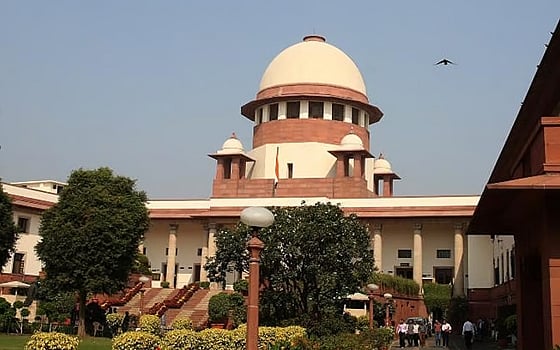
The Supreme Court on Friday directed the Union government to respond to petitions challenging the amendments made to the Right to Information (RTI) Act through the Digital Personal Data Protection Act.
Earlier, the RTI Act exempted the disclosure of personal information unrelated to public activity or public interest under Section 8(1)(j). However, the law also allowed the disclosure of personal information if it was a matter of overriding public interest.
In this context, under Section 44(3) of the Digital Personal Data Protection Act brought in last year, the clause relating to matters of broad public interest was removed, and disclosure of personal information was completely exempted.
A bench comprising Chief Justice of India Surya Kant and Justices Jayamalya Bagchi and V. Mohana heard on Friday the petitions filed in the Supreme Court challenging this.
At that time, senior advocates Brinda Grover and Prashant Bhushan, appearing for the petitioners, argued that “earlier, the safeguards specifying the circumstances under which personal information should not be disclosed were mentioned in Section 8(1)(j) of the RTI Act. But they have now been completely removed. In an earlier privacy-related case, it was stated in the judgment delivered by Justices D.Y. Chandrachud and N.V. Ramana that the right to information and privacy are fundamental rights under Article 19(1)(a) of the Constitution.
It was also noted in that judgment that the actual RTI Act ensures proper maintenance of the balance between these two.
In this situation, due to the amendments made under the Digital Personal Data Protection Act, personal information of those including cases filed against a person, charge sheets, and welfare scheme beneficiaries cannot be obtained,’ they said.
Following the arguments of senior advocates, the bench of judges ordered the Central government to respond on this matter.