Our daughters are demonstrating the ability to lead the nation's military!
Prime Minister Modi said, “In the THDC tunnel under construction in Chamoli, 22 workers who were on duty at the time got trapped due to a sudden influx of debris and water... Search operations are continuing for the three people who have not yet been rescued. All agencies, including the NDRF, SDRF, and the district administration of the Uttarakhand state government, are closely monitoring the situation. I have ordered a magistrate-level inquiry to clearly ascertain the facts and determine the precautionary measures that need to be taken in the future. The safety of workers employed in any construction project must at all times be our foremost priority; I issued instructions regarding this yesterday.”
I announce today from the Red Fort that in the coming days we will build a vibrant Civil Defence framework. We will train them in modern systems. What measures can be taken to protect citizens from contemporary crises? We are going to create a grand and modern civil defence volunteer force capable of facing the challenges of our times. The contribution of our sisters and daughters in building the nation is today a great source of inspiration for all of us. Whether it is fighter aircraft or civil aviation, our daughters are at the forefront. Whether it is sports or STEM (science, technology, engineering, mathematics) education, our daughters are leading in every field. Even in the armed forces, our daughters who complete their training at the National Defence Academy (NDA) are demonstrating the ability to lead the nation’s military with great confidence and authority.
Today, standing at the ramparts of the Red Fort beneath the tricolor, I make an appeal to all political parties in the country: come forward and be part of women’s empowerment. Come forward to honor women and ensure that our mothers and sisters receive 33 percent representation in the legislatures and the Lok Sabha as soon as possible. Let them play a role in shaping India’s policies. This is the need of the hour; therefore, I once again urge all political parties: come, join the effort to honor women by implementing women’s reservation. Take the credit or the praise for it; but please grant our mothers and sisters their rightful rights.” he said.
Because it is now free from Naxalism!
Prime Minister Modi said, ``In the 21st century too, it is necessary to eliminate challenges that have continued for decades. Naxalism and Maoism have ruined the future of millions of young people; they tore young people away from their mothers in the prime of their lives, destroyed them, and shattered their parents' dreams. This made a mockery of the Constitution itself; and more than 3,500 of our police and security personnel were martyred in the duty of protecting ordinary citizens...
When you gave us the opportunity in 2014, we pledged to free the country from Naxalism. Today, I am pleased to say that Naxal-Maoist violence has lost its strength and may have reached its final stage. We are moving toward completely eliminating it; in the very same areas where, once upon a time, Naxal bullets flew and the land was soaked in blood, today the tricolor flies high as a symbol of development, hope, and collective effort, because that region is now free from Naxalism.
For many years, people with a Maoist mindset were deeply rooted in the country’s centers of power. By being part of advisory groups to the government, they also influenced policy decisions. We have succeeded in eliminating armed Naxalites in the forests and in freeing the country from that crisis. However, even though armed Naxalites have been eliminated, “intellectual Naxalites” still continue to exist; people with such a mindset are waiting for an opportunity. They lead to violence and divisions. They use various strategies to mislead society. We must identify such “intellectual Naxalites.” We must isolate them and unite the country’s youth in the important journey of transforming the nation into a developed country,” he said.
We should not miss this opportunity!
Prime Minister Modi said, “Today, India is emerging as a country that has gained widespread recognition and respect on the global stage. India has a stable political mandate and a stable government; we have a vibrant democracy, a strong judiciary, and a Constitution that guides us all. The world has begun to recognize these strengths of ours. As a result, since 2014, we have been entering into free trade agreements (FTAs) with around forty countries. Look at the immense opportunity that has emerged; these trade agreements have opened the door to a huge opportunity. Therefore, I especially want to emphasize that our micro, small, and medium enterprises (MSMEs) should not let this opportunity slip away. We must reach the global market. Whether it is textiles, machinery, or pharmaceuticals, we must ensure that Indian products reach global markets; we must not miss this opportunity” he said.
If we had not been traveling in the right direction over the past decade, guided by the mantra of self-reliance.!
Prime Minister Modi said, ``At one time, when I spoke about 'self-reliance,' those sitting in air-conditioned rooms asked, 'What will become of globalization?' But over the past decade, the world has been witnessing a situation in which the global debate on globalization itself seems to have come to a halt; the voices that once championed it are no longer heard.
Every country has shifted to a mindset focused on protecting its own interests. Unfortunately, in this time of crisis, some have engaged in using resources as a weapon to establish their dominance. The world is busy trying to turn whatever it has into a weapon—whether petrol, diesel, fertilizers, medicines, or technological chips; indeed, even land itself is being used as a weapon.
"If we had not been traveling in the right direction over the past decade under the guidance of the mantra of self-reliance, we cannot even imagine with what strength we would have faced such challenges," he said.
We are moving forward, standing tall and relying on our own strength!
Prime Minister Modi said, ``We are moving forward, standing tall and relying on our own strength. Everyone has been affected by global crises; we are no exception. The price of a sack of urea rose to 3,000 rupees globally. However, we did not pass that burden on to the farmers of our country.
The government bears that expense; even if it is bought for 3,000 rupees in the global market, we provide a bag of urea to our farmers for just 300 rupees. Moreover, the market price of DAP (DAP) fertilizer has reached 5,000 rupees globally. Yet, to ensure that my country’s farmers do not face any hardship, we continue to provide DAP fertilizer for just 1,350 rupees," he said,
We need a new impetus to achieve the goal of 'Viksit Bharat'.!
Prime Minister Modi said, “Today I want to remind you of ‘Sapta Sindhu’ (seven rivers/sources of energy). To achieve the goal of ‘Viksit Bharat’ (developed India), we need a new impetus. The first of these seven energy sectors, ‘Shakti,’ is the manufacturing sector. For this, we must focus on three aspects: cost, quality, and production volume. There should be no compromise on quality; that will become our ‘brand’ value.
The second ‘Shakti’ is food processing. Through new Free Trade Agreements (FTAs), we now have opportunities to access vast global markets.
The third 'shakti' is technology, innovation, and digital technologies.
The fourth shakti of 'Sapta Tara' (the seven powers) is 'Gati-shakti' (Gati-shakti); it is about ensuring seamless and rapid connectivity across the country. We need seamless high-speed rail connectivity, modern highway connectivity, inland waterways, airports, multi-modal logistics hubs, and ports. We must work toward port-centric development.
The fifth pillar is 'defence production'; in this, we must aim not only to achieve self-reliance but also to become a global supplier.
The sixth aspect is the green economy. We must work in the fields of renewable energy, energy storage, green storage, and manufacturing. India also has an opportunity in the blue economy sector.
The seventh aspect is India’s 'soft power'. Today, yoga has connected the world with India. This includes our Ayurveda, holistic healthcare system, handicrafts, culture, films, animation, gaming, and digital content. The world recognizes India’s 'WAVES' summit and is eagerly awaiting it. We have more than 100 national parks. Through this 'soft power', we have the opportunity to attract foreign tourists," he said.
What could not be achieved in the past 5 to 7 decades, we must achieve in the coming 5 to 7 years.!
Prime Minister Modi said, “India has a stable political system, a stable government, a vibrant democracy, a strong judiciary, and a Constitution that guides us all. The trade agreements we have recently signed offer us a great opportunity. What I want to say to our micro, small and medium enterprises is that we must not miss this opportunity.”
Young people have a major role to play in the journey toward the goal of ‘Viksit Bharat’ (Developed India). The youth of the country will be the biggest beneficiaries of this Viksit Bharat.
We must achieve in the coming 5 to 7 years what could not be achieved in the past 5 to 7 decades. In the years ahead, the government is moving toward reforms—that is, in the direction of aligning thinking and goals.
Places once considered 'no-go areas' have now become 'go-ahead areas'!
Prime Minister Modi said, “'Atmanirbhar Bharat' (self-reliant India) is extremely important. That is why, over the past few years, we have been firm in our resolve that India should no longer depend on other countries; we must become self-reliant... We must improve our own capabilities and protect our own interests ourselves. With this determination, we are moving forward firmly toward 'Atmanirbhar Bharat'. Every Indian is joining hands with initiatives such as 'Make in India', 'Swadeshi', and 'Local for Local'.”
In today’s digital and technological world, we are well aware of the importance of chips. Whether it is electronic goods, medical equipment, or transportation systems, chips are indispensable; without them, the world would come to a standstill. India has moved toward self-reliance in this sector; three major semiconductor plants have already been established, and I have been informed that production for exports has also begun there. In the coming 7–8 years, another five to eight semiconductor plants are expected to come into operation soon.

In the past, we have faced many dangers. Just as we were recovering from the impact of Covid, news began to come in about wars in Ukraine and the West Asian region. There was an atmosphere of tension. Only God knows what all the forecasters predicted! Some people took pleasure in spreading rumors that vaccines would not be available, that petrol, diesel, and fertilizers would not be available, and in plunging the country into fear. Some found joy in creating a tense atmosphere in the country.
Today, the country has to depend on other nations for crude oil; this is the result of our misguided thinking. You may be surprised to learn that we ourselves had declared 99 percent of our coastal areas as a 'No-Go area'. We had decided not to carry out exploratory work in the sea. This is a manifestation of poverty of thought. Areas that were once considered 'No-Go areas' have now been transformed into 'Go-Ahead Areas'," he said.
We also plan to launch new nuclear power reactors!
Prime Minister Modi said, "Self-reliance will take India toward the goal of 'Viksit Bharat' (Developed India).
Energy security is an imperative of the times. We are moving forward with the aim of achieving 100 gigawatts of nuclear power capacity by 2047. We also plan to launch five new nuclear reactors in this decade.
Nuclear energy is an important means for energy security. By passing the 'Peace Act' in Parliament, we have set a path toward a new goal. We are moving forward with the goal of reaching 100 gigawatts (GW) of nuclear power capacity by 2047. India has achieved a major milestone this year by mastering 'fast breeder' nuclear technology; this has marked a major leap toward achieving self-reliance in the nuclear fuel sector.
When the nation gained independence, it was founded with many dreams. However, we failed to gain enough speed or momentum. We remained stuck in the mindset of “let things happen,” “it’s going on,” “it will happen,” or “we’ll see.”
By 2014, the world had included us in the list of “Fragile Five” countries. Even in that situation, India has gained new momentum over the past 12 years. We are moving forward rapidly; the determination of our 1.4 billion citizens is such that no one can now stop our collective resolve and capability.

Over the past 12 years, defense sector production has increased by nearly four times, and the production of khadi and rural industries has increased by nearly five times. The production of electronic devices has expanded nearly sevenfold. The production of modern railway coaches has increased 21 times, and mobile phone production has increased 33 times. Beyond that, we have also made our mark in digital technology and innovation sectors.
The number of internet users has increased nearly fourfold, patent approvals have increased fourfold, and digital transactions have increased a hundredfold. We have worked with the same intensity to improve conveniences for ordinary citizens.
We have provided piped drinking water connections at an average annual rate 15 times faster than before. Cooking gas connections have been provided at six times the pace of the previous year.
We have built toilets for the poor at four times the previous annual rate, and houses for the underprivileged at three times the previous rate. The country has also undergone a major transformation in governance; thousands of compliance requirements have been removed, and hundreds of outdated laws have been repealed.
You cannot step into the 21st century by relying on the laws of the last century. To build modern infrastructure, we expanded metro rail networks and strengthened public transportation. The speed and scale at which these works were carried out — that is, this momentum, this expansion, and these achievements — reflect a massive transformation seen for the first time since independence, and that too within the past decade. Twelve years ago, piped gas facilities were available in only 70 cities. Over the past 12 years, this number has risen to 700 cities. Today, 1.75 crore families in the country have received piped gas connections.
Prime Minister Modi said, “A nation becomes great and achieves its goals only when it moves forward driven by its dreams, determination, and inner strength. Small dreams are no longer enough. We must dream big;
because big dreams expand our thinking and widen the horizons of our vision. Our determination must be firm; when determination is strong, the ability to forge a path forward even amid difficulties and disasters naturally emerges...

We too have envisioned a grand dream—a dream driven by firm determination and the ambition to reach new heights. The long-term vision is to transform India into a developed nation by the time it completes 100 years of independence—that is, by 2047. We must achieve this goal through the collective efforts and hard-working spirit of our 1.4 billion citizens. When the world’s most populous country resolves to become a developed nation, it stands as a testament to our courage in the eyes of the global community; the world is compelled to change its perception of us.
Over the past 12 years, countless citizens—Dalits, the oppressed, people on the margins, or tribal communities; rural or urban residents; the poor or the middle class; the young or the elderly; women or men; those from the north, south, east, or west—all have striven in every possible way with unwavering determination and dedication to take the nation to new heights. I respectfully acknowledge such efforts.
We must become self-reliant and protect our interests. Today, every Indian is coming together with initiatives like 'Make in India', 'Swadeshi', and 'Vocal for Local'." he said.
India today has a great dream of becoming a developed nation!
Prime Minister Modi said, “India today has the great dream of becoming a developed nation by 2047. As the world’s most populous country, when India resolves to become a developed nation, it stands as a symbol of our courage; at the same time, it compels the world to view us from a different perspective.
Over the past 12 years, defense sector production has increased fourfold, khadi and village industry production has increased fivefold, and the production of electronic devices has increased sevenfold. At the same time, mobile phone production has grown by 33 percent, and digital transactions by 100 percent,” he said.

This is a historic day.!
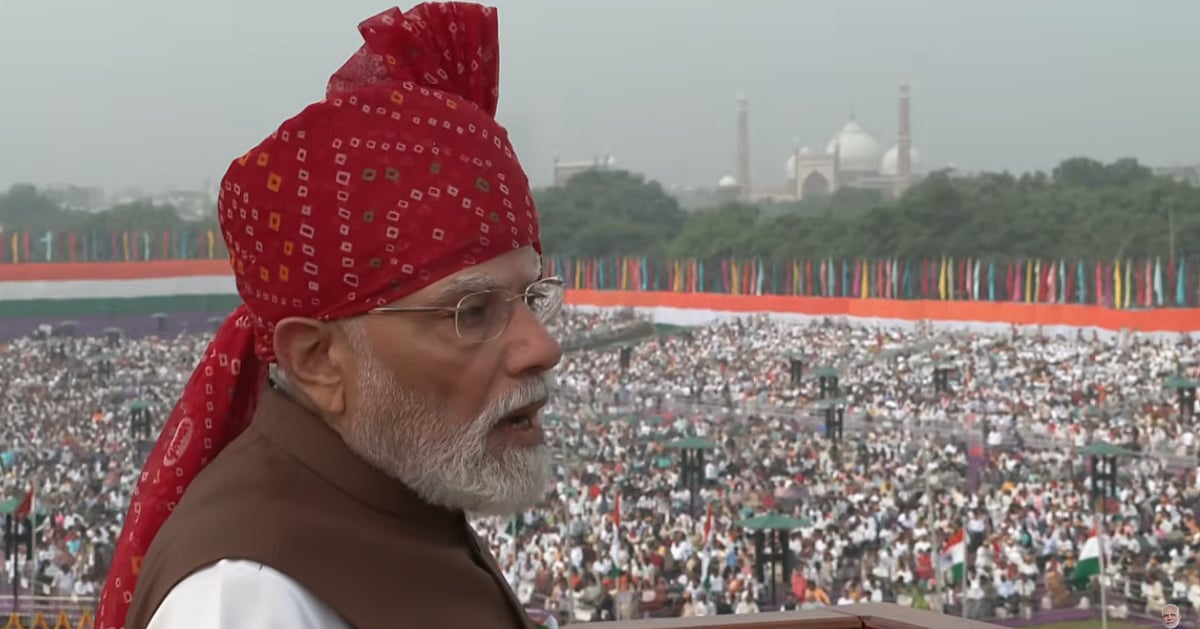
On the 80th Independence Day, Prime Minister Modi addresses the nation.
Prime Minister Modi said, "Today, every heart beats to the rhythm of 'Vande Mataram.' Today, every home has the tricolor flag; every mind has the tricolor flag.
On this Independence Day, I pay my tribute to Mahatma Gandhi and all the freedom fighters and revolutionaries.

This is a historic day. After independence, this is the moment when the cry of “Vande Mataram” echoed from the ramparts of the Red Fort.
For everyone who has gathered here for today’s ceremony, this is a historic moment. For the first time since independence, the cry of “Vande Mataram” is echoing at the Red Fort on August 15.
Embracing new resolutions, the nation is moving forward with enthusiasm and inspiration.
The floods that have occurred in some parts of the country over the past few days have affected many people. I assure the affected families that the entire nation stands with them," he said.
Prime Minister Modi hoisted the national flag at the Red Fort for the 13th time!


Today is India’s 80th Independence Day. On this occasion, Prime Minister Modi hoisted the flag at the Red Fort today. Prime Minister Modi hoisted the national flag at the Red Fort for the 13th time.
The Independence Day celebrations at the Red Fort began with the song “Vande Mataram.”
The national flag-hoisting ceremony was coordinated with a 21-gun salute by the 1721 Field Battery (Ceremonial) artillerymen. This ceremonial battery, which uses indigenously made 105mm light field guns, is led by Major Pawan Singh Shekhawat. Its gun position officer is Naib Subedar (Artillery Instructor) Anutosh Sarkar.
Prime Minister Modi at the Red Fort!
This morning, Prime Minister Modi visited the Mahatma Gandhi memorial and paid his respects. He also visited the war memorial and paid tribute there.
He has now arrived at the Red Fort. He was welcomed on behalf of the three armed forces.!
#WATCH | Prime Minister Narendra Modi pays floral tributes to the Father of the Nation, Mahatma Gandhi, at Rajghat on the 80th Independence Day
— ANI (@ANI) August 15, 2026
(Video source: PM Modi/ YouTube) pic.twitter.com/xIcfLPeDol
Today is India's 80th Independence Day. On this occasion, Indian Prime Minister Modi will hoist the flag and deliver a speech at the Red Fort today.
You can follow the Independence Day celebrations in Delhi and Modi’s speech in this Live Blog.