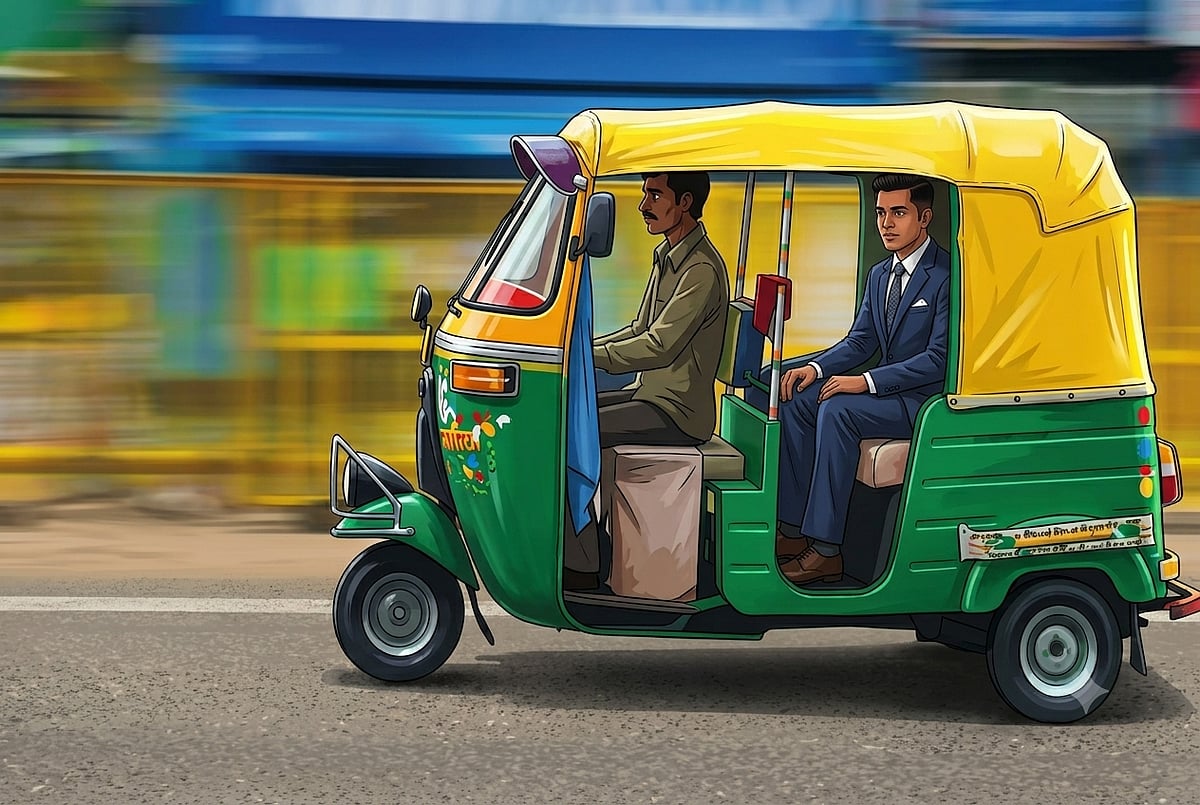
Officials said on Thursday that the state government has amended the Motor Vehicles Act in Maharashtra to make practical knowledge of the Marathi language mandatory for auto-rickshaw and taxi drivers.
The final notification issued by the state transport department states that the Maharashtra Motor Vehicles Third Amendment Rules, 2026, have been brought into effect under the state Motor Vehicles Act, 1988.
The notification further said: As per the amended rules, it will be mandatory for drivers of taxis and auto-rickshaws fitted with electric meters to have practical knowledge of the Marathi language.
Accordingly, if it is found that drivers do not possess language proficiency, a notice will be issued on behalf of the licensing (transport department) officer instructing them to acquire that language proficiency within one month. If a driver does not obtain a language proficiency certificate within this deadline, their driving licence will be temporarily suspended for the next 3 months.
Even after that, if the driver fails to comply with the regulations, the concerned department may cancel their driving licence. However, it has been stated that before taking this action, the driver must be given a reasonable opportunity to present their explanation.
Earlier, “August 15 is the last day for auto-rickshaw and taxi drivers to obtain a certificate of proficiency in the Marathi language. This deadline will not be extended. The aim is to avoid language barriers between passengers and drivers and provide quality services. The state Deputy Chief Minister will distribute certificates on the 17th to those who complete this Marathi language proficiency training at centers arranged by the government,” said State Transport Minister Pratap Sarnaik.
Tribal language proficiency mandatory in Arunachal Pradesh... In Arunachal Pradesh, a permanent residence certificate, a state tribal certificate, and proficiency in one of the state’s tribal languages have been made mandatory for all government jobs.
The state cabinet on Thursday approved this uniform eligibility procedure for direct recruitment to all government jobs.
It has been stated that this recruitment procedure will apply to direct appointments to all government posts in state government departments, public sector undertakings, autonomous bodies, and local bodies.
Amid continuous demands and protests by various organizations across the state seeking the cancellation of the practice in the state government recruitment examination of filling 80 percent of the posts for state tribal applicants and the remaining 20 percent of the posts on a general category basis in an 80:20 ratio, the state government has introduced this new recruitment procedure.