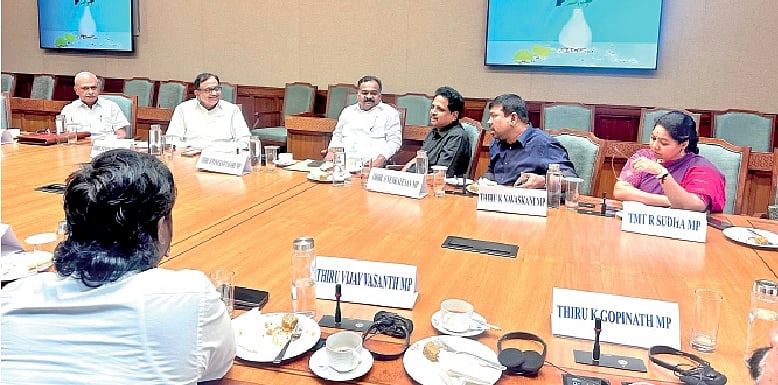
As the BJP government at the Centre is preparing to once again introduce the "Constituency Delimitation Amendment Bill" in Parliament, MPs from Tamil Nadu in the INDIA alliance met and held discussions in Delhi on Wednesday to discuss the next course of action against it.
The meeting was attended by several Congress MPs, including P. Chidambaram, Manickam Tagore, V. Vaithilingam, and Karti Chidambaram. Also present were MDMK MP Durai Vaiko, Communist Party of India MP Selvaraj, Marxist MPs Su. Venkatesan and Sachithanantham, and IUML MP Nawaz Kani, among others.
Regarding this, MP Su. Venkatesan, who attended the meeting, told reporters: The central BJP government is preparing to reintroduce the constituency delimitation bill in Parliament. Its consequences will severely affect the power-sharing rights of Tamil Nadu and the southern states. We understand that the amendment bill is likely to be framed in a way that reduces the number of constituencies influenced by minority voters across the country.
We discussed how to confront this and to ensure that there is not even the slightest room for compromise on matters concerning Tamil Nadu’s interests and rights, with the Tamil Nadu MPs in the "INDI" alliance. We will continue to hold such meetings, he said.
What is DMK’s stance?:
Meanwhile, when asked about DMK’s stance on the constituency delimitation bill, the party’s Rajya Sabha group leader Trichy Siva said, "How can one comment on the bill without knowing what is in it?"
When the DMK was previously in power in Tamil Nadu, it strongly opposed the amendment brought in by the central government that linked the women’s reservation bill with the constituency delimitation bill. This time, regarding this bill, Parliamentary Affairs Minister Kiren Rijiju and Union Home Minister Amit Shah have been holding informal discussions with various parties.
The resolution proposed through the Delimitation Reorganization Bill and the 131st Constitutional Amendment Bill, introduced by the Union government last April, to increase the total number of Lok Sabha members from 543 to over 800 and raise Tamil Nadu’s seats from 39 to 59, was put to a vote in the Lok Sabha. The Union government did not have the majority needed to introduce the bill. Opposition parties have been strongly objecting, saying that this bill would undermine the representation share and the right to power-sharing of southern states, including Tamil Nadu, which have successfully controlled population growth, and would reduce the voting influence of minorities.
Meanwhile, the central government is planning to reintroduce it in Parliament, explaining that it will come into effect only before the 2029 Lok Sabha elections, based on the new census, and that no state’s rights will be affected.