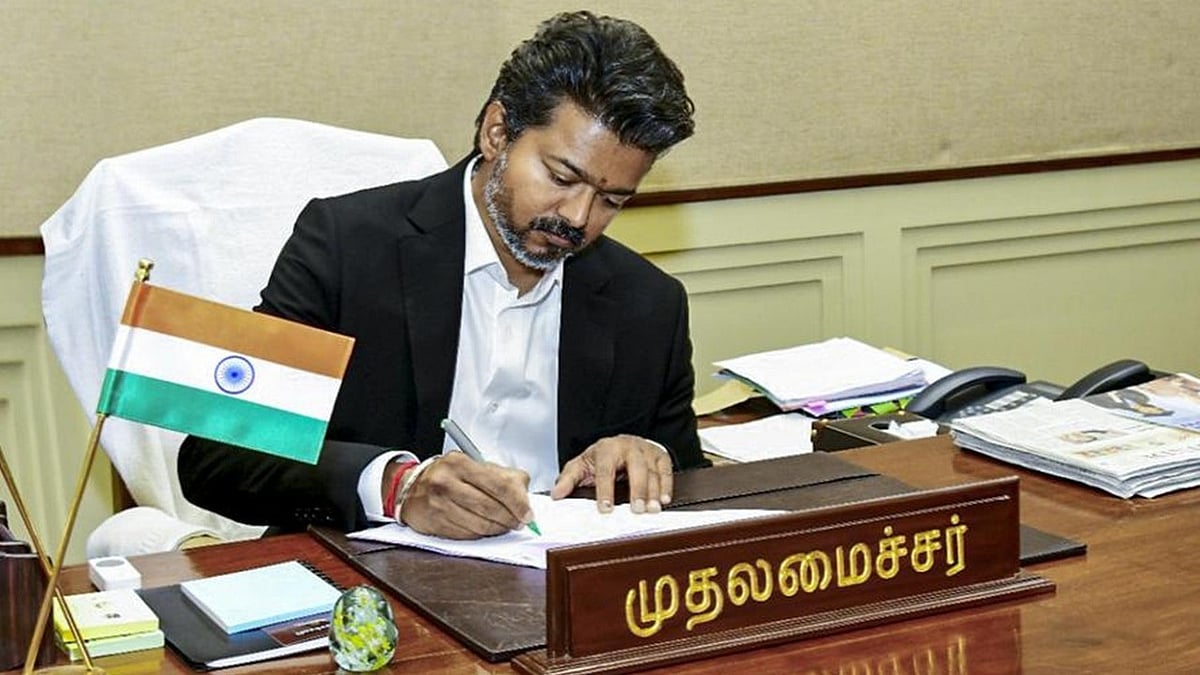
Chennai: Chief Minister Vijay has written a letter to Prime Minister Modi, urging that admissions to veterinary medicine courses should not be conducted on the basis of an entrance examination, but should instead be based solely on higher secondary school examination marks.
Details of that letter: I wish to bring to your attention a very important matter regarding admissions to the undergraduate course in Veterinary Science and Animal Husbandry (BVSc & AH).
In accordance with the provisions of the Indian Veterinary Council Act, 1984, the Indian Veterinary Council has recommended that admissions to the undergraduate degree programs in Veterinary Science and Animal Husbandry in all veterinary colleges should be allotted through a centralized counselling process based on the Common Entrance Examination.
As an alternative arrangement, it has come to my attention that the Indian Veterinary Council has instructed the states that, if it is not possible to conduct a separate entrance examination from the above-mentioned academic year 2026-27, student admissions should be carried out on the basis of the merit list of the NEET (NEET UG-2026) examination.
Furthermore, this proposal will cause various serious adverse impacts on Tamil Nadu. Veterinary medical education holds a unique place among Tamil Nadu’s development priorities.
Veterinary medical education is not merely a vocational course; rather, it is the foundation of our efforts to strengthen the state’s livestock care, improve animal health, reinforce dairy development, and safeguard the livelihoods of millions of rural families.
The students who are admitted to veterinary medical education today will, in the years to come, emerge as veterinarians who serve our farmers, our villages, and the livestock care sector.
Tamil Nadu has, for several decades, followed an admission system for vocational education courses based solely on the marks students obtain in the higher secondary school examination. This system (Model) has not only continuously produced skilled professional experts, but has also ensured a fair opportunity for deserving students from rural areas, government schools, economically disadvantaged sections, and socially marginalized communities to pursue higher education.
This examination system has served as an effective tool for social justice, regional equality, and inclusive development.
Since the 2007-2008 academic year, the Tamil Nadu government has abolished the common entrance examination for vocational education courses, and the state government has consistently emphasized that integrated entrance examinations, including NEET, create major barriers at the entry stage for many talented students, especially those from rural and disadvantaged backgrounds.
Considering that the National Testing Agency (NTA) has been facing various difficulties in conducting the NEET examinations, and that, due to recent irregularities, the agency was compelled to cancel the exam and hold a re-examination, and also that allegations of question paper leaks in 2024 led to an investigation by the Central Bureau of Investigation, introducing the NEET exam for admission to veterinary medical courses would not be appropriate.
Recent years’ experiences have further reinforced the view that success in such entrance examinations is determined not by the aptitude reflected through school education, but by opportunities for special coaching, financial resources, and the chance to take the exam multiple times.
Extending such a practice to veterinary medical admissions would likewise produce similar adverse effects.
Moreover, veterinary medical education is naturally linked to each state’s agricultural and rural economy. The demand for veterinary professionals, the background of students entering this field, and the priorities for the growth of the livestock sector vary significantly from state to state across the country.
In this context, it would be appropriate to leave the authority to determine the admission criteria for the undergraduate degree programs in veterinary science and animal husbandry to the respective state governments. Such an approach would respect our federal structure and also help continuously raise educational standards and ensure the development of qualified veterinary doctors.
At the same time, this will also enable states to formulate student admission policies suited to their social and economic conditions and educational systems. Therefore, the Prime Minister should personally intervene in this matter. The Indian Veterinary Council should be instructed to reconsider its decision.
Either the admission process for the undergraduate degree in Veterinary Science and Animal Husbandry should continue on the basis of higher secondary school examination marks, or the respective state governments should be allowed to decide the student admission criteria.
Furthermore, this request should be considered favorably, and equal access to veterinary education for all should be ensured.
Opportunities for students from rural and socially disadvantaged backgrounds must be protected. The letter states that within our federal system, the states’ ability to make their own lawful policy decisions must be ensured.