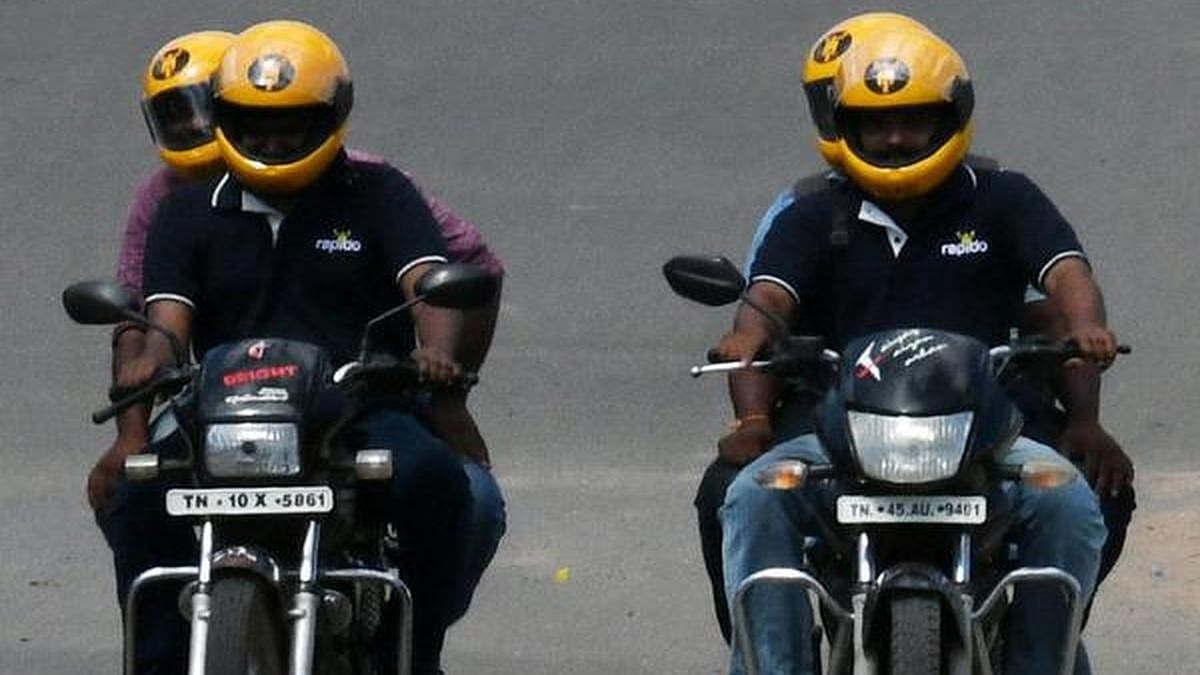
The Tamil Nadu government recently told the Madras High Court that bike taxis will not be permitted until a policy decision is made on them.
At the same time, as support for bike taxis among the public continues to grow, calls have intensified for safety regulations related to them to be framed and implemented immediately.
Although the central government has permitted bike taxis, states including Tamil Nadu and Maharashtra have not yet given them approval.
. While no restrictions have been imposed on bike taxi companies, measures including imposing fines on their drivers are being carried out in Tamil Nadu.
A public interest litigation filed pointing this out recently came up for hearing before the bench of Justices C.V. Karthikeyan and R. Sakthivel at the Madurai Bench of the Chennai High Court.
At that time, the Tamil Nadu government side stated that an expert committee comprising representatives from the Transport Department, the Finance Department, and the Chennai Unified Metropolitan Transport Authority had been appointed to study the regulation of bike taxis.
The Additional Advocate General of the Tamil Nadu government told the court that bike taxis will not be permitted until the government takes detailed policy decisions on the matter, and that those who violate this will be subjected to legal action, including fines.
Following this, the judges asked, ‘Will the public be informed that bike taxis are not permitted?’ and ‘Who will be responsible if an accident occurs?’ They also ordered that the Tamil Nadu government must immediately take a policy decision on whether bike taxis will be permitted or rejected.
Bike taxis have been popular among the public for the past few years because of their low fares and shorter travel times.
Organizations including auto and taxi drivers' associations have been opposing them, saying their livelihoods are being affected. Questions are also being raised about passenger safety.
The Motor Vehicles Act did not have provisions regarding the commercial use of two-wheelers.
In this context, in a response given by the Ministry of Road Transport and Highways in Parliament in December 2018, it was stated that “the Motor Vehicles Act permits bike taxis under Sections 72 and 73.” So far, 16 states and union territories have given their approval for this.
India currently has the highest number of gig workers in the world. It has been found that nearly 50% of them do this alongside another job.
In particular, students and those seeking permanent employment are taking part in this and benefiting economically.
Therefore, the government has the responsibility to regulate an industry in which both workers and users are increasing together.
Accordingly, detailed regulations should be framed regarding monitoring to ensure user safety, vehicle inspections, and the reliability of drivers, among other things.
In a way that benefits the concerned workers and the public, the Tamil Nadu government should immediately announce its decisions on this matter.