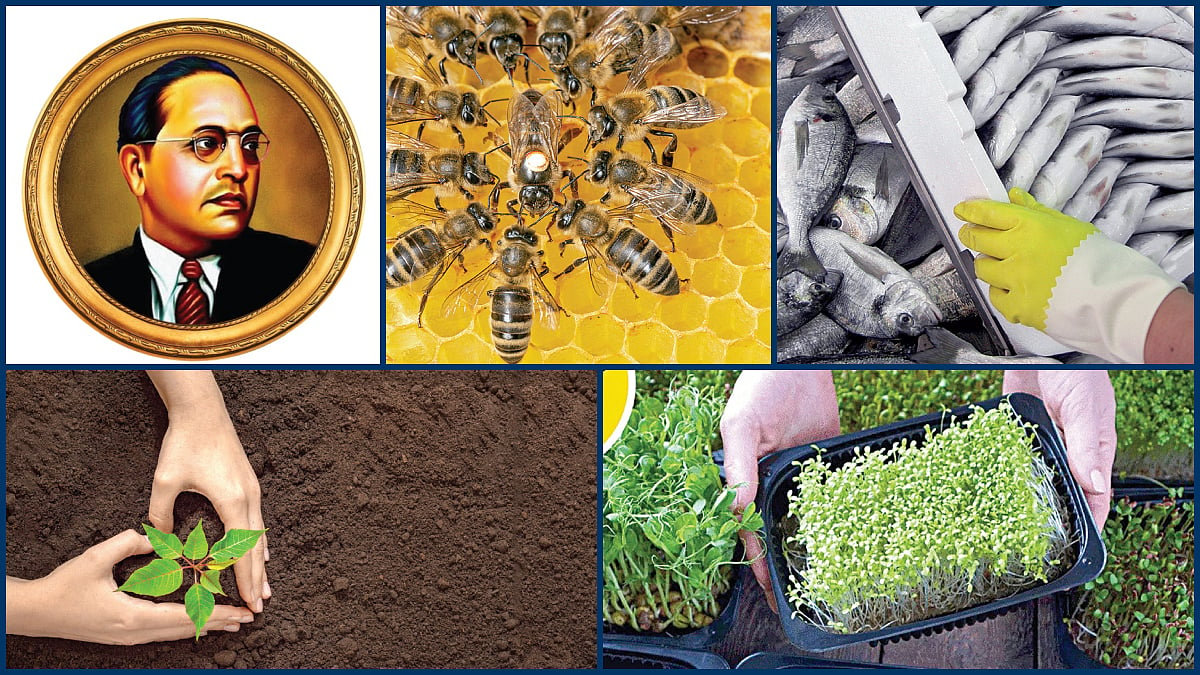
The Annal Ambedkar Agricultural Assistance Scheme will be implemented to enable Adi Dravidar (SC) and tribal (ST) farmers to access government scheme benefits without hindrance, create irrigation infrastructure and increase production, and improve their standard of living.
Under this scheme, the above-mentioned farmer beneficiaries will be provided an additional 20 percent subsidy on the contribution amount they are required to pay for high-value agricultural schemes.
A 70 percent subsidy will be provided for shade net houses, solar tunnel dryers, value-added machinery, integrated farming, greenhouses, farm machinery, and an 80 percent subsidy will be provided for installing solar-powered pump sets.
For 300 Adi Dravidar and tribal farmers who do not have irrigation facilities, deep borewells or tube wells will be set up as an irrigation source in their dryland fields with 100 percent subsidy, along with electric motors or solar-powered pump sets. For this scheme, Rs. 56.72 crore will be allocated in the current year.
Rs. 3,000 crore short-term loan for livestock, fisheries, and beekeeping
A capital loan of Rs. 3,000 crore will be provided for farmers’ short-term needs for agriculture-related activities including livestock, fish farming, and beekeeping. To prevent wastage of produce, tarpaulins will be provided to 43,500 farmers at a cost of Rs. 10 crore.
At a cost of Rs. 2.80 crore, 100 threshing floors will be set up on individual farmers’ lands. At a cost of Rs. 23.06 crore, a scheme to install solar pump sets for 1,000 farmers will be implemented. At a cost of Rs. 23 crore, the Tamil Nadu Farmers’ Income Enhancement Board will be established.
Farmers’ markets will be upgraded at a cost of Rs. 20 crore. Rs. 2.04 crore will be allocated to provide nutritional support for 1,000 buffalo heifer calves and 1,000 pregnant buffaloes.
Special drive to protect soil fertility
To increase the number of microorganisms in the soil, reclaim saline and alkaline lands, reduce the use of chemical fertilizers, and promote natural and organic farming methods, the ‘Tamil Nadu Soil Conservation Mission’ will be introduced this year as a five-year plan at a cost of Rs. 600 crore, to ensure that the fertile Tamil soil thrives for generations to come.
Under this, green manure seeds required for 22,000 acres will be provided at subsidized prices. A ploughing subsidy of Rs. 3,000 per acre will be given for ploughing the grown green manure into the soil itself. An allocation of Rs. 63.50 crore has been made for this.
Permanent vermicompost units will be set up at a cost of Rs. 10 crore. To restore low-fertility lands, a demonstration on soil improvement will be carried out on 2,000 acres at a cost of Rs. 2 crore.
Rs.34.72 crore will be allocated to establish seed farms and produce 7,730 tonnes of certified paddy seed, and to provide paddy seed production subsidy to farmers supplying seeds to the Tamil Nadu State Seed Development Agency, as well as paddy seed distribution subsidy to distribute 14,570 tonnes of certified seeds at subsidized rates.
Growing Tender Greens
The young seedlings of broccoli, cabbage, radish, green peas, chickpeas, flax seeds, onion, green gram, horse gram, sesame, wheat, and leafy vegetables are called “tender greens.”
These contain up to 40 times more nutrients than mature plants. Therefore, the “Tender Greens Scheme” will be implemented at a cost of Rs. 1.20 crore to distribute 20,000 tender greens kits, including seeds, a water-spraying device, and a guidebook, in major cities such as Chennai, Coimbatore, and Tiruchi.
The scheme to set up permanent pandals for horticultural crops at a cost of Rs. 11.73 crore, the banana staking scheme at a cost of Rs. 6.25 crore, and the special scheme for coconut at a cost of Rs. 16 crore will be implemented.