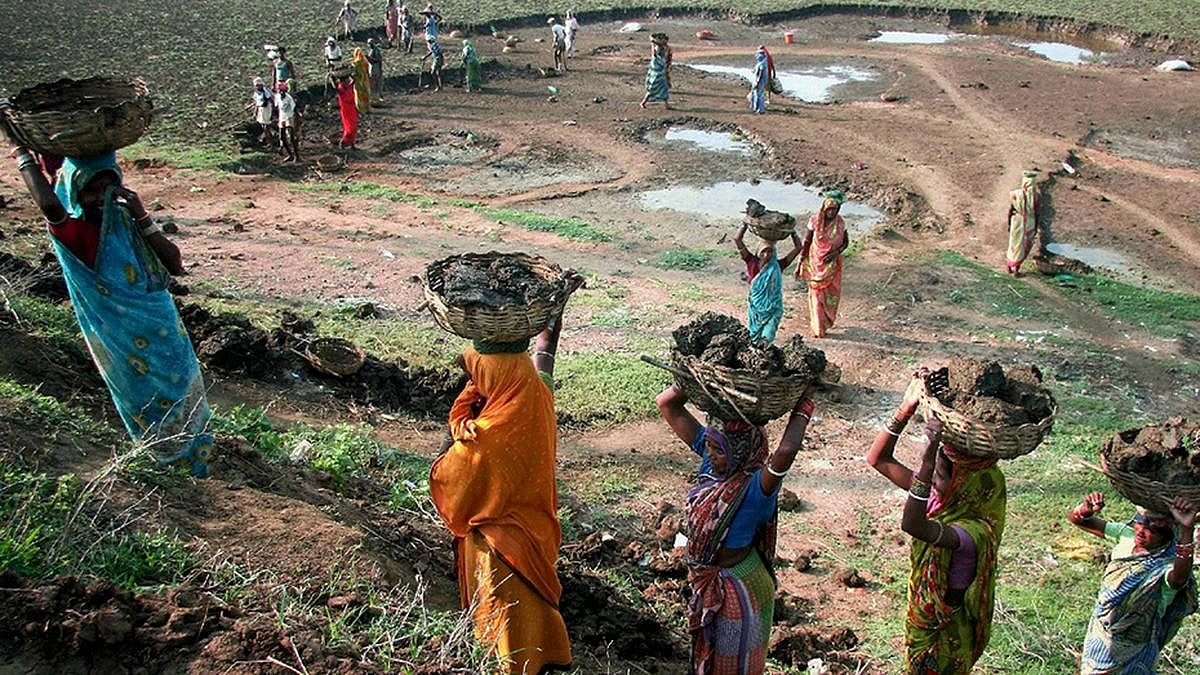
According to the 2025 Periodic Labour Force Survey report, there has been a significant increase in women’s labour force participation rate (FLFPR – Female Labour Force Participation Rate) after the coronavirus pandemic. In 2019–20, the overall participation rate for those aged 15 and above was 30%, and in 2025 it has risen to 40%. This increase was particularly notable in rural areas, where it rose from 33% to 45.9%. In contrast, in urban areas it increased only from 23.3% to 27.7%. This difference highlights the need to examine how some states have performed after the coronavirus pandemic.
Annual Percentage Point Change: For this, the average annual percentage point change (AAPP) in rural FLFPR for each state from 2019–20 to 2025 must be calculated. This is used to indicate the pace of progress, not to rank states. In particular, in states such as West Bengal, Uttar Pradesh, Gujarat, Odisha, Bihar, Rajasthan, and Haryana, the AAPP was higher than the all-India rural average of 2.58 percentage points per year. In other words, rural FLFPR in these states has risen faster than the national average.
In contrast, AAPB was below the national average in five southern states as well as Madhya Pradesh, Punjab, Jharkhand, Chhattisgarh, Uttarakhand, Maharashtra, Goa, and Himachal Pradesh. However, most states continued to record a positive change.
Similarly, in the change in AAPB for urban areas, the states of Rajasthan and Gujarat have shown particularly strong progress, recording AAPB growth of more than 2 percentage points per year. In addition, Uttarakhand, Kerala, Chhattisgarh, Karnataka, Odisha, Bihar, and Andhra Pradesh also recorded AAPB growth higher than the all-India urban average of 0.88 percentage points per year.
In contrast, the remaining states have recorded below the national average. Thus, although the pace of overall progress in urban areas has been significantly slower than in rural areas, many states have recorded relatively strong progress.
Shift in approach: However, AAPB alone is not sufficient to assess the performance of states. This is because it does not take into account the level from which a state started in terms of women’s labour force participation. Therefore, by using each state’s 2019–20 FLFPR as the baseline and examining this baseline together with the subsequent AAPB, it becomes possible to accurately assess whether states are progressing from a low base, further improving already high participation, or facing slow progress.
Based on this, Bihar, Uttar Pradesh, West Bengal, and Haryana, in the relationship between the rural 2019-20 (FLFPR) baseline level and AAPB, started from a relatively low female FLFPR, yet have recorded AAPB higher than the all-India average.
This indicates relatively rapid progress and the potential for a catch-up trend. On the other hand, Odisha, Gujarat, and Rajasthan, despite starting from a relatively high rural FLFPR baseline level, have recorded AAPB higher than the all-India average.
Although Madhya Pradesh, Jharkhand, Uttarakhand, Chhattisgarh, Maharashtra, Himachal Pradesh, and five southern states had relatively high baseline levels, they recorded AAPB below the national average. Next, in the relationship between the urban 2019-20 (FLFPR) baseline level and AAPB, the states of Rajasthan, Gujarat, Uttarakhand, and Bihar, despite starting from relatively low baseline levels, recorded an annual average participation rate above the all-India average.
This indicates relatively rapid progress starting from a low baseline. In contrast, the states of Uttar Pradesh, Jharkhand, Haryana, and Punjab, although they also started from relatively low levels, recorded an annual average participation rate below the average. This indicates slower progress.
Speed of progress: Among states with relatively high baseline urban household participation rates, Kerala, Karnataka, Chhattisgarh, Odisha, and Andhra Pradesh recorded higher average annual participation rates. This shows that some states that already had high participation levels have continued to make relatively rapid progress. On the other hand, Tamil Nadu, Telangana, West Bengal, Maharashtra, Madhya Pradesh, Himachal Pradesh, and Goa, despite having relatively high initial levels, recorded slower progress.
Overall, the pace of progress in women’s labor force participation varies across states and differs significantly between rural and urban areas as well. Therefore, comparing the baseline level in 2019–20 with the pace of progress since then helps us gain a nuanced understanding of the changes taking place in women’s labor force participation across India after the coronavirus pandemic.