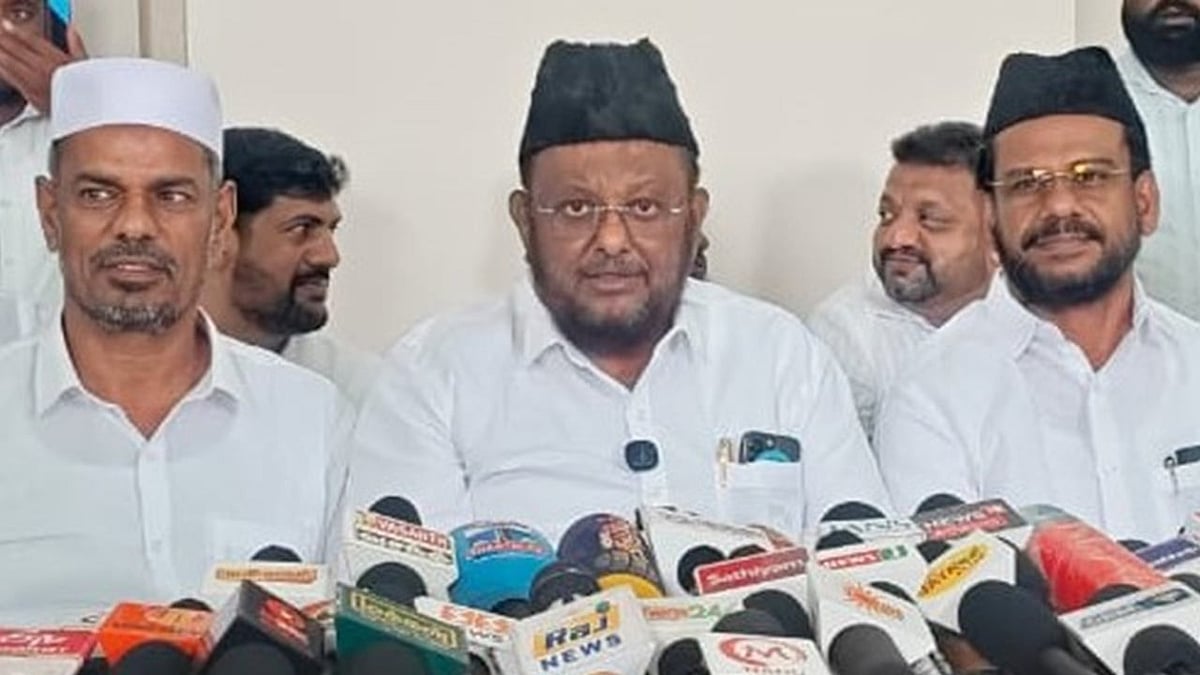
Chennai: “If the DMK truly wants to protect state autonomy, it should insist on the recommendations of the Kurian Joseph Commission and stay away from supporting delimitation bills until constitutional guarantees for them are secured. This is the time to prove the DMK’s commitment to protecting state rights,” said Jawahirullah, leader of the Manithaneya Makkal Katchi.
In the statement he issued regarding this, “Today, after the consultation meeting held by DMK leader M.K. Stalin on delimitation, the party’s executive committee meeting was held via video conference under my leadership. In this meeting, the DMK’s position on delimitation was discussed in detail.
At the end of this, the following resolution was unanimously adopted:
The DMK leader’s discussion with the leaders of allied parties regarding delimitation is regarded by this executive committee as a commendable practice. Delimitation is not merely an administrative measure to change the number of electoral constituencies. It is a highly important constitutional issue that can determine India’s federal structure, the political representation of states, the voice of states in Parliament, and the future of state rights.
In particular, it is essential to approach this issue not merely as a political exercise, but with constitutional guarantees that protect the rights of the states. In this context, the recommendations made by the high-level committee headed by Justice Kurian Joseph, which was constituted during the previous DMK government and tabled in the Legislative Assembly, are of great importance.
That committee has recommended two fundamental constitutional amendments regarding delimitation.
First, the recommendations of the Delimitation Commissions should be subjected to mandatory scrutiny by Parliament and the State Legislatures before they come into effect. Before the announcement of elections, provision should also be made for judicial review on constitutional and jurisdictional grounds.
For this purpose, the committee has recommended that the necessary amendments be made to Articles 82, 170, and 329A of the Constitution, and that until then, any delimitation law enacted by Parliament should provide for mandatory legislative scrutiny.
Secondly, a separate commission at the Union level should be established for redrawing parliamentary constituencies, and separate state commissions should be set up for redrawing state legislative constituencies. For this purpose, amendments should be made to Articles 82, 170, and 327 of the Constitution, as well as to Entry 72 of the Union List and Entry 37 of the State List in the Seventh Schedule. It has also been recommended that the representation of various political parties in these commissions, along with an appointment system based on an electoral college, should be guaranteed by the Constitution.
This executive committee believes that the DMK should first strongly insist on these recommendations to protect the rights of the states and the federal principle. The DMK, which has consistently upheld state autonomy, federalism, and state rights as its political principles, has a responsibility to demonstrate them in action at such a crucial moment.
Therefore, we urge that the DMK should not support any bills related to delimitation unless the recommendations of the Kurian Joseph Commission are given constitutional guarantee.
Assam is a bad precedent
The delimitation carried out in Assam in 2023 stands as an important precedent for how the political representation of minority communities can be affected.
Constituency boundaries were altered in areas including Barpeta, Karimganj, and Hailakandi. Through this, the electoral influence of Muslim voters was reduced.
Political analyses indicated that the proportion of Muslim voters in the Barpeta Lok Sabha constituency fell from about 50 percent earlier to between 30 and 35 percent. At the same time, some assembly constituencies with a majority of Muslim voters were merged with the Dhubri Lok Sabha constituency.
The number of assembly constituencies in the Kashmir Valley was reduced from 15 to 13. In addition, some constituencies that Muslim representatives had been winning were reserved for Scheduled Castes and Scheduled Tribes.
The bitter situation in Jammu and Kashmir
The delimitation carried out in Jammu and Kashmir in 2022 also sparked a similar political debate. Before the delimitation, the Jammu region had 37 constituencies, and the Kashmir Valley had 46 constituencies.
After the delimitation, Jammu was allotted six additional constituencies, and the Kashmir Valley was allotted just one additional constituency. This increased Jammu’s constituencies to 43 and the Kashmir Valley’s constituencies to 47.
According to the 2011 census, Muslims made up 68.31 percent of Jammu and Kashmir’s total population. Hindus accounted for 28.44 percent of the population.
The Kashmir Valley, which has 56 percent of the population, received 52 percent of the constituencies, while the Jammu region, with 44 percent, received 48 percent of the constituencies. This change affected the proportional balance between population and political representation.
In particular, these measures were designed to reduce the political influence of the Kashmir Valley, which has a Muslim majority. These experiences in Assam and Kashmir show that delimitation is not merely an exercise in changing geographical boundaries; it can also affect a community’s political representation.
Rajya Sabha
Under the proposed plan, while the number of Lok Sabha members is increased by 50 percent, there is no clear announcement in the Union government’s bill regarding an increase in the number of members of the Rajya Sabha.
If the 543 members of the current Lok Sabha are added to the 245 members of the Rajya Sabha, there are a total of 788 members. Of this, the Rajya Sabha’s share is 31.09 percent. If the Lok Sabha members are increased to 816 while the Rajya Sabha continues to have 245 members, the Rajya Sabha’s share in the combined strength of the two Houses will fall to 23.09 percent. This is a significant decline in the Rajya Sabha’s voting share.
In situations where there is a difference of opinion between the two Houses on ordinary bills and a joint sitting is held under Article 108 of the Constitution, the increase in the number of Lok Sabha members will reduce the Rajya Sabha’s relative voting strength.
Although constitutional amendment bills are not passed through joint sittings, this committee notes the concern that the role of the Rajya Sabha is being diminished in ordinary legislative proceedings, which relates to the federal principle. Should not a bill that claims to protect the representation of the states also safeguard the role of the Rajya Sabha, which serves as the voice of the states?
Before supporting this bill, the DMK should demand a clear constitutional guarantee that the parliamentary representation ratio of states that have succeeded in controlling population will not be affected under any circumstances. In addition, it should insist that the Union government accept the recommendations of the Kurian Joseph Committee.
This executive committee expresses concern that supporting the bill without such guarantees would strengthen the BJP-led Union government's majoritarian political approach and aid a political arrangement that could weaken the voice of the states.
The DMK, which truly wants to protect state autonomy, should emphasize the recommendations of the Kurien Joseph Commission and stay away from supporting the delimitation bills until constitutional guarantees for them are secured, this executive committee has said.