- Our Special Correspondents Team
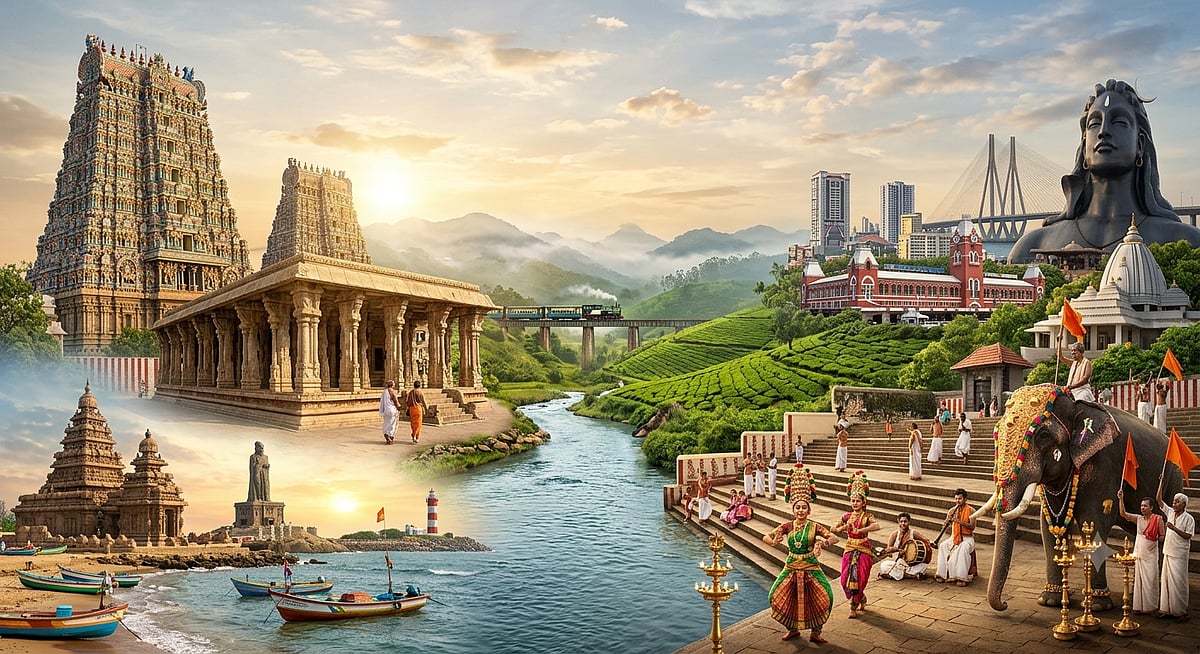
The government led by Chief Minister Joseph Vijay has announced that Tamil Nadu Day will be celebrated every year on November 1 by the Tamil Nadu government. On July 18, 1967, the DMK government led by Anna brought a resolution in the Legislative Assembly to rename “Madras State” as “Tamil Nadu,” and it was passed with the support of a majority of members. While the DMK led by M.K. Stalin had announced that July 18 would be celebrated as Tamil Nadu Day, the TVK government led by Chief Minister Vijay has announced November 1, the day states were reorganized on linguistic lines, as Tamil Nadu Day.
There is no denying that behind the creation of the name Tamil Nadu lie many historical events, the efforts of Tamil leaders, martyrs, and political party leaders. It was only after states were divided on linguistic lines that Tamil Nadu was named ‘Tamil Nadu.’
But many years passed before that name took shape and came into being. At the anti-Hindi conference held at Chennai Beach in 1938, Maraimalai Adigal, Periyar E.V.R., and Somasundara Bharathiar raised the slogan, ‘Tamil Nadu is for Tamils.’ During the same period, Silambu Selvar M.P. S. was holding conferences and insisting that a ‘Tamil state’ was needed.
In June 1948, the central government appointed a committee under the leadership of S.K. Dhar to examine the pros and cons of forming states on linguistic lines. The committee recommended that linguistic states were not necessary; states should be created according to administrative convenience.
This was also strongly advocated by many of the leading figures of the time, including the country’s first Prime Minister, Pandit Jawaharlal Nehru. However, opposing this, people from each language group took to the streets demanding separate states under the names “Visalandhra,” “Akhanda Karnataka,” “United Kerala,” “Samyukta Maharashtra,” and “Maha Gujarat.” As part of this movement, the fast undertaken on 9.6.1952 by the Gandhian Potti Sriramulu, and his subsequent death, caused an uproar among the Telugu people. Unable to control the riots, the Central Government declared Andhra a separate state on 1.10.1953.
November 1
After various struggles and consultations, the announcement that states would function on a linguistic basis came into effect from 1.11.1956. For this purpose, the Central Government passed the States Reorganisation Act, 1956 in Parliament. This Act received the President’s assent on 31 August 1956.
According to Section 2 of the Act, 1 November 1956 is the date on which the reorganization of states came into effect.
Five southern taluks from the Travancore-Cochin state were merged with the Madras state: the taluks of Agastheeswaram, Thovalai, Kalkulam, and Vilavancode were joined to form Kanyakumari district. Sengottai taluk was merged with Tirunelveli district.
The Malabar region was merged with Kerala. The Kannada-speaking areas were merged with Mysore State.
Following this, while other states were given the names they desired, the government announced that only Tamil Nadu would continue to be called “Madras.” Demanding, among other things, that “Madras State” be renamed “Tamil Nadu,” Sankaralinganar from Virudhunagar began a fast on 27.7.1956 and died after a 76-day struggle. Sankaralinganar’s death gave new momentum to this movement.
Tamil Nadu Resolution
When the DMK first entered the legislative assembly in 1957, it did so with a resolution that “Madras State” should be renamed “Tamil Nadu.” On 7.5.1957, when the DMK’s resolution came to a vote, 42 people voted in favor and 127 against, and the resolution was defeated at that time.
After that, in January 1961, when Socialist Party member P. Chinnathurai introduced a resolution calling for “Madras State” to be renamed “Tamil Nadu,” the then Chief Minister Kamaraj postponed the debate until February. Following that, the DMK and other opposition parties boycotted the legislative assembly for three consecutive days.
After that, Kamarajar agreed that in administrative correspondence alone, ‘Tamil Nadu’ should be mentioned instead of ‘Madras State’.
In 1961, the resolutions brought before the Rajya Sabha regarding the ‘Madras State’ issue by Bhupesh Gupta, a Rajya Sabha member of the united West Bengal unit of the Communist Party of India, and in 1964 by DMK member Rama. Arangannal were defeated.
The DMK, which came to power in Tamil Nadu in 1967, introduced a resolution on July 18 of that year to rename “Madras State” as “Tamil Nadu,” and it was passed with the support of a majority of members. Following that, the Tamil Nadu Name Change Bill was passed in Parliament on 23.11.1968, and on 14.1.1969, “Madras State” was officially renamed “Tamil Nadu.”
Only the territory now called “Tamil Nadu” was declared the new Madras Province in 1956. After 11 years, in 1967, a resolution was passed to name Madras Province as Tamil Nadu.
On 1.11.1956, the day when states were divided across India on linguistic lines—that is, November 1, when non-Tamil-speaking regions separated from the Madras State—the AIADMK government led by Edappadi K. Palaniswami announced in 2019 that it would be celebrated as Tamil Nadu Day.
In this situation, various political parties, Tamil activists, members of the Tamil alliance, and Tamil scholars have continuously insisted that Nov. 1 should be observed only as a day to commemorate the border struggle, and that it would not be appropriate to celebrate it as Tamil Nadu Day. They have also said that the day on which the name was changed from Madras Province and, through a resolution passed in the Assembly by Anna on 18.7.1967, it was named Tamil Nadu, should be celebrated as Tamil Nadu Day.
As soon as the DMK government came to power in 2021, then Chief Minister M.K. Stalin had announced July 18 as Tamil Nadu Day. In this situation, the current government led by Chief Minister C. Joseph Vijay has decided to celebrate November 1 as Tamil Nadu Day.