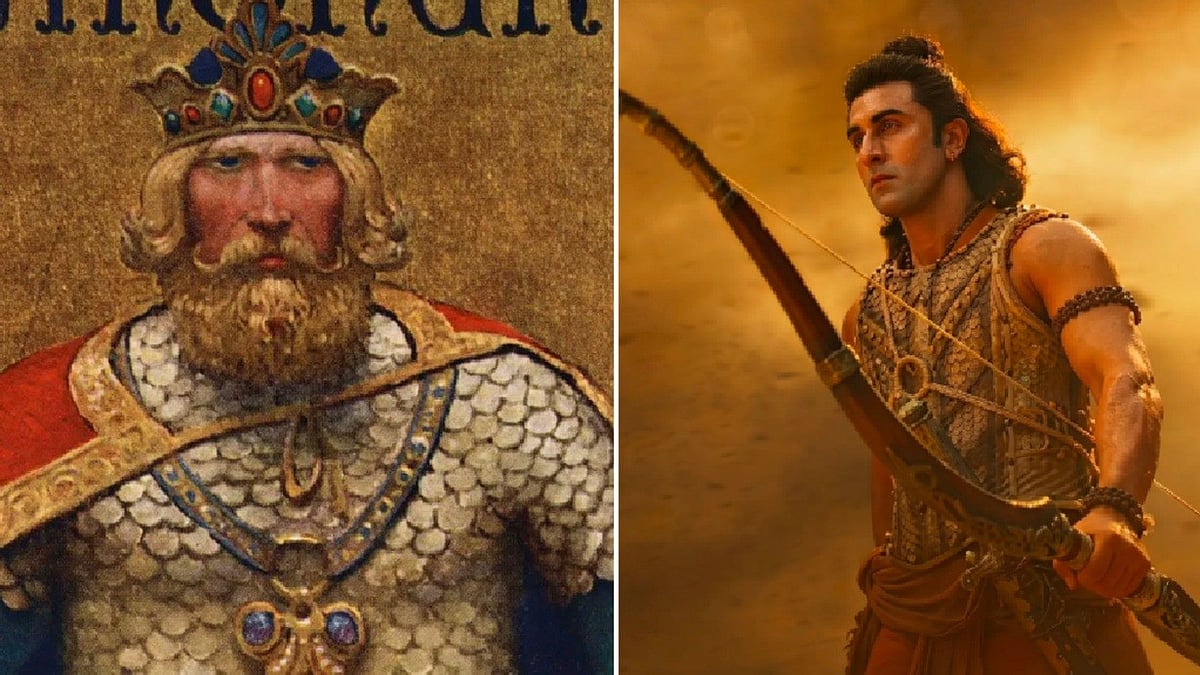
Valmiki’s epic Ramayana from the East and T. H. White’s Western classic, The Once and Future King, were born in very different cultural settings. Yet the questions they raise for humankind are timeless and universal.
Whether it is King Arthur, created by T. H. White, the father of the Western epic, grieving over Camelot, ruined by the betrayal of his closest friend, or Rama in Valmiki’s epic, sitting on the throne with tears in his eyes after parting from Sita, dearer to him than his own life, those scenes tell us one truth in flesh and blood: “Leadership is not comfort; it is a great sacrifice.”
Just as Ravana’s obsession brought ruin upon his empire, in The Once and Future King the love of the military commander Lancelot for the queen also shattered Camelot. The message these timeless epics convey to the world is very clear... “Laws may govern a nation; only righteousness can protect humanity.”
In today’s modern democracy, corporate management, and political arenas, whenever leaders are torn between personal relationships and public justice, the silence of these epic heroes makes us think deeply.
What the epics and legends tell us:
The Ramayana, composed by Valmiki in the period 750–500 BCE, speaks of Rama’s struggle to rescue Sita, who was abducted by the king of Lanka, Ravana, and of the righteousness of the ‘Ramarajya’ he established for the people.
On the other hand, T. H. White’s novel, published in 1958 against the backdrop of the Second World War, criticizes humankind’s lust for war and its struggle for power. It shows how the ‘Round Table’ council created by Arthur to eliminate violence ultimately falls apart because of human ‘ego’ and weaknesses (the Lancelot-Guinevere relationship and Mordred’s conspiracy). Its essence is that ‘good intentions alone cannot save a society; human nature must also change.’
What do the two epics emphasize?
These two epic heroes fought until the very end to uphold the rule of law. Arthur replaced the barbaric doctrine of “might is right” with the principle of “right is might” (Might for Right). Rama, too, rose above personal likes and dislikes and held to the ideal that “righteous duty to the king” comes first.
Rama emphasized to Sita “purity” and “faith in social morality.” Since the king and queen were expected to be role models for society, Sita too had to undergo severe tests such as “trial by fire” and “exile in the forest” to dispel the people’s doubts.
On the other hand, Arthur indirectly emphasized to Queen Guinevere “friendship, forgiveness, and the stability of the kingdom.” Although he knew of the Guinevere-Lancelot relationship, he restrained his personal anger and tried to preserve peace, fearing that if he made too much of it and war broke out, the nation would be destroyed.
Although the two stories differ in their cultural backgrounds, writer Joe Adensunji notes that comparing them is entirely appropriate because they present the epic tragedy of “even the greatest ruler could not prevent the sorrow of his own family” (tragic irony).
Message to rulers:
These stories reflect the biggest challenges faced by today’s political leaders and corporate chief executives.
Personal affection vs. public justice:
Arthur, the novel’s hero, was torn: if he punished his friend Lancelot and his wife, his heart would break; if he forgave them, the law would become a laughingstock. Today’s leaders too face this dilemma when those close to them do wrong—whether to protect them or bring them before the law.
Public trust:
Even though he knew Sita was pure, Rama made that decision against his conscience in order to answer the doubt of a citizen. Leaders must sometimes make bitter decisions to preserve ‘public trust’ (Public Trust).
Use of Power:
Power should not be used for selfish purposes (like Ravana), but only for the welfare of the people (like Arthur and Rama). However, today’s leaders are often more concerned with personal interests than with righteousness.
Former U.S. President Joe Biden’s granting of an “unconditional pardon” to his son Hunter Biden, who was caught up in tax and weapons cases in 2024, was criticized as an abuse of public power to protect his family. Likewise, Donald Trump, in his second term, granted pardons to nearly 1,600 people involved in the January 6 attack on Congress, freeing them.
In such situations, rulers forget the virtue that literature has shown. There can be no difference between a leader’s private life and public life. Because every action of his becomes a lesson to society.
“Leaders who ask themselves the single question, ‘Is this decision of mine for my own benefit or for the benefit of the people?’ will never stray from the path of righteousness in any difficult situation” is the timeless essence conveyed by world literature.
| Supporting article: The Conversation |