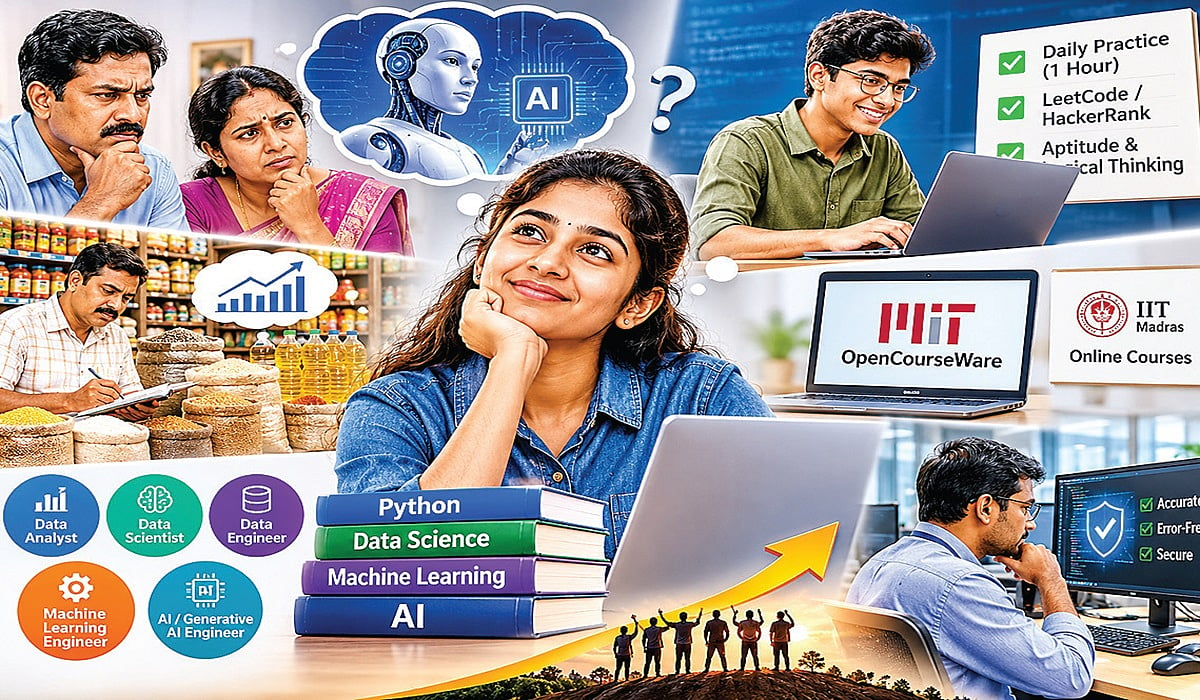
Every year, when engineering counseling takes place, one question inevitably arises among parents: “Should we study AI and data science?” Some celebrate it as a field that will determine the future.
Others hesitate, asking, “If AI has arrived, won’t there be no jobs left? What’s the use of studying this?” There is some truth and some exaggeration in both views.
Think of a grocery shopkeeper in your town. Two weeks before Diwali, he stocks up on items like oil and sugar in greater quantities than usual.
No one taught him this; it is his account notebook, which he has maintained for many years, and his experience that are the reason for it. This approach of making decisions by looking at past data is the foundation of data science. If a computer learns this same task on its own using millions of data records and does it, that is AI.
Self-learning
Classroom learning is only a beginning; beyond that, students must continue learning on their own as well. Today, there are many ways to do that. What is needed is simply the habit of setting aside at least one hour every day for this.
You cannot learn swimming just by reading books. Problem Solving is the same; only by continuously trying and practicing can you become proficient in it. Practice Platforms like Loops and Logics, LeetCode, and HackerRank are useful for this. The habit of solving one or two problems every day will help you face coding interviews with confidence.
Not only coding; training in Aptitude and Logical Thinking is equally important. In the placement tests of many companies, the Aptitude test is conducted as the first round. It includes questions such as numerical calculations, logical puzzles, tables, and Data Interpretation, where you understand data and answer accordingly.
If you do not clear this round, you may not even get the chance to showcase your coding skills. Therefore, it is good to set aside a few hours each week from the first year itself for Aptitude and Puzzle practice.
Logical Thinking, which breaks a problem into small steps and examines it, is a fundamental skill for AI as well. Only when we clearly understand something can we teach it properly to a computer.
MIT provides course materials for its more than 2,500 courses free of charge through OpenCourseWare.
Institutions like IIT Madras also offer data science courses online. The message they convey is the same: learning becomes deeper not by merely asking and finding out, but by trying and doing it yourself.
Experience is strength
In this field, there are job opportunities for roles such as Data Analyst, Data Scientist, Data Engineer, Machine Learning Engineer, and AI / GenAI Engineer.
AI and data science are not limited to the younger generation alone. Whether you work in banking, medicine, engineering, or technology, the experience you have gained in your field is a major strength.
Learning the basics of Python, SQL, and Statistics, and trying to solve a problem at your workplace using data, would be an excellent starting point.
Those in senior positions should also pay attention to aspects of “Responsible AI” such as Model Monitoring, Bias, Explainability, and the DPDP Act, 2023.
Today, AI tools themselves can write “code” in a matter of seconds; many times, they are even correct.
But there will now be greater demand for those who know how to test whether AI-generated code is correct, error-free, and secure. The question of whether AI will take away our jobs cannot be answered in a single line.
But one thing can be said for sure. Those who know how to use AI effectively will be ahead of those who do not. To be among them, start strengthening your foundation today.
- Ashwin Ramasamy, Writer, educator, career guidance expert