As digital transactions in India continue to set new records every day, the Ministry of Communications has created a powerful shield to protect the money the public has saved little by little from the schemes of online (cyber) criminals.
The 'Financial Fraud Risk Indicator' (FRI) facility, launched on May 22, 2025 under the Department of Telecommunications' 'Digital Intelligence Platform' (DIP), has successfully completed 15 months. In this short period, the central government says that online fraud losses worth more than Rs. 5,000 crore have been prevented.
The special feature of this is that this huge sum was not stolen and then later discovered, frozen, or recovered. Rather, it was stopped at the very second the transaction was about to take place, in such a way that not even a single paisa left the users’ bank accounts.
Usually, when an online fraud occurs, the criminal transfers the stolen money to several fake (mule) bank accounts within a few minutes and withdraws it immediately. By then, the affected people file a complaint, the police register a case, and before the bank accounts can be frozen, it is already too late.
Automatic verification: That is, when a user makes a money transfer through UPI or a banking app, this verification check is completed in the background in a very short time. As a result, the people involved do not have to go to the police station, there is no need to register a First Information Report, and there is no hassle of freezing bank accounts.
'In this matter, the fact that Rs. 5,000 crore was safeguarded is only the amount of money that was stopped. If one calculates the millions of complaints avoided on the ground, the time spent on investigations, the human effort of police investigators, and the mental distress spared to the public, its contribution to the country’s economy is immeasurable,' say officials of the Union Telecommunications Department.
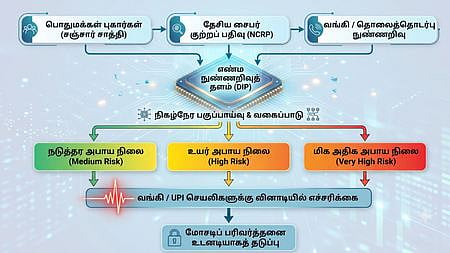
How does FRI work?: FRI is a modern security feature that operates by combining telecommunications data with artificial intelligence analysis. This digital intelligence platform (DIP) operates
The method is explained as follows: Data obtained from three key systems—the Sanchar Saathi platform for registering public complaints, the National Cyber Crime Reporting Portal (NCRP), and intelligence inputs from banks and the Department of Telecommunications—are integrated and sent to the FRI platform.
This platform analyzes the received information in detail in real time and, based on its risk level, classifies it into three categories: medium risk, high risk, and very high risk.
Based on the results analyzed in this way, an alert SMS is sent in a single second to the relevant bank and UPI apps. Through this, fraudulent transactions carried out online or through digital means are immediately detected and prevented.
For example, these alert SMS messages will be sent via DIP to banks and UPI app companies. When a user sends money to that suspicious number, an alert saying 'This number is dangerous' will appear on the screen within the app itself, or the transaction will be automatically canceled.
'Behind the figure of Rs. 5,000 crore lies the safety of millions of people. For example, a pensioner who escaped losing his life savings by believing a fake KYC call, a small business owner whose money intended for a fraudulent distributor was stopped just seconds before being sent, and a new digital user who immediately halted a transaction after seeing the warning on the screen — each of them has been protected before harm occurred, instead of being forced into the ordeal of investigation after suffering a financial loss,' point out officials from the Union Department of Telecommunications.
'Cybercrimes' are not stopped by the telecom department alone. The Reserve Bank of India (RBI) and the National Payments Corporation of India (NPCI) have together linked more than 1,600 banks and UPI apps to the 'DIP' platform.
In addition, in collaboration with the Securities and Exchange Board of India (SEBI), the FRI platform has been expanded to help prevent stock market fraud carried out through fake demat accounts and fake trading apps.
Moreover, this risk indicator is now being used to prevent fraud in the issuance of insurance policies, the filing of claims, and the theft of money from pensioners’ accounts.
Training for officials: To ensure the proper use of this technology, the Department of Telecommunications has provided more than 25 specialized training sessions to officials from 1,500 banks and financial institutions.
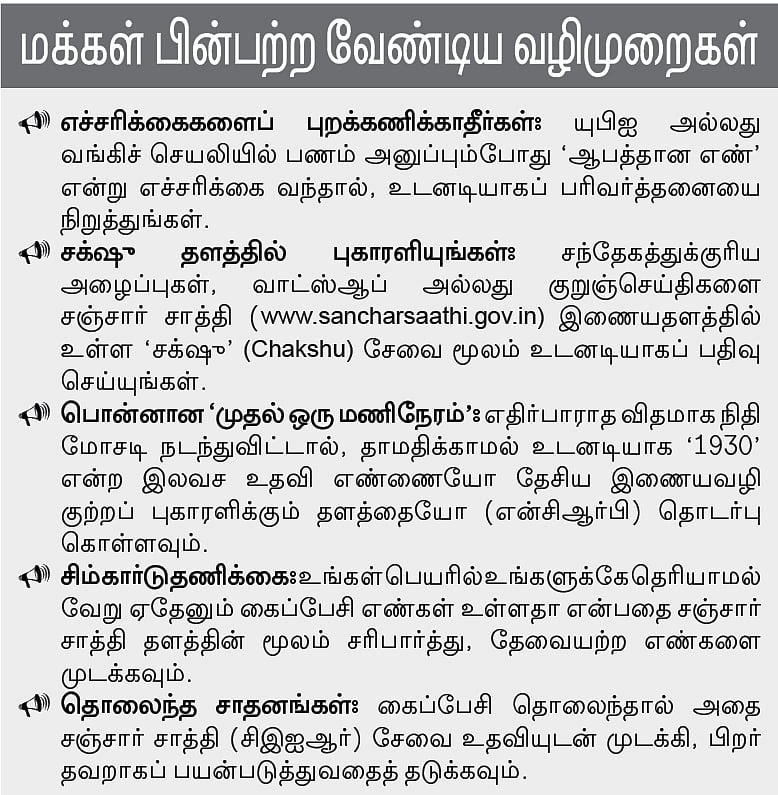
In this matter, the central government says that public participation, known as 'Jan Bhagidari,' is the first line of defense. A small complaint from an aware citizen saves the money of thousands of people. The 'Sanchar Saathi' app can be downloaded from the Android and iPhone platforms and installed on mobile phones.
This modern technological safeguard from the Union Department of Telecommunications has made India’s digital economy even more secure and reliable, and public acceptance of this service is growing day by day.