There is anticipation over how President Donald Trump, who has lost his majority in both houses of the U.S. Congress, is going to handle the next two years of governance.
Just as the Indian Parliament has two houses, the Lok Sabha and the Rajya Sabha, the U.S. Congress has the Senate (upper house) and the House of Representatives (lower house).
Of these, elections to the 435-member House of Representatives are held once every two years. The 100-member Senate has a six-year term, and elections are held once every two years for one-third of the seats.
(The election for the President of the United States is held once every four years. In this election, the American people vote directly for the presidential candidate.)
In this situation, voting for 435 House seats and 35 Senate seats, along with various state governors and local government positions, was held on the evening of Nov. 3, according to Indian time.
As the votes cast after the polling ended on the evening of Nov. 3 are being counted, U.S. President Donald Trump’s Republican Party has suffered a crushing defeat.
With 218 seats needed for a majority in the House of Representatives, the Democratic Party has won 231 seats and the Republican Party has won 144 seats, and the opposition Democratic Party has taken control of the House of Representatives. (Status as of 3 p.m. Indian time)
In the Senate election for 35 seats, the Democratic Party has won 20 seats and the Republican Party has won 13 seats. Vote counting is underway in the remaining 2 constituencies.
With this, while 50 seats were needed for a majority, the Democratic Party won 54 seats and the Republican Party 44 seats, and the opposition has also captured the Senate, delivering a shock to Trump.
Historic victory
Kansas, Texas, and South Carolina, long considered strongholds of the ruling Republican Party, have seen Democratic senators win there for the first time in several decades.
In Kansas, Pastor Adam Hamilton defeated Roger Marshall to deliver an unexpected victory for the Democratic Party. This is the party’s first win in 94 years.
In New Hampshire, Chris Pappas, an openly gay candidate who ran on behalf of the Democratic Party in the state, has won.
In Georgia, Democratic Keisha Lance Bottoms has won the gubernatorial race. She has made history as the first Black woman elected governor of a U.S. state.
Abdul El-Sayed, who contested the Michigan state Senate election on behalf of the Democratic Party, has won. He is the first Muslim to be elected to the U.S. Senate.
Indian American businessman Vivek Ramaswamy, who ran for the Ohio governorship on behalf of the Republican Party, has lost.
Senate, House of Representatives Power
With the ruling Republican Party having lost its majority in the U.S. Senate and House of Representatives, U.S. President Donald Trump does not need to step down.
However, the power to make laws and the power to release funds to government departments belong only to the two houses of Parliament, the Senate and the House of Representatives. The two houses function like the engine of the United States.
In this situation, with the ruling Republican Party having lost its majority in both houses, President Trump cannot do anything without the support of the Democratic Party.
Can Trump be impeached?
U.S. President Donald Trump was directly elected by the people and became president. The Democratic Party cannot remove him from office merely because it has a majority in the Senate and the House of Representatives.
However, the House of Representatives has the authority to bring forward an impeachment resolution by levying charges against U.S. President Trump. If this House has the support of more than half of the total number of members (218), charges will be filed against Trump.
Next, the Senate will investigate those charges and render a verdict. If the resolution has the support of two-thirds of the Senate in favor of that verdict, it will be passed.
An American president removed in this way will not be able to hold any federal office in the future.
During Trump’s first term as U.S. president, the House of Representatives initiated impeachment proceedings against him twice. However, both times the effort failed because a two-thirds majority could not be secured in the Senate.
What is Trump’s next move?
President Trump, who accepted defeat in the U.S. midterm elections, had noted on Truth Social, “We did not win the election. Perhaps if I had run, we would have won by a landslide.”
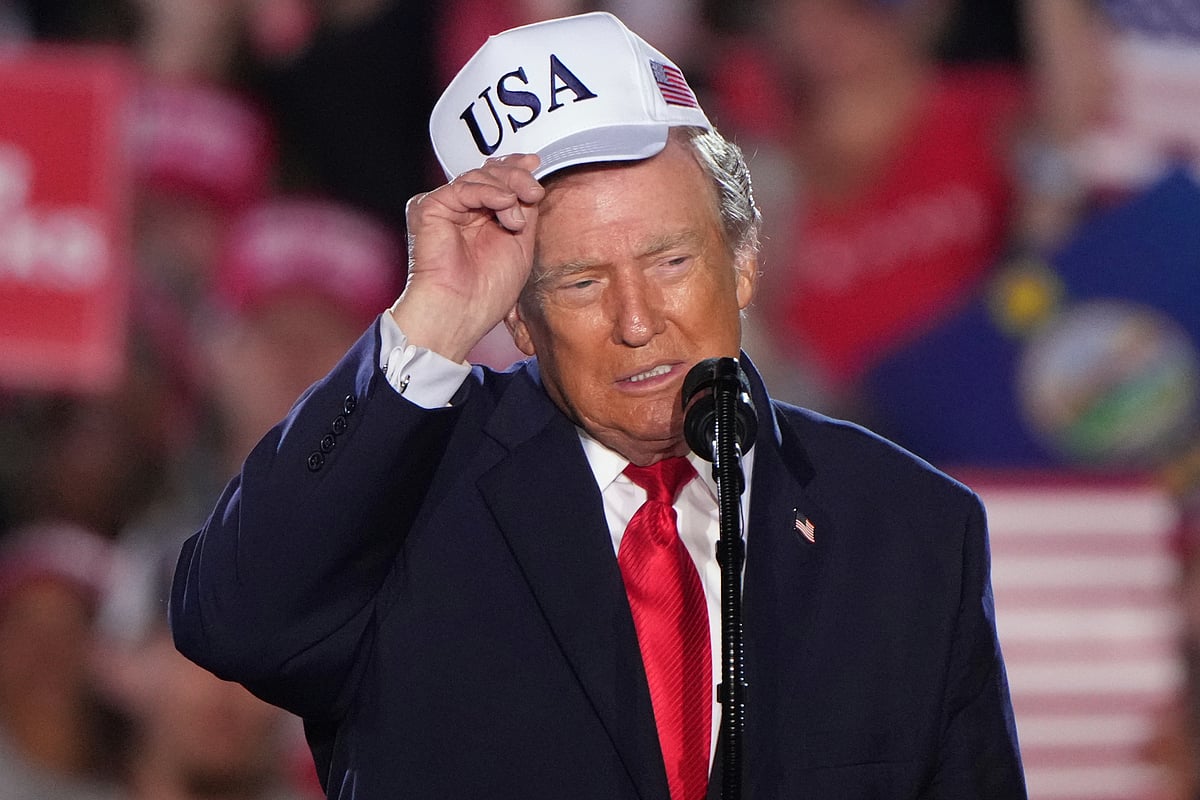
Following this, Trump posted a hat printed with the word “Veto,” indicating that he would use the special presidential power of “veto.”
Although the Democratic Party won both houses of the U.S. Congress, Trump, as president, can refuse to approve any legislation they pass and use his “veto” power to block it. That is what Trump was referring to.
(During Trump’s previous term as president, he used his veto power to overturn 10 laws passed by the U.S. Congress)
However, without a majority in the U.S. Congress, Trump will not be able to do anything as president for the next two years.
He will no longer be able to take actions such as releasing funds for wars in countries like Israel and Ukraine, supplying weapons, carrying out military operations against other countries, or imposing import tariffs without the approval of Congress.
On the other hand, Trump is expected to firmly do everything he can with his power to prevent the Democratic Party, which has the strength of a majority, from functioning.
How will Trump, who has lost power, govern over the next two years? How will the Democratic Party, which has taken control of Parliament, deal with Trump’s disruptions? Let’s wait and see!