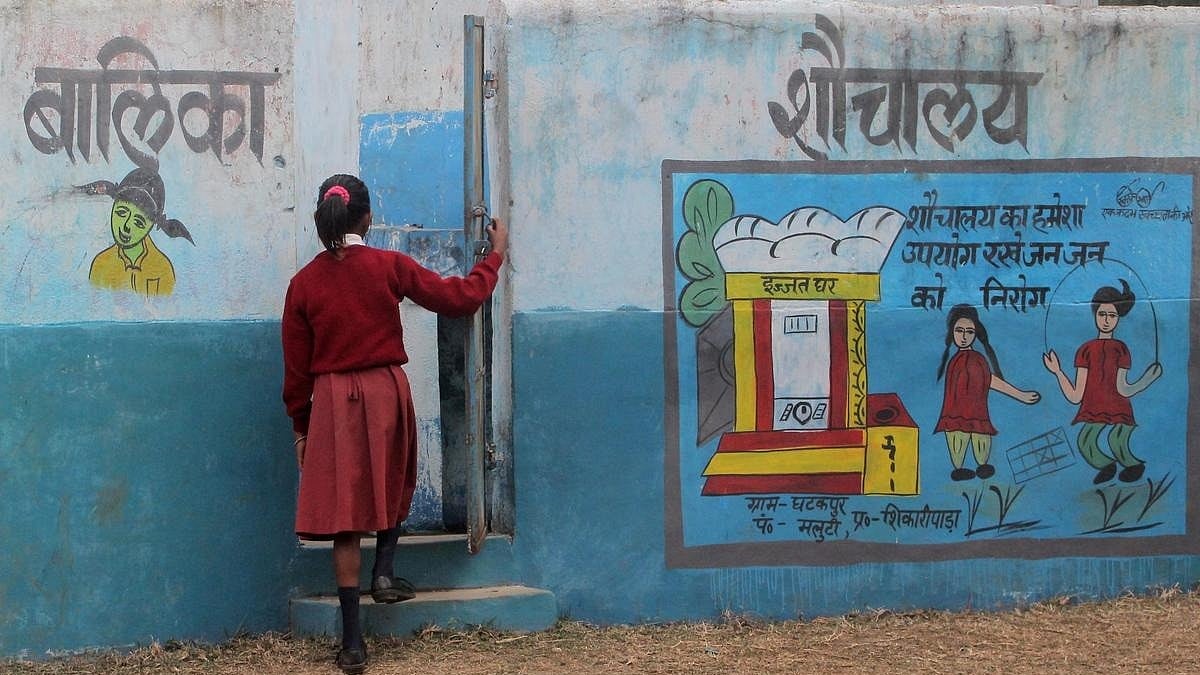
Education is not merely about reading textbooks. It is also about teaching a girl to live with self-respect and dignity. For decades, the lack of toilet facilities in Indian schools stood as a silent barrier against the educational rights of girl children. In particular, the distress and mental anguish faced by adolescent girls during their menstrual days are beyond words.
Today, the news that separate toilet facilities for girls in Indian schools have reached more than 95% is not just an infrastructure achievement. It is a dignified educational environment that we have restored for our girl children.
Toilet facilities are a basic human necessity. But there was a time when they became a factor that determined a girl child’s life or future. Our history contains many painful chapters of girls hesitating to go to school because there were no toilets, and young girls controlling their thirst without drinking even when they were thirsty because there was no safe drinking water.
As a result of cleanliness initiatives such as the ‘Swachh Bharat Mission’ and the ‘Swachh Vidyalaya Abhiyan’ for schools, introduced by the government led by the Bharatiya Janata Party after 2014, toilet facilities for girls in Indian schools today are on the verge of being almost fully in place.
Barriers to girls’ education have been broken. New doors have opened. A situation has now emerged in which no girl child will have to discontinue her studies midway because of poor sanitation.
2014 - 2025: A Comparison
Along with the ‘Swachh Bharat Mission’ launched by Prime Minister Narendra Modi on October 2, 2014, the Swachh Vidyalaya scheme was also introduced to provide separate toilet facilities for boys and girls in schools. As this scheme completes 10 years, its goals have been almost achieved.
Let us look at the information released in the joint monitoring survey by the World Health Organization and UNICEF (WHO/UNICEF).
Drinking water facility: In 2015, basic drinking water access for students stood at 55%, and by 2025 it has risen to 97%. (In a study conducted across 164 countries, only 5 countries have progressed faster in this sector. India is one of them.)
Toilet facility: In 2014, toilet access in schools stood at 67%, and it has now increased to 98%. The share of schools without toilets, which was 27% in 2014, has now fallen to 14%.
While the global average is 75% for toilet facilities and 80% for drinking water facilities, India has surpassed both.
According to information from the Ministry of Education, separate toilet facilities for girl students have been completed in 99% of the 1.456 million schools. While only 40% of toilets were operational in 2014, 92% of toilets are now in use.
Toilets as an educational facility
In a 2017 study conducted by economist Anjali Adukia, it was noted that after separate toilets were installed, school enrollment among adolescent girls increased and dropout rates declined significantly.
According to statistics from the Ministry of Education, toilets have been built in more than 95% of schools in the country. The availability of separate toilet facilities for girl students has reached 95% to 97% at the national level. Only 1.5% of schools do not have toilet facilities; 2.7% of schools have toilets but they are in need of renovation.
According to data from the Unified District Information System for Education (UDISE+), the dropout rate of girl children from classes 9 to 12 has decreased from 8.3% to 6.7%.
Safety for teenage girl students
Toilets without privacy caused mental distress and illness among girl students. After 2014, the lakhs of separate toilets built in government schools and the free sanitary napkin schemes increased girls’ attendance. As a result, dropout rates, which were at 23% due to lack of infrastructure, have now fallen to 8%.
Lower dropout rate
Primary school dropout: It was 5% in 2013-14, and has now fallen to 1.4%.
Middle school dropout: It was 4%, and has now fallen to 3%.
High school dropout: It was 17.8%, and has now fallen to 8%.
According to the World Health Organization and UNICEF’s ‘WASH’ ranking, India is in a high position globally with a score of 89 out of 100 in basic toilet facilities. Indian schools have reached 95% in the provision of clean drinking water.
Toilet maintenance status
A UNICEF report says that only 81% of toilets are properly maintained. In the comprehensive sanitation metric that includes soap and water facilities, India stands at only 53%. There is still a need to address the inconsistency in maintenance.
What needs to be done next:
Maintenance Fund: A separate mandatory fund allocation should be made for toilet maintenance work.
Community Contribution: Sanitation facilities should be inspected through the Parent-Teacher Association and reported in the annual report.
Menstrual Hygiene: Napkin vending machines and incinerators should be widely installed.
The Swachh Bharat Mission, which succeeded in building toilets over 10 years, should next focus on maintaining them cleanly. Education activists hope that a woman should never again be forced to choose only one between her self-respect and her education.