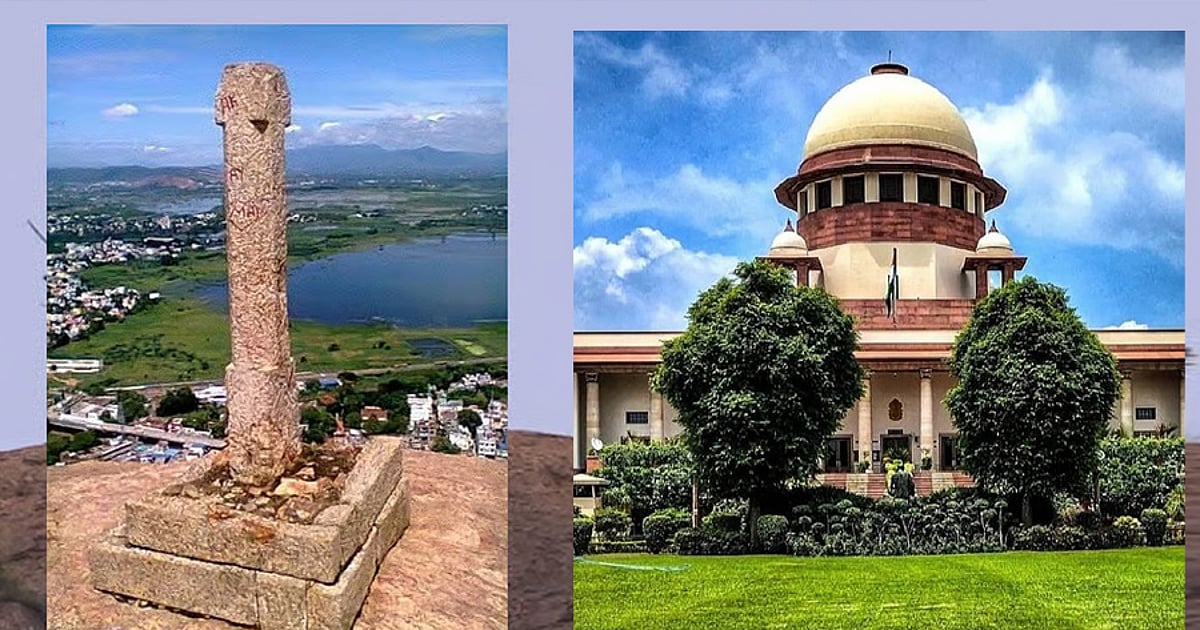
The Supreme Court has today (November 20) granted interim permission to light the Karthigai Deepam only once this year at the ancient lamp pillar atop the Thiruparankundram hill in Madurai. At the same time, the judges have imposed an interim stay on the Madras High Court’s order permitting the lamp to be lit permanently, and have also issued strict security conditions.
Background of the case:
Last year, Ram Ravikumar from Madurai submitted a petition to the temple administration seeking permission to light the Karthigai Deepam at the ancient Deepa Thoon on the hilltop, instead of the Deepa Mandapam of the Uchipillaiyar Temple, where the lamp is usually lit on the Thirupparankundram hill. The temple administration responded that, according to traditional practice, the lamp is lit only at the Deepa Mandapam near the Uchipillaiyar Temple.
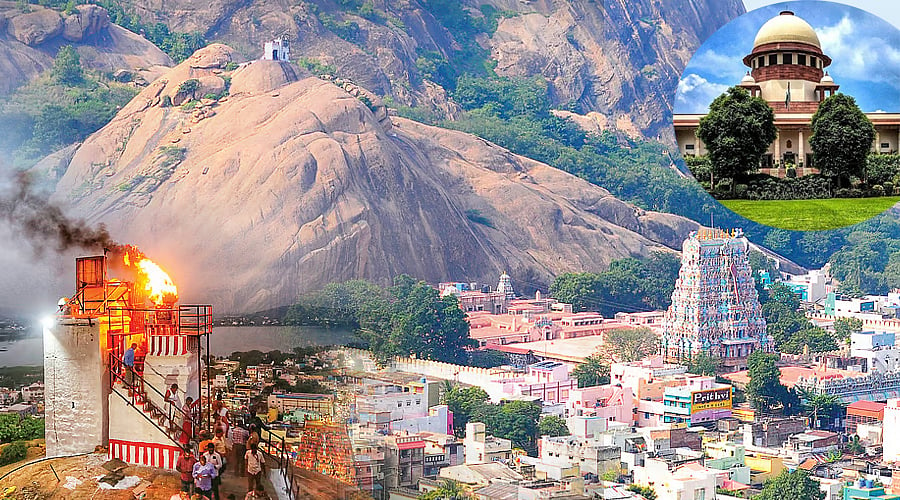
Following this, Rama Ravikumar filed a case in the Madurai Bench of the Chennai High Court: after hearing this petition, Judge G.R. Swaminathan ordered permission to light the lamp at the Deepa Thoon on the hilltop. However, on the temple administration’s side, as usual, the lamp was lit only in the Deepa Mandapam. Following this, Rama Ravikumar filed a contempt of court case against the Tamil Nadu government and officials of the Hindu Religious and Charitable Endowments Department.
Justice G.R. Swaminathan, who heard the matter, ordered that the petitioner and nine others go to the hilltop under the protection of Central Industrial Security Force (CISF) personnel and light the lamp on the Deepa Thoon. A two-judge bench of the Madurai Bench of the High Court, which heard the Tamil Nadu government's appeal against the single judge's order last January, dismissed it and also ordered that a lamp be lit on the Deepa Thoon every year on Karthigai Deepam day. The Tamil Nadu government filed an appeal in the Supreme Court against this order.
What happened in the Supreme Court today?
Following intensive hearings over the past few days on the Tamil Nadu government's appeal petition, a bench headed by Supreme Court Judge Aravind Kumar has issued an important interim order today:
The Supreme Court has stayed the Madras High Court's verdict that allowed the permanent lighting of a lamp on the lamp pillar.
At the stone pillar near the dargah, only for this year, interim permission to light a lamp once has been granted. The judges have clarified that this is entirely only a temporary arrangement.
For the detailed final hearing of this case, the judges have ordered that the case be adjourned to the second week of January 2027.
Key conditions imposed by the Supreme Court:
With regard to lighting the lamp atop the hill, taking into account law and order and rights of worship, the strict guidelines issued by the Supreme Court:
1. Safety and administrative restrictions:
No members of the public are permitted to go to the place where the lamp is lit. Only the authorized team and officials engaged in monitoring and security duties should go to that area.
The Madurai District Collector should decide, in consultation with the temple executive officer, the Archaeological Survey of India (ASI), and the Commissioner of Police, how many people should participate in the lamp-lighting event and who should be included. All arrangements should take place under the Collector’s direct supervision.
The police must provide adequate security. If necessary, assistance from the Central Reserve Police Force (CRPF) may also be obtained.
Gathering of the public, holding processions, engaging in protests, and raising slogans in that area have been completely prohibited.
2. Clarifications on worship and land rights:
Worship at places on Thiruparankundram Hill where worship is customarily performed must continue without any hindrance. Likewise, no obstruction should be caused to lawful access to the dargah and mosque.
This order does not grant anyone any additional right to enter, occupy, or retain control over the hill area. The court has not made any decision on claims relating to traditional worship rights or rights over the land.
The one-time permission granted this year, or the lamp-lighting event, cannot be used as legal proof of a traditional custom or a right of entry. Permission cannot be sought in future years on the basis of this either.
No adverse decisions should be taken against any party for complying with this order.
If there are any legal, practical, or security-related obstacles, the Madurai District Collector must immediately bring them to the court’s attention.

Within 3 days of the conclusion of the Karthigai Deepam festival, the Madurai District Collector must file a detailed report in the Supreme Court regarding the implementation of the court order.
The significance and impact of this order:
The Supreme Court, by staying the High Court’s order mandating that lamps be lit every year, has provided interim relief to the Tamil Nadu government’s legal concerns, while also temporarily considering the petitioner’s request by allowing the lamp to be lit only once this year.
The order to hold the event under the supervision of the District Collector and central forces, while prohibiting the public, processions, and slogans, will help avoid a tense situation and maintain peace.
“This one-time permission cannot be shown as evidence for future rights,” the Supreme Court has categorically stated, and therefore the final decision on ownership of the hill and the traditional worship issue will be determined during the detailed hearing scheduled for January 2027.