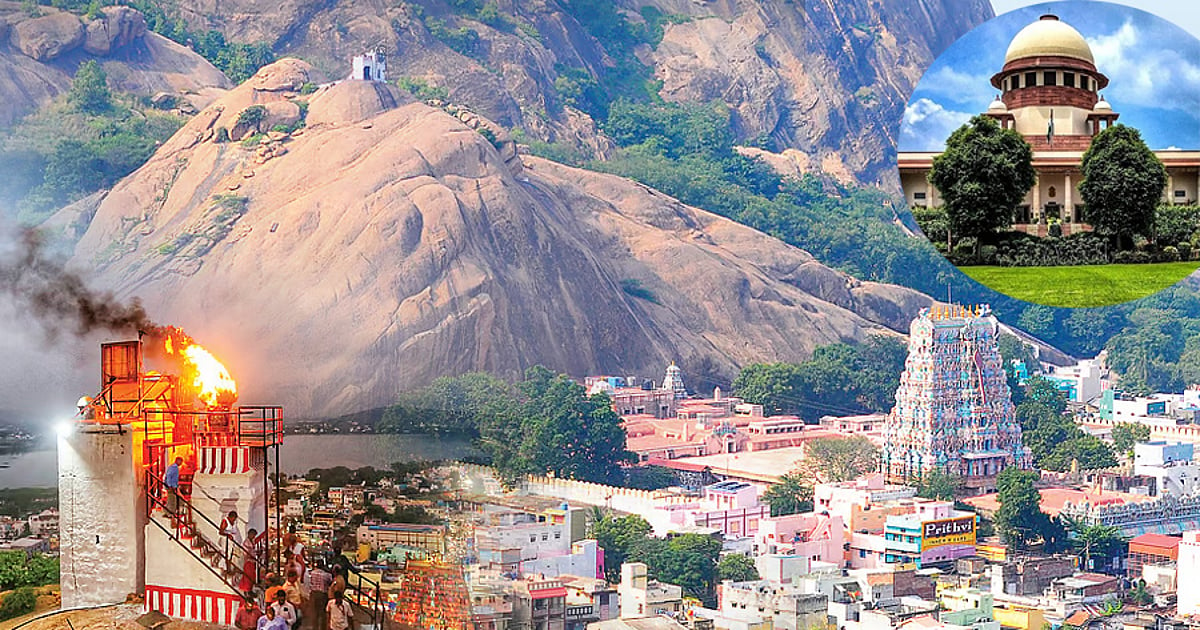
When the case concerning the lighting of the Karthigai Deepam at the summit of Thiruparankundram Hill in Madurai came up for hearing in the Supreme Court, it caused great excitement and confusion. In particular, the Madurai District Collector’s counsel faltered when the judges asked who owned the place where the Deepam pillar is located, and the historical evidence presented by the dargah side has brought about a major turning point in this case.
Background of the case
Last November, a single judge of the Madras High Court, G.R. Swaminathan, had issued an order to light the lamp on the pillar atop Thiruparankundram Hill in Madurai.
This order had also been upheld by a two-judge bench. The Tamil Nadu government appealed against it in the Supreme Court.
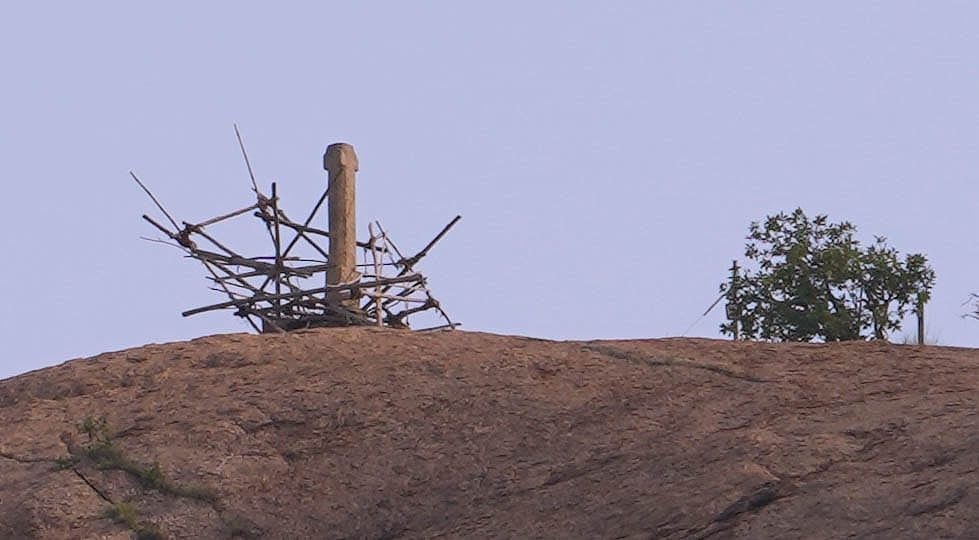
Meanwhile, despite the High Court’s order, a petition was filed by the original petitioner, Rama Ravikumar, seeking contempt proceedings against the Hindu Religious and Charitable Endowments Department Commissioner and the Madurai District Collector for not permitting a lamp to be lit on the pillar on the hill. All these cases came up for hearing before a bench of the Supreme Court comprising Justices Aravind Kumar and Vipul M. Pancholi.
Arguments on behalf of the Madurai District Collector
Senior advocate Gopal Shankar Narayanan, appearing for the Madurai District Collector, said, “For more than a hundred years, lamps have been lit only at the place near the temple. But the petitioner is asking that the lamp be lit at the place near the dargah instead. The place where they are asking for the lamp to be lit is actually just a ‘stone pillar used to measure and mark the land.’ During the British era, such stone pillars were used to survey land in hilly areas. Similar land-survey stone pillars can be seen in various hilly regions of Tamil Nadu, including St. Thomas Mount in Chennai, and they are like the geodetic survey markers used to measure Mount Everest.”
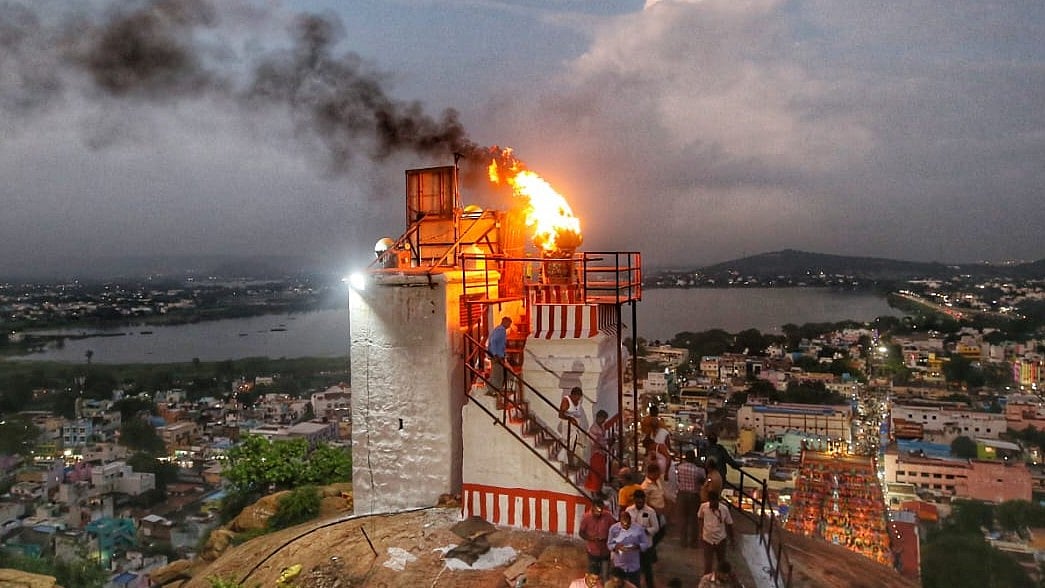
They are asking that a lamp be lit on that pillar in Thiruparankundram solely because it looks like a lamp pillar. But in reality, it is not a lamp pillar. It is a land-survey stone. We have submitted evidence for this, from the British era all the way to post-independence court judgments. There is no dispute that the area they call the lamp pillar belongs to the temple administration. At the same time, all the access routes leading to that area belong to the dargah administration," he presented detailed arguments.
The Supreme Court’s question and the district collector’s side’s confusion
Interrupting the arguments, the judges again posed a direct question: "Is the area where the pillar mentioned by the petitioner stands owned by the temple administration or not?" In response, the lawyer representing the Madurai District Collector stumbled badly. When he said, "The dargah side says it is their own land," the dissatisfied judges sternly asked, "As a District Collector, what are you saying? Tell us in one word whether that land belongs to the temple or not."

When the lawyer replied, "I will ask the officials and tell you," the petitioner’s lawyer raised his voice, saying, "Even a district collector does not know what information there is on this matter; what is going on?"
Following this, the Tamil Nadu government’s lawyer asked the Madurai District Collector’s lawyer to say, “Yes, that is indeed land belonging to the temple administration,” and the District Collector’s lawyer made the same statement in the Supreme Court. This caused great confusion in the court.
Arguments from the dargah administration side
Lawyers appearing on behalf of the dargah said, “For several centuries, the Sikandar Dargah, known as the ‘Nellithoppu Dargah,’ has existed in the Thirupparankundram hill area. It is not a full-fledged mosque. It is a dargah established for Islamic religious leaders. There are documents defining the title rights of this place as belonging to the dargah, from the time of the kings through the British period and thereafter up to the Government of India. Even during the periods of 1862 and 1902, when attempts were made to engage in activities of another religion on land belonging to the dargah, the rulers and courts of that time prevented them, taking into account public peace and after examining religious worship practices.”
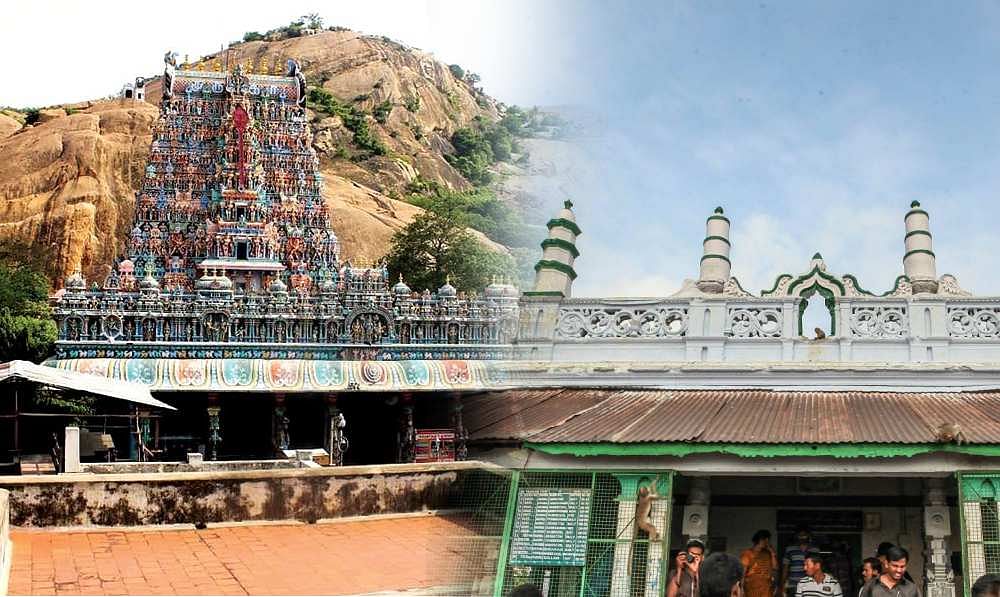
It was argued that the steps of the Nellikuppam Puthu Mandapam, the land measurements they mention, the area where the dargah is located, and the flag-hoisting place beside it are all land belonging to the dargah. Generally, lighting a lamp in hilly areas is done so that the entire village can see it. At present, if a lamp is lit in the Uchi Pillaiyar temple area, everyone can see it. On the other hand, if it is lit at the stone area mentioned in their land measurements, the graveyard, the flagpole, and the other trees in front of it would block most of the area. Therefore, it is neither customary to light a lamp in a place where the public cannot see it," the arguments were made.
Supreme Court Order and Deadline
After recording the arguments of all sides, the Supreme Court judges instructed, "Do not present any detailed arguments at this stage. Present only arguments for the interim order. Save all your energy for the final hearing."
They also allotted a specific amount of time for each side to present arguments during the hearing:
Petitioner Rama Ravikumar’s side: 15 minutes
Respondent side senior advocate: 15 minutes
Another lawyer’s side: 10 minutes
After this definite allocation of time, the next stage of the case hearing is scheduled to resume tomorrow at 2 p.m.