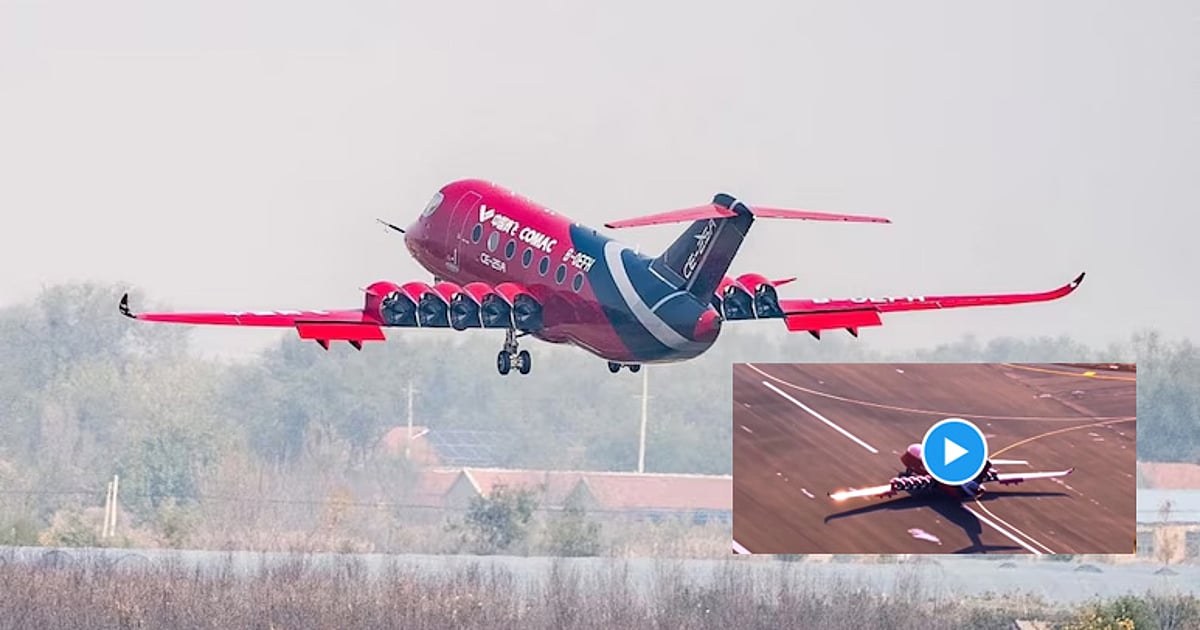
The 10-ton CE-25A aircraft, capable of traveling at 300 km/h and developed by the state-owned Chinese commercial aircraft company (COMAC), successfully completed its first test flight on November 14 in Shandong Province with three crew members on board.
The aircraft is designed to carry passengers over distances of up to 400 km.
During the test, the aircraft operated normally, and all performance indicators met expectations. According to CCTV, China’s state broadcaster, the flight test lasted 57 minutes and 46 seconds.
However, the aircraft flew in the air for 16 minutes and 38 seconds, covering a distance of 60.4 km. The aircraft carried two pilots and one flight test engineer.
In this test, its first unmanned autonomous flight on February 2, 2026, and 19 unmanned flight validation exercises conducted as part of the development program were carried out consecutively.
Unlike conventional passenger aircraft that rely on fuel-powered jet engines or turboprop engines, the CE-25A uses a distributed electric ducted fan propulsion system.
Multiple fans mounted on its wings generate the thrust needed to propel the aircraft. These fans are driven by electric motors that draw power from the aircraft’s battery system.
Chinese state-owned aircraft manufacturer COMAC completed the first crewed flight of its CE-25A electric aircraft in Binzhou, state broadcaster CCTV reported https://t.co/Bh49hvp8Tm
— Reuters (@Reuters) November 14, 2026
This distributed system spreads thrust across the wings instead of concentrating it in conventional engine arrangements. It allows engineers to explore different aerodynamic and propulsion configurations for electric aircraft.
However, its true performance and operational benefits must be established through further testing.
About the CE-25A:
Developed by COMAC in collaboration with Chinese battery manufacturer CATL, Shanghai Jiao Tong University, and other partners, the CE-25A is designed for short-haul regional passenger transport.
This project brings together aircraft manufacturing, battery technology, and academic research to develop a large electric commercial aircraft.
This aircraft will feature a maximum takeoff weight of 10 tons, a capacity of 19 passengers, a cruising speed of 300 km/h, a cruising altitude of 2,400 meters, and a range of 400 km.
The aircraft is being developed under China’s CCAR-25 transport category aircraft airworthiness regulations. China’s Civil Aviation Administration has accepted the application for its type certificate.
The development of the CE-25A marks an important step in China’s efforts to move small electric aviation toward commercial passenger transport.