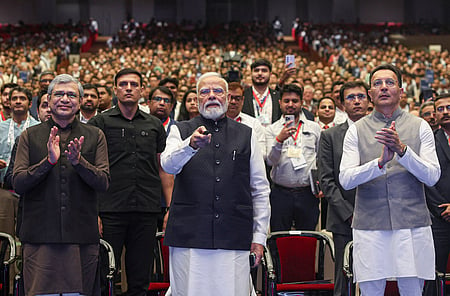
Prime Minister Narendra Modi said that as the country’s semiconductor sector is expanding rapidly, new opportunities for innovation, investment, and growth have emerged. He also assured that the government is ready to provide all the facilities needed for this sector.
The Prime Minister said this while inaugurating and addressing the Semicon India 2026 conference in Delhi on Thursday.
The 5th ‘Semicon India 2026’ conference-cum-exhibition, aimed at enhancing global cooperation, investment, innovation, and skill development in the country’s semiconductor sector, as well as bringing together investors, researchers, and innovative companies, began in Delhi on Thursday.
Prime Minister Modi inaugurated this three-day conference, which is being held with the participation of more than 600 companies from various countries in the semiconductor, electronics, and technology sectors, along with more than 50,000 visitors, including representatives from 52 countries.
Speaking on the occasion, he said: As the country’s semiconductor sector is expanding rapidly, new avenues for innovation, investment, and growth have opened up. New, reliable locations for semiconductor manufacturing are becoming essential in the world.
Based on that, India is preparing itself. All measures have been taken for India to emerge as a preferred hub for semiconductor manufacturing.
The government has taken all necessary measures to ensure the success of industrial enterprises through policies and regulatory action plans suited to this sector.
Allocation of Rs.1.29 lakh crore
So far, approval has been granted for 12 semiconductor manufacturing projects in the country. In the next phase, this number will increase further. An allocation of $13.5 billion (Rs.1.29 lakh crore) has been made for the Semiconductor 2.0 scheme. Compared with the $8 billion (Rs.76,772 crore) allocated for the first phase scheme, this is a significant increase.
A target has been set to train one lakh engineers in chip design and related fields, and so far 70,000 people have been trained.
As the country’s economy is expanding rapidly, India has become the world’s hope. As we strive to strengthen the production of electronic goods and reduce dependence on global supply chains, in the semiconductor sector we must build a complete ecosystem beyond design and integration, in advanced packaging, equipment, raw materials, research, and skill development.
Call to young talent
Young talents engaged in research in India should join hands with fellow foreign researchers and develop cutting-edge technologies domestically.
We are expanding solar power and nuclear power generation to meet the energy needs of artificial intelligence data centers and semiconductor manufacturing plants, said Prime Minister Modi. Earlier, when Prime Minister Modi came to the stage, birthday greetings were shouted in his honor.
Under the Semiconductor 1.0 scheme, approval has been granted for 12 semiconductor plants across 6 states—Gujarat, Assam, Uttar Pradesh, Punjab, Odisha, and Andhra Pradesh—and 3 plants have already begun production.
Target of 200 companies
Speaking at the Semicon India conference, Union Minister for Electronics and Information Technology Ashwini Vaishnaw said, “Under the country’s Semiconductor 2.0 scheme, the central government’s goal is to create at least 200 companies, including startup companies in chip design.
Under the first phase of the semiconductor scheme, 105 startup companies were created. Of these, 20 companies attracted an investment of about Rs. 800 crore. The second phase of the scheme has 6 key pillars: design, machinery and raw materials, assembly plants, advanced packaging, research and development, and capacity building,” he said.
Tata Electronics 16 agreements
Tata Electronics CEO Randhir Thakur said that at the Semicon India conference, the company would be entering into a total of 16 agreements with companies not only from India but also from European countries, Japan, and Singapore.
“The semiconductor sector is emerging as an industry of the future. India is ready to write a new chapter in this sector. With the government’s complete alignment with industry and its proactive policies, obstacles have been removed and a dynamic ecosystem has been created,” he said.