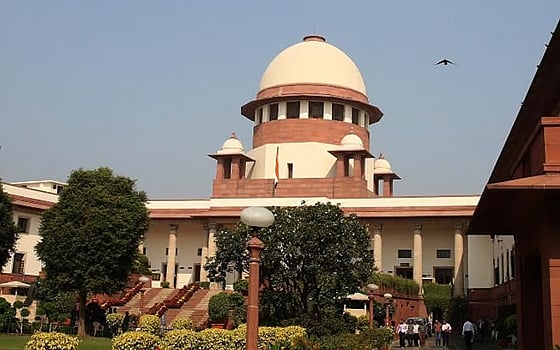
The Supreme Court has said that in criminal cases, the investigating agency must inform those who are arrested of the reasons for the arrest in writing and in a language they understand.
Last May in Punjab, under the Protection of Children from Sexual Offences (POCSO) Act, Shiromani Akali Dal party functionary Jaskaranjeet Singh was arrested.
However, since the police did not provide him with the reasons for his arrest in writing, the magistrate court released him.
At the same time, following legal procedures, the magistrate court granted permission and ordered the police to arrest him again. Seeking to quash this order as well as his arrest, Jaskaranjeet filed a petition in the Punjab and Haryana High Court. The High Court dismissed the petition and issued its order.
Articles 22(1) and 22(2) of the Constitution...: A bench comprising Justices Ujjal Bhuyan and A.S. Chandurkar delivered its verdict on Monday on the petition filed in the Supreme Court against the High Court’s order. At that time, the bench said the following:
Under Articles 22(1) and 22(2) of the Constitution, a person cannot be arrested without being told the reasons for the arrest. A person so arrested must be produced before the nearest magistrate within 24 hours.
If any attempt is made to deprive a person of the fundamental rights guaranteed under Article 22(1) of the Constitution, the courts must condemn it and take strict action.
Informing the person being arrested of the reasons for the arrest is not merely a ritualistic procedure. It is a safeguard provided by the Constitution. It must be strictly followed. The reasons so communicated must be in writing and in a language understood by the arrested person.
Failure to inform the reasons for arrest amounts to a violation of fundamental rights. This would affect the right to life and personal liberty guaranteed under Article 21 of the Constitution.
The arrest will become unlawful...
If the investigating agency does not follow the deadline and procedure for providing the reasons for arrest in writing, that arrest will be considered unlawful. This will result in the arrested person having to be released automatically.
Compensation can be sought in the High Court
If Article 22(2) of the Constitution is violated by not producing the arrested person before the nearest magistrate within 24 hours, the person so arrested may approach the High Court and seek compensation.
Re-arrest in the same case...
It stated that if the reasons for arrest are not disclosed or if a person is detained for more than 24 hours, the investigating agency must approach the magistrate to re-arrest the person, who had already been released by the court, in the same case.
Following this, in connection with Jaskaranjeet’s petition, the bench of judges set aside the order issued by the Punjab and Haryana High Court.