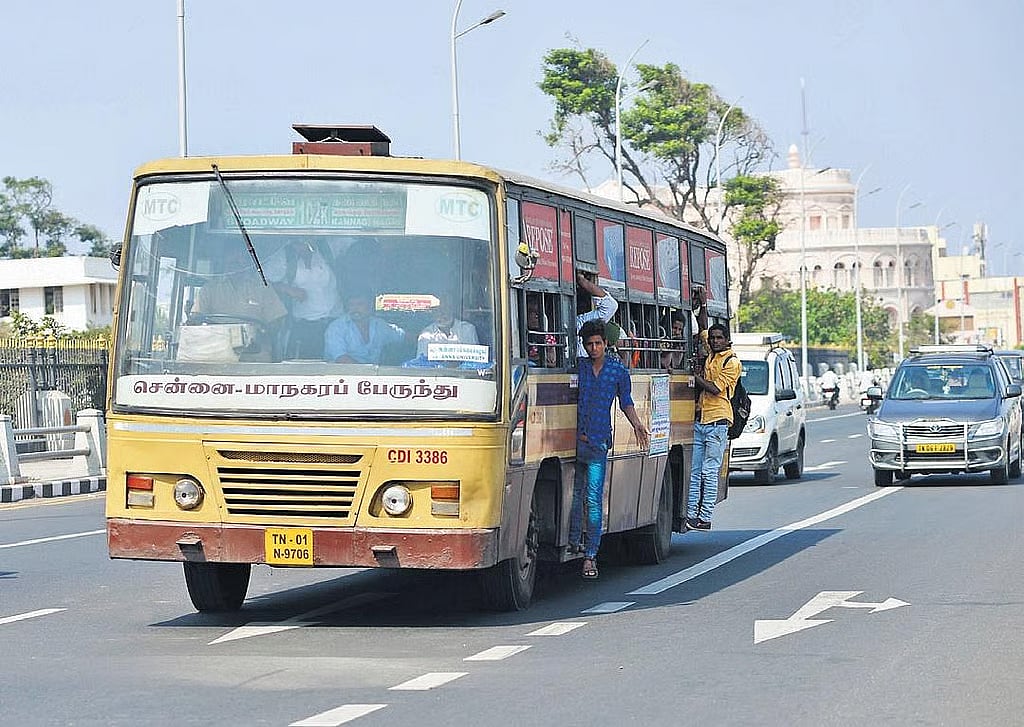
Due to the inadequate operation of government buses in Sivaganga district, the public commuting to work, school and college students, and patients are facing severe hardship.
In Sivaganga district, a total of 224 buses, including suburban and city buses, are operated through depots at four places under the Karaikudi region: Karaikudi, Sivaganga, Tirupattur, and Devakottai. For the past year, passengers have said that the number of city and route buses operating from Sivaganga to towns such as Devakottai, Karaikudi, Kalaiyarkoil, Manamadurai, Thiruppuvanam, Tirupattur, and Ilayangudi, as well as to the hundreds of villages surrounding them, has been significantly reduced.
They are being accused. Buses that used to run to many villages 4 to 6 times a day are now operating only once or twice. In the morning and evening, the lack of enough buses causes excessive crowding.
School and college students are forced to travel in life-threatening ways, standing on the bus steps and holding onto the window bars. In many villages, because buses do not arrive on time or pass by without stopping, students are unable to reach school on time.
Previously, buses used to come and go every half hour, but now they arrive only once every 2 or 3 hours. Villagers say they are forced to wait at the bus stop as early as 6 a.m. for this.
Increase in travel expenses: Out of the total buses operating in Sivaganga district, only 70 are new buses. All the others are old buses. In addition, due to a shortage of technical staff, many government buses are being run on the road without adequate maintenance.
During the rainy season, water leaking into the bus and buses suddenly stopping midway have become a recurring story.
Since government buses do not come to rural areas, the public has to rely on autos and private share autos. Similarly, because there is no bus from the bus stand to Sivagangai Government Women’s College at the proper time, female students travel in share autos. As a result, the travel expenses of poor and underprivileged female students are increasing significantly.
Suffering from workload: Regarding this, government transport corporation CITU regional leader Deivira Pandian said: Across Tamil Nadu, 22,500 buses were being operated by the state transport corporations. During the previous regime, 3,000 buses were reduced, and now only 19,500 buses are being operated. Earlier, 1.40 lakh workers were employed. At present, only 1.05 lakh workers are employed. There is a shortage of nearly 35,000 people.
In 2007, more people were selected for the transport corporations than were needed, and after those who joined service, the remaining candidates were kept on a waiting list. As a result, there was a favorable situation for operating transport corporation buses without a shortage of workers. At present, workers are suffering because they are unable to take rest due to work pressure. It is painful that the number of buses is being reduced in transport, which is an essential service, he said.
Public demand: Government buses are the primary means of transportation for the rural poor and middle-class people. Therefore, the State Transport Corporation and the Sivaganga district administration must intervene in this issue immediately. The old, damaged buses should be removed and new buses should be operated.
Additional buses should be operated in the morning and evening hours for the convenience of students. Action should be taken immediately to restart the discontinued old route bus services. The public emphasized that only if the government acts swiftly will there be a solution to the daily hardships of the rural people of Sivaganga district and to the uninterrupted education of students.