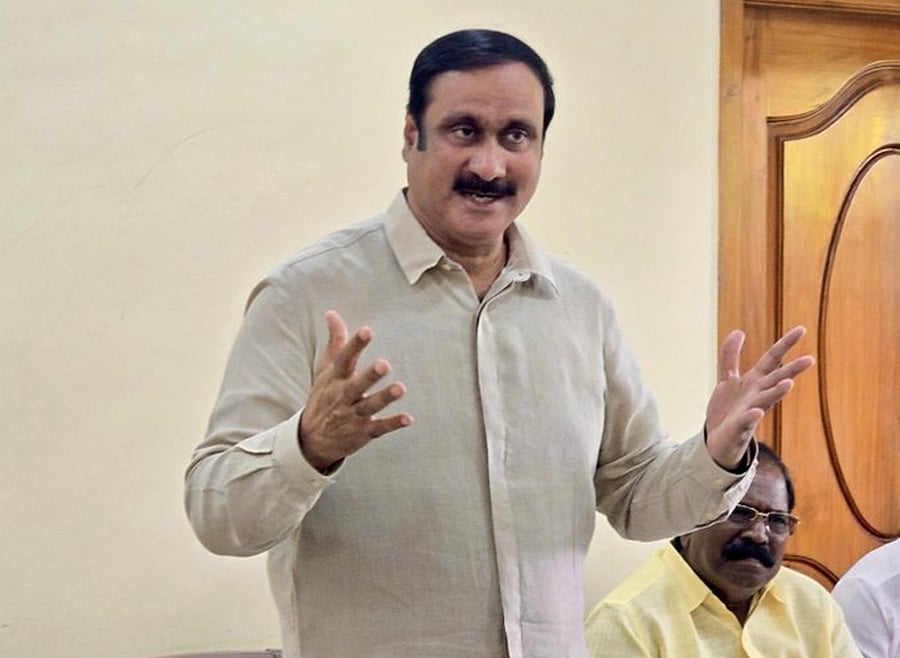
Chennai: PMK leader Anbumani has urged that not only government employees, but also ministers and Members of the Legislative Assembly should disclose their asset details.
The Tamil Nadu government has ordered that all government employees, including teachers and court staff, must submit their asset details within the next month. This move is welcome as a good effort to eliminate corruption in government administration. At the same time, imposing this restriction only on government employees while exempting the Chief Minister, ministers, Members of the Legislative Assembly, and local body representatives will not help eliminate corruption in administration.
According to the amendment made last January by the previous DMK government to Section 7(3) of the Tamil Nadu Government Servants Conduct Rules, all categories of government employees are required to file, in separate forms on the Tamil Nadu government’s Integrated Financial and Human Resource Management System portal, by March 31 of the following year, details of immovable assets such as lands and buildings, movable assets such as vehicles, jewelry and bank deposits, and liabilities, held in their own names and in the names of other family members, as of December 31 each year. Since the asset details of government employees as of December 31, 2025 have not yet been filed due to reasons including elections, they have been ordered to be filed by October 31.
If government employees fail to file their asset details, it will be considered a violation; it has been announced that this will affect their promotions. Therefore, everyone will have to respect this rule and make it mandatory to file asset statements. Filing asset statements by government employees is not a new practice. In the past, they were required to file an asset statement in the first year after joining service and then once every five years. Now that this practice has been changed to once a year, the purchase of assets through corruption by government employees will decrease; through this, government administration may gradually become cleaner.
However, these anti-corruption measures should not be limited to government employees alone. This restriction should also be extended to local representatives, including the Chief Minister, ministers, members of the Legislative Assembly, mayors of municipal corporations, chairpersons of municipalities and town panchayats, district panchayat chairpersons, and panchayat union chairpersons. Only then will it be possible to completely eradicate the corruption that has been rampant for many decades in the Tamil Nadu government administration and in local bodies.
In order to eliminate corruption in government administration, various measures have been taken over the past few decades in many states of India. The foremost among them is the establishment of the Lokayukta system. In all the states where the Chief Minister, ministers, and members of the Legislative Assembly have been brought under the jurisdiction of the Lokayukta, corruption in government administration has been brought under control, even if it has not been completely eradicated. But in Tamil Nadu, if the Chief Minister and ministers are not brought under the jurisdiction of the Lokayukta, and are not even required to disclose their assets, then talk of eliminating corruption will remain a joke.
Politicians are the ones who should set an example for government employees in the fight against corruption. If they are honest, officials cannot engage in corruption. Therefore, the Chief Minister and the ministers must take the initiative to eliminate corruption in Tamil Nadu’s administration.
As the first step in this regard, the Chief Minister, ministers, members of the Legislative Assembly, and local body representatives including municipal mayors, municipal and town panchayat chairpersons, district panchayat chairpersons, union panchayat chairpersons, should be required to publicly disclose all their assets every year on the first day of January and be subjected to social audit. If the asset value of public representatives has increased beyond a certain percentage, it should be made mandatory for the concerned representative to explain this to the public. Anbumani has stressed that rules should be framed making such measures mandatory to ensure integrity in public life.