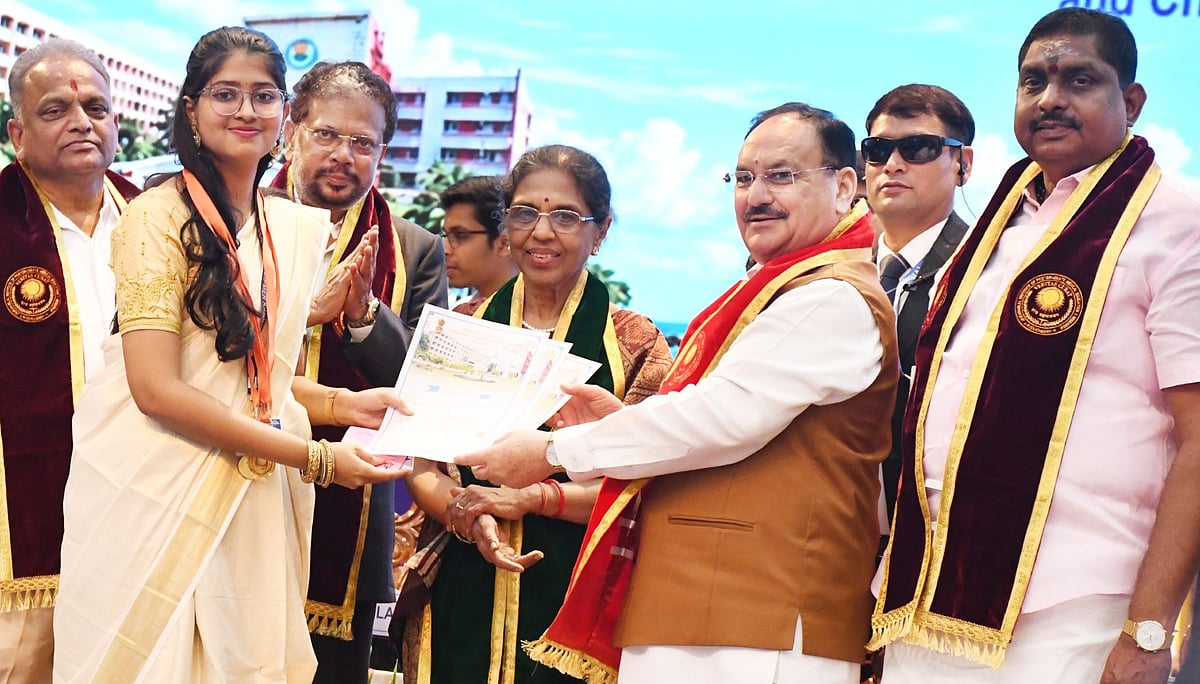
Puducherry: “The government’s aim is to create a balance in the number of student admission seats for undergraduate and postgraduate medical courses in the future,” said Union Minister J.P. Nadda.
He further said, “By 2029, Prime Minister Modi has set a target of creating an additional 75,000 seats in undergraduate and postgraduate medical courses.”
The 15th convocation ceremony of the JIPMER institution in Puducherry was held today at the Abdul Kalam Auditorium on the institution’s campus. At the ceremony, Union Minister for Health and Family Welfare J.P. Nadda attended as the chief guest and conferred degrees on students from courses including PhD, DM, MD, MS, and MBBS, and also felicitated outstanding students with awards.
Lieutenant Governor Kailashnathan, Home Minister Namachivayam, Public Works Minister Malladi Krishna Rao, Government Whip Arumugam, Chief Secretary Sarath Chauhan, JIPMER Chairperson Chitra Sarkar, Director Veer Singh Negi, and several others attended the event.
Speaking at the event, Union Minister J.P. Nadda said, “Before 2017, only curative treatment was being provided in the country. Prime Minister Narendra Modi’s focus is to ensure that ordinary people also get quality, advanced treatment.
It was in line with that that the National Health Policy was introduced in 2017. This policy was restructured to emphasize prevention of disease, creating awareness, and only then curative treatment. Moreover, this policy brought about many changes. In addition, all treatments have been digitized.
If a child does not receive a specific vaccination, warning information is sent to the concerned mother, the ASHA worker, health officials, and even up to the Union Health Ministry. This is India’s digitalization initiative.
While the country had one All India Institute of Medical Sciences, at the beginning of the 21st century, then Prime Minister Vajpayee established 6 medical institutions. Prime Minister Narendra Modi took steps to establish 16 medical institutions.
There are now 23 All India Institutes of Medical Sciences. Before that, students used to go to the United States and European countries for medical studies and research. Now, excellent institutions have been created and strengthened so that all research can be carried out within India itself.
From 2018 to the present, tests for diagnosing various diseases have been conducted for about 420 million people. Efforts are under way to extensively digitize the healthcare sector in India.
In the future, young doctors must ensure that the details of patients coming to the outpatient department are recorded digitally. They should come forward to follow the electronic prescription system.
Under the health account scheme called Ayushman Bharat Health Account, 129 crore health accounts have been linked so far.
The medical records of each patient are being digitized and brought under the health identification system linked to the Aadhaar infrastructure.
Moreover, health expenditure has decreased from 64 percent to 42 percent. This progress has been made through the Ayushman Bharat scheme, the world’s largest health insurance program. Under this scheme, health coverage has been provided to 63 crore people.
Under the Ayushman Bharat scheme, more than Rs. 2 lakh crore has been spent so far on medical treatment. Over the past 12 years, India’s healthcare sector has undergone the biggest transformation and significant progress.
This is a historic development. The number of student admission seats for medical courses has also increased significantly. Earlier, there were only 51,000 seats for undergraduate medical courses. Now, that number has increased to 143,000.
In addition, Prime Minister Narendra Modi has set a target of creating an additional 75,000 seats in undergraduate and postgraduate medical courses by 2029. Work to achieve that target is progressing as planned.
Previously, there were only 31,000 seats for postgraduate medical courses. That number has now increased to 91,572. The government’s goal is to create a balance in the number of student admission seats for undergraduate and postgraduate medical courses in the future.
The government’s aim is to improve the quality of medical education in India while also expanding opportunities to produce a larger number of doctors. Last year, at a Cabinet meeting chaired by Prime Minister Narendra Modi, an allocation of Rs. 15,000 crore was made to create 10,000 additional seats in undergraduate and postgraduate medical courses.
Each medical education seat costs about Rs. 1.5 crore over four years. Through this, students should understand the huge financial investment made by the government and society toward medical education.
Therefore, medical education should not be seen merely as a right that has been given to them, but as a valuable opportunity provided by society. Those of us who study with the support of society also have a duty to give back to that society,” he said.