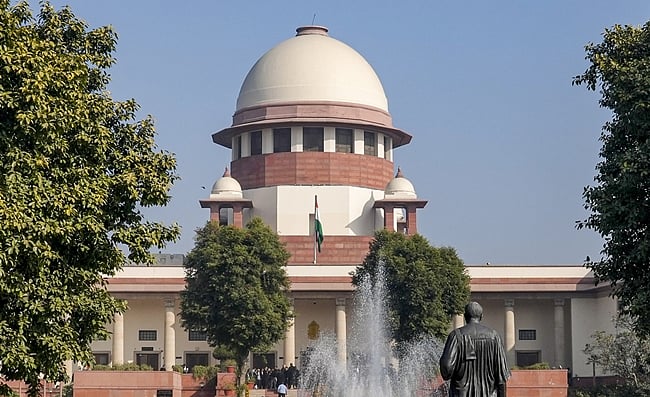
The Supreme Court’s 7-judge Constitution Bench on Tuesday concluded the long-running case concerning legislators’ privileges and freedom of speech.
The Constitution Bench, headed by Chief Justice of India Surya Kant, comprised Justices Aravind Kumar, Prashant Kumar Mishra, Jaymalya Bagchi, Vipul M. Pancholi, Sri Chandrasekhar, and V. Mohana.
The judges who considered this matter noted, "Since these writ petitions have become infructuous in the present circumstances, the case is being closed. However, the legal questions raised in this will be considered in accordance with due procedure when appropriate cases are dealt with in the future."
Articles and editorials published by the English daily "The Hindu," describing the events of the Tamil Nadu Legislative Assembly in 2003, were translated and published by "Murasoli," a newspaper supportive of the DMK, which was then in opposition. Regarding the publication of these articles and editorials, then Assembly Speaker Kaliyamuthu ordered the Tamil Nadu Legislative Assembly privileges committee to investigate senior journalist N. Ravi and others.
Accordingly, based on the recommendation of the privileges committee, a resolution was passed in the Assembly on November 7, 2003, to arrest the concerned journalists.
Following this, the journalists concerned approached the Supreme Court against the actions taken against them. Subsequently, the Supreme Court imposed a stay on their arrest. Later, the resolution against them was withdrawn in August 2004. This information was brought to the court’s attention by senior advocate Raju Ramachandran, appearing on behalf of the Tamil Nadu Legislative Assembly, during the hearing held on Tuesday (Oct. 6). At that time, the Chief Justice pointed out, “When this case was transferred to a seven-judge bench, this important fact that the resolution had been withdrawn was omitted and not brought to the court’s attention.” The Chief Justice further noted in the order that, in the present circumstances, the matter has become infructuous, and the case is being closed.
Legal questions remain open: Judges
The Supreme Court clarified on Tuesday that the legal questions raised in the matter concerning an individual's fundamental rights and parliamentary proceedings will be considered in due course in appropriate cases in the future.
This matter was first referred to a 5-judge bench and, in 2004, to a 7-judge bench to examine the relationship between Article 194(3) of the Constitution (legislative privileges) and Article 19(1)(a) (freedom of speech) and the fundamental rights involved. At that time, the key question was whether an individual’s fundamental rights or the privileges of the legislature took precedence.
This larger bench was constituted to resolve the inconsistencies in Supreme Court judgments from 1959 and 1964 in different cases on this issue.
In this situation, since the Tamil Nadu Legislative Assembly itself has withdrawn the resolution against journalists, the Supreme Court has now closed the case, stating that there is no basis for delivering a judgment in this matter. At the same time, the seven-judge bench headed by the Chief Justice has clarified that the legal debates concerning fundamental rights and legislative privileges will remain open for future cases.