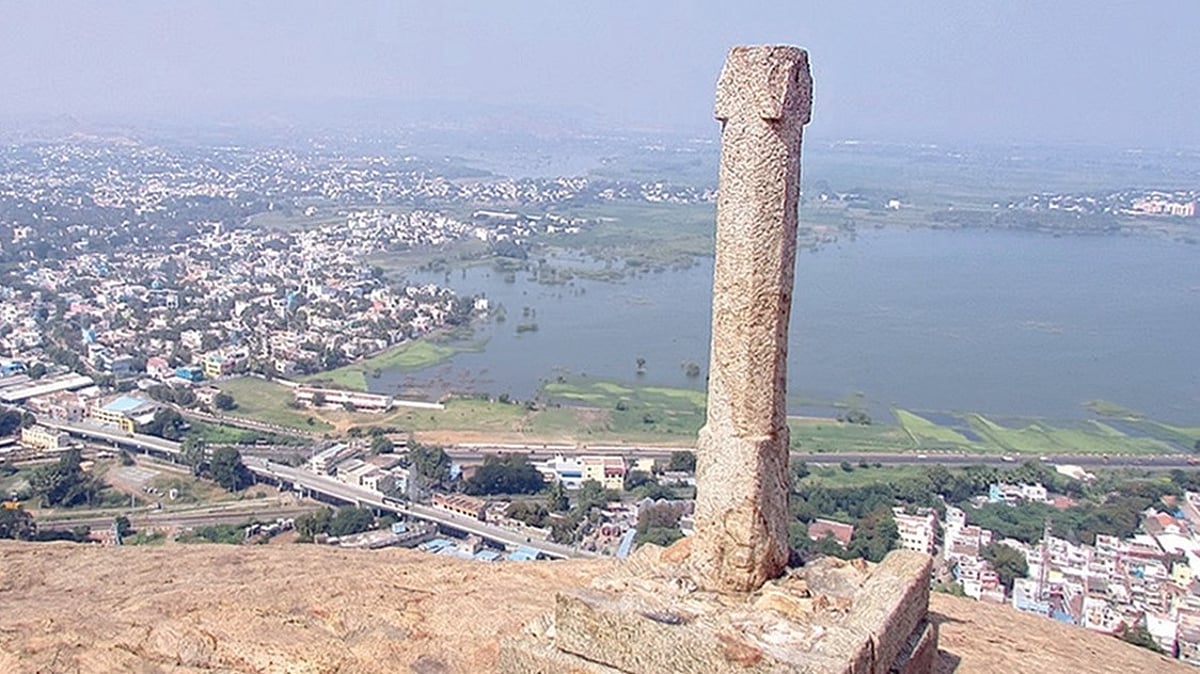
New Delhi: The Supreme Court, which stayed the Madras High Court’s ruling permitting the lighting of a lamp on the Deepathoon at Thiruparankundram Hill, has allowed it with conditions as a one-time measure, permitting the lamp to be lit on the Deepam festival of Karthigai only. However, the Supreme Court has clarified that this permission should not be treated as the final approval in this case.
The Tamil Nadu government and the dargah administration filed an appeal in the Supreme Court against the Madras High Court’s ruling allowing a lamp to be lit on the stone pillar on Thiruparankundram Hill.
Likewise, Ram Ravikumar had filed an appeal in the Supreme Court seeking permission for all devotees to light lamps on the hill on Karthigai Deepam day, and also challenging the condition that permission must be obtained from the Archaeology Department.
A bench of Supreme Court judges Aravind Kumar and Vipul.M.Pancholi heard these petitions. Both sides presented their arguments for three days.
After hearing arguments from both sides, the judges have issued an interim order today. In their order, the judges said, “Permission is granted only once to light the lamp at the Deepathoon in Thiruparankundram hill. Therefore, permission is granted to light the lamp at the Deepathoon for one day on the upcoming Karthigai Deepam day (November 24).
At the same time, the court is aware of the risks that granting permission once could later become a precedent. However, the court takes note that two different benches of the High Court have granted permission to light the lamp.
At the same time, a stay is being imposed on the final observations of the judgment delivered by the Chennai High Court on January 6, which affirmed lighting the lamp on the lamp pillar as an essential practice.
The temple administration alone should decide who will be included in the lamp-lighting group on November 24. The Madurai District Collector will serve as the responsible officer for this event. The Madurai District Police Commissioner should make the security arrangements. If necessary, the Central Government should take steps to strengthen security by deploying Central Reserve Police Force personnel.
No permission is granted for processions, chanting slogans, or public gatherings. Only authorized persons are allowed at the place where the lamp is lit.
Once the lamp is lit, the group must immediately leave the lamp-pillar area. No temporary or permanent structure of any kind should be left there.
No damage or alteration should be made to any religious symbol, including the dargah on the hill. No interference should be caused with the worship rights of devotees going to the dargah or with their use of the dargah.
This interim order permitting the lighting of lamps on the Deepathoon does not confer any legal right on anyone. It should not be treated as a precedent in the years to come.
The issues raised by the state government will continue to be investigated. Since the Deepa festival is scheduled to be held on November 24, this temporary arrangement has been made taking into account the immediate and extraordinary circumstances.
No one should assume or conclude that this permission for November 24 has been recognized as an essential religious practice. People of different faiths should follow their religious rights with mutual respect for one another.
“A status report on this should be submitted to the court by the District Collector within three days after the event is completed,” they said.
Furthermore, the judges adjourned the next phase of hearing in this case to the second week of January 2027.
Arguments presented by both sides:
Appearing on behalf of the Madurai District Collector, senior advocate Gopal Shankar Narayanan argued the day before yesterday that, “The stone pillar near the dargah is not a lamp pillar. It is a boundary stone erected during the British rule for surveying land.
There are such survey stones in various hilly regions of Tamil Nadu as well. The stone pillar in Thiruparankundram is still being used as a survey stone to this day. He argued that the path leading to the stone pillar area belongs to the dargah administration.”
At that time, the judges directly asked, “Is the place where that stone pillar stands owned by the temple administration or not?”
In response, district collector’s counsel Gopal Shankarnarayanan said, “We will ask the authorities and inform you.” Dissatisfied with this reply, the judges again emphasized, “As the district collector, say in one word whether that place belongs to the temple or not.”
Following this, counsel Gopal Shankarnarayanan stated, “That place does belong to the temple administration.”
After that, advocate Haseefa Ahmadi, appearing for the Sikandar Dargah side, said, “In documents from the time of the kings through the British rule and up to the period of the Indian government, the lands belonging to the dargah have been defined.
In particular, the orders from 1862 to 1923 confirm the current worship practices. The area from Nellithope to the dargah, the steps, the place where the dargah is located, and the flag-hoisting area all belong to the dargah.
There is only a 20-meter distance between the stone pillar and the dargah. Our side has been the most affected by the Madras High Court order. Therefore, that judgment should be stayed,” he urged.
After hearing arguments from both sides, the judges adjourned the hearing of the case to 2 p.m. yesterday (Nov. 19).
Yesterday, during the third day of the hearing, when senior advocate Narendra Hooda, appearing on behalf of Aranganathan, argued while insisting that lamps should not be lit near the Sikandar Dargah, “In the years 1862 and 1902, when some people attempted to light lamps near the dargah with the intention of disrupting communal harmony, it was prevented.
Following this, the Madras High Court, which heard the case filed in 1994 seeking permission to light lamps near the dargah, clarified that lighting lamps near the dargah is not a tradition, and therefore the request cannot be accepted.
Likewise, on behalf of the dargah, it cannot be permitted to sacrifice animals and worship in the Nellithoppu area. It has clearly stated that a century-old practice cannot be changed, and that new customs that are not being followed cannot be added and described as religious worship.
Moreover, for more than 150 years, lamps have been lit near the temple on the hill. There is no history of lamps being lit near the dargah, so the claim that a lamp must be lit on the stone pillar near the dargah cannot be accepted. If permission is now granted to light a lamp on the stone pillar, later they will demand permission to conduct worship there as well, which will lead to problems,” he argued.
Senior advocate Valliyappan and lawyer Lakshman Raja, appearing on behalf of Rama Ravikumar, said, “The dargah owns only 86 cents of land in total, including the steps, flagpole, and new mandapam, whereas the temple has 171.17 acres of land. That particular stone pillar is located on temple land. We are only asking that the lamp be lit there.”
At present, the specified stone pillar has a hollowed-out recess for lighting a lamp. If ghee is poured into it, a wick is placed, and the lamp is lit, it will burn for two hours without going out. In Tamil Nadu, this is how lamps are lit at the Murugan temples of Marudamalai, Swamimalai, and Palani hill as well. It is noteworthy that they said, “If a lamp is lit on that particular stone pillar for just two hours on one day a year, what problem is anyone going to face?”