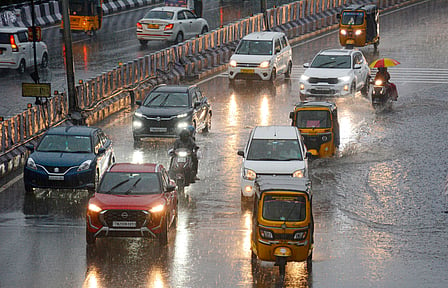
A low-pressure area (cyclonic circulation) formed over the southwest Bay of Bengal on Wednesday. Following this, another cyclonic circulation is likely to form over the southeast Bay of Bengal and the central Bay of Bengal on Friday (Oct. 23). This may gradually intensify and turn into a cyclone, said V.R. Durai, head of the southern region of the India Meteorological Department.
Speaking to reporters in Chennai on Wednesday about this, he said: A low-pressure area (cyclonic circulation) formed over the southwest Bay of Bengal and parts of southern Tamil Nadu at around 5 a.m. on Wednesday. This cyclonic circulation is weak. There is currently no favorable environment for it to intensify further.
However, due to its impact, there is a possibility of heavy to very heavy rain in Tamil Nadu on Oct. 26. In particular, on Thursday (Oct. 22), there is a possibility of very heavy rain (105 mm - 204 mm) accompanied by thunder, lightning, and strong winds in 17 districts—Thoothukudi, Tirunelveli, Kanyakumari, Tenkasi, Virudhunagar, Ramanathapuram, Theni, Dindigul, Madurai, Coimbatore, Nilgiris, Sivaganga, Pudukkottai, Thanjavur, Tiruvarur, Nagapattinam, and Mayiladuthurai—as well as in the Karaikal region. An orange alert has therefore been issued for these districts.
Also, there is a possibility of heavy rain in other districts of Tamil Nadu and in Puducherry. Likewise, strong winds may blow over the coastal areas of Tamil Nadu, so fishermen should avoid going out to sea for fishing in the coming days.
Rainfall will increase: Meanwhile, the storm system that formed in the southwestern Arabian Sea may move west-northwestward and head toward the Somalia coast. When the sea surface temperature of the Arabian Sea is higher than normal, the northeast wind speed will be stronger. As a result, rainfall will be heavier in the Western Ghats region. That is why, unusually, heavy rain is currently being experienced in Western Ghats districts including Coimbatore and Nilgiris. Similarly, due to the ‘super El Niño’ phenomenon, rainfall during this year’s northeast monsoon season will be higher than normal. In that sense, rainfall in November will be above normal. However, there is no chance that the monsoon season will be prolonged because of El Niño.
Chance of becoming a cyclone: Another cyclonic system is likely to form over the southeast Bay of Bengal and the central Bay of Bengal on Friday (Oct. 23). It may intensify and move west-southwestward. Since there is a possibility that this cyclonic system could strengthen further, it may turn into a cyclone. For now, this system is not expected to cause major impact to Tamil Nadu. However, the weather situation is being continuously monitored. He said that further announcements regarding this cyclone will be released soon.
Rainfall: In Tamil Nadu, during the past 24 hours until 8.30 a.m. on Wednesday, the highest rainfall of 130 mm was recorded in areas including MGR Nagar, Vadapalani, Saidapet, Airport, Alandur in Chennai district, and Kolapakkam in Kanchipuram district. The Chennai Meteorological Centre said in a press release issued on Wednesday that 120 mm of rain was recorded in Meenambakkam, DGP Office, Madipakkam, Valasaravakkam, Maduravoyal (Chennai), and Kulachal (Kanyakumari); 110 mm in Nerkundram, Nungambakkam, and Adyar (Chennai); and 100 mm in Korattur (Chennai), Azhiyur (Coimbatore), and Uthirakosamangai (Ramanathapuram).
‘The cyclone will be named “Murasu”’
With the possibility of a cyclone forming in the Bay of Bengal, it may be named “Murasu,” the Tamil word recommended by India.
The India Meteorological Department is responsible for naming cyclones that form in the Bay of Bengal and the Arabian Sea in the northern part of the Indian Ocean. Thirteen countries—Bangladesh, India, Iran, Maldives, Myanmar, Oman, Pakistan, Qatar, Saudi Arabia, Sri Lanka, Thailand, the United Arab Emirates, and Yemen—jointly create the list of cyclone names. The names recommended by each country are used in order.
In this situation, the weather department has said that the low-pressure system forming over the southeast Bay of Bengal and the central Bay of Bengal on Friday (Oct. 23) is likely to intensify into a cyclone and move toward Tamil Nadu. Accordingly, if this system turns into a cyclone, it will be named “Murasu,” the Tamil word recommended by India.
In ancient times, the murasu was a traditional leather percussion instrument used by kings to widely announce their messages, proclamations, and declarations of war to the people. Since it served as a means of spreading information, it was also used to warn people during natural disasters and emergencies. It is noteworthy that, along with the scepter and the flag, the murasu was one of the king’s important symbols.