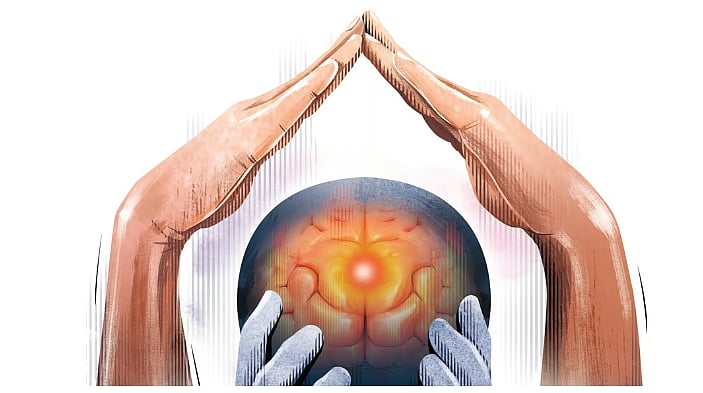
Among non-communicable diseases, the one that causes the most severe impact and can bring a person’s entire way of life to a standstill is stroke. The severity of this disease lies in its highest risk: it can disable a healthy, normal person and affect the body’s movement.
The human brain contains 90 billion neuron cells. These neuron cells are the foundation of the body’s movement. When there is a blockage in the blood vessels leading to the brain, the number of neuron cells decreases. At that time, problems such as paralysis of the hands and legs, dizziness, and slurred speech may occur.
The days when a person who suffered a stroke would live the rest of their life with one side of the body, arms, and legs paralyzed have changed. Now, with modern medicine, if a person affected by a stroke reaches the hospital within that golden time, there are possibilities of curing the stroke itself through advanced treatments.
After a stroke occurs, the golden time is important. Although a stroke happens suddenly, it shows warning signs in advance. Patients have also reported noticing some symptoms as early as a month before. But because they are not severe, many people fail to pay attention to them.
It is far better to protect yourself before illness strikes than to seek treatment after it has come.
Stroke can be prevented by recognizing the symptoms.
Key symptoms
Facial drooping or sudden weakness on one side of the body
Difficulty speaking or understanding
Vision problems in one eye
Unsteadiness while standing and walking
These are the key symptoms
Many people who have had a stroke and are recovering have said that they had some signs in their body movements as early as a month before. The symptoms vary from person to person.
Those symptoms...
Severe headache
An unexplained severe headache, especially one that is more intense than a usual headache.
A headache that does not improve with medication and lasts a long time
Some people also have vision problems or a feeling of nausea along with the headache.
Changes in vision
Blurred or double vision
Sudden loss of vision in one or both eyes
Difficulty focusing on an object
Weakness
Numbness in part of the body or face
A sudden weakness in the body — weakness and numbness that appear suddenly and then disappear, as if indicating a blockage in the flow of blood to the brain.
Difficulty speaking
Difficulty starting and finishing a sentence.
Stammering or speech becoming blocked
Difficulty recalling words used in everyday life
Unsteadiness
Unsteadiness, as if about to fall while standing
Weakness and inability to walk straight.
Suddenly falling down, bumping into objects in front of you
Memory impairment
Struggling to recall common words
Being unable to remember people's names
Being unable to engage in ordinary conversations
Mood changes
Sudden anger and stress
Losing interest even in simple tasks
Dizziness
Feeling tired even after getting enough sleep and rest.
Lack of energy, appearing unwilling to do tasks
If these symptoms appear, immediately consult a neurologist or a hospital that treats stroke. Blood tests, scans, and other examinations will be done, and if there is a possibility of stroke, it is essential to begin the appropriate treatment immediately.
Transient stroke
If stroke symptoms go away on their own within a few minutes, it is called a transient stroke or a "mini-stroke." Doctors say that although it may not cause major damage, it can also be a sign of an impending severe stroke.
Therefore, even if a transient stroke occurs, it is essential to consult a doctor immediately.
October 29 - World Stroke Awareness Day