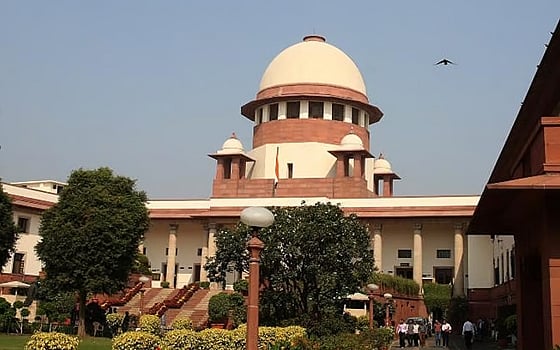
Under the old tax regime, the Supreme Court on Wednesday ruled that the 1974 judgment that upheld the states’ power to levy additional sales tax is valid.
It was also noted in the judgment that the legal framework related to taxation has been completely changed through the implementation of the Goods and Services Tax (GST) in 2017; therefore, the present case has become infructuous.
In the 1974 case of businessman S. Kodar v. State of Kerala, a Constitution Bench of five Supreme Court judges delivered an important judgment. It affirmed that, under the Constitution, state governments have the authority to impose an additional tax or surcharge on the regular sales tax levied on traders.
The traders’ arguments that ‘imposing an additional tax or surcharge on an existing sales tax amounts to a tax on our income. Only Parliament can enact such a tax law; state legislatures have no authority’ were rejected by this judgment.
Meanwhile, in 1999, the Odisha government brought in an amendment to the law. Under it, an additional tax of 10 percent was imposed on traders with annual income ranging from Rs. 10 lakh to Rs. 1 crore, and 15 percent on traders with income above Rs. 1 crore.
Against this, a case was filed in the Supreme Court on behalf of the traders. The traders raised the questions: ‘Do state legislatures have the authority under Entry 54 in List II of the Seventh Schedule of the Constitution to levy tax on the sale or purchase of goods? Does this additional tax amount to a tax on income, which falls under Parliament’s jurisdiction under Entry 82 of List I?’
It was also argued that there were conflicting interpretations in the judgments delivered by the Supreme Court in various cases, including the S. Kodar case. Following this, the question of whether states have the authority to impose an additional tax or surcharge on sales tax was referred to a larger bench for examination.
Judgment by a 7-judge bench: In this context, a Constitution Bench comprising 7 judges — Chief Justice Surya Kant, K.V. Viswanathan, S.V.N. Bhatti, Jaya Malya Bagchi, N.V. Anjaria, Arun Palli, and V. Mohana — delivered a unanimous judgment on Wednesday. Surya Kant authored the judgment on behalf of the other judges, except K.V. Viswanathan. Agreeing with his fellow judges, K.V. Viswanathan wrote a separate judgment.
In those judgments, the ruling that “the additional tax calculated on the basis of the sales tax payable to the government is nothing but an increase in the sales tax rate, and it is not a tax on the trader’s income; therefore, the ruling from 1974 that state governments have the authority to impose additional sales tax or surcharge remains valid” continues to be valid.
Useless case: At the same time, with the implementation of the Goods and Services Tax (GST) in 2017, the legal framework related to taxation has been completely transformed; several provisions that were opposed by traders have been changed or amended. Therefore, examining the question recommended to the larger bench 27 years ago has become practically useless,” it was stated.
Earlier, during the hearing held last September, Solicitor General Tushar Mehta, appearing for the central government, said that following the implementation of GST in 2017, this dispute had largely been resolved; only a very few issues remain pending.