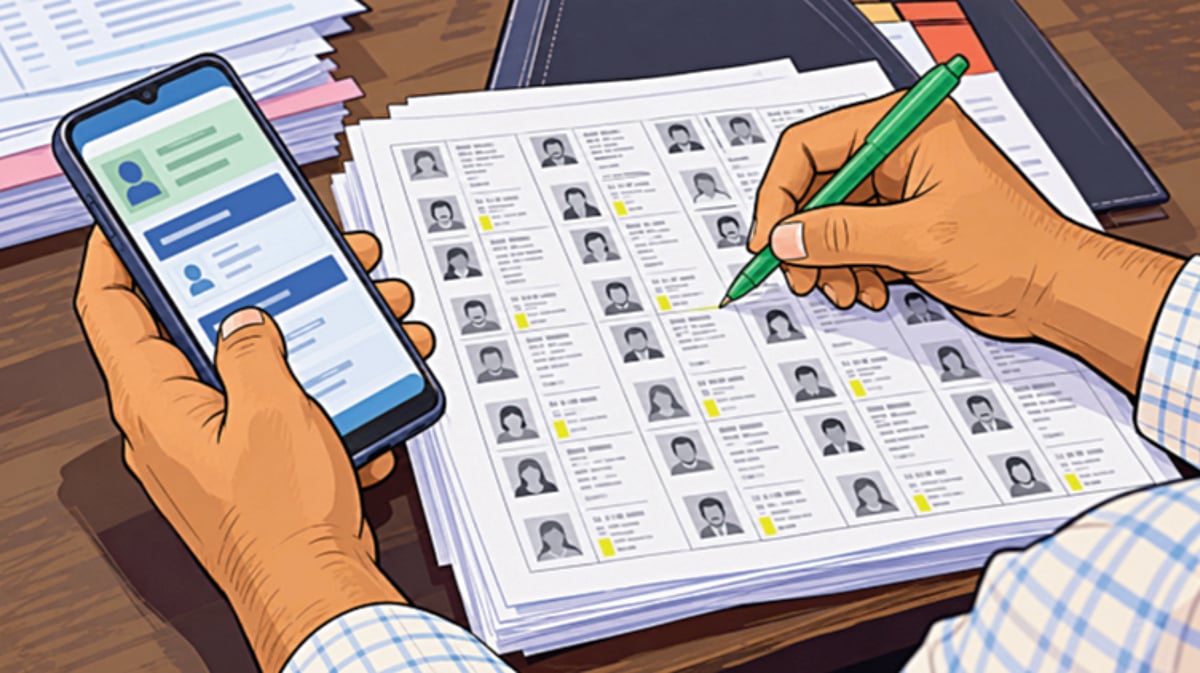
New Delhi: The Election Commission of India has ordered a Special Summary Revision (SSR) to be carried out in 17 states and union territories, including Tamil Nadu, to include new voters and those left out in the SIR.
Special intensive revision work of the voter list (SIR) is being carried out across the country in various phases. Opposition parties have been continuously alleging that there are various irregularities and malpractice in this, and that 130 million voters have been removed. India alliance parties and the Karappan Poochi Janata Party (CJP) have been holding continuous protests, demanding that Chief Election Commissioner Gyanesh Kumar resign, taking responsibility for these irregularities.
India Alliance leaders have not only submitted a petition to President Droupadi Murmu, but have also filed a case in the Supreme Court. When this petition, filed on behalf of Lok Sabha Opposition Leader Rahul Gandhi, came up for hearing yesterday, the Supreme Court ordered the Election Commission to provide an appropriate response.
Amid these controversies, as a new development yesterday, the Election Commission of India has ordered a Special Summary Revision (SSR) to be carried out in 17 states and Union Territories, including Tamil Nadu, to include new voters and those left out in the SIR. The details are as follows;
>> The special summary revision is to be conducted in 17 states, including Tamil Nadu, West Bengal, Uttar Pradesh, Punjab, and Bihar, as well as Union Territories. January 1, 2027 has been fixed as the eligibility date for those who are to be included in this.
>> Polling stations will be reorganized by November 2. The draft electoral roll will be published on November 12. Claims and objections may be filed from November 12 to December 11. A decision on these must be made by December 28. The final electoral roll will be published on January 4, 2027. Along with claims for the qualifying date of January 1, 2027, election registration officers will also accept advance applications for the three subsequent qualifying dates of April 1, July 1, and October 1, 2027.
>> Those who need to have their names added must apply using Form 6.
>> If more than 2 percent of the total voters are proposed for deletion, the election registration officers must verify them directly. No polling station should have more than 1,200 voters. Voters should not have to travel more than two kilometers or cross natural barriers, and polling stations must be located on the ground floor.
>> Families with the same door number or the same apartment number should not be split into different divisions or polling stations.
>> Even if a single person has submitted more than five objections, the election registration officers must examine them separately. In each deletion case, only after giving the concerned person an opportunity to explain should the election registration officers issue a reasoned order. That order must be uploaded on the Election Commission’s website.
>> The lists relating to the requests and objections received must be published every week on the websites of the Chief Electoral Officers. They must also be provided to political parties.
>> This SSR process is set to be conducted in 14 states—Tamil Nadu, Assam, Bihar, Chhattisgarh, Goa, Gujarat, Kerala, Madhya Pradesh, Manipur, Punjab, Rajasthan, Uttar Pradesh, Uttarakhand, and West Bengal—as well as in 3 Union Territories—Andaman and Nicobar Islands, Lakshadweep, and Puducherry.
>> Since SIR is being conducted or has recently been completed in Andhra Pradesh, Arunachal Pradesh, Chandigarh, Dadra and Nagar Haveli, Daman and Diu, Haryana, Jharkhand, Karnataka, Maharashtra, Meghalaya, Mizoram, Nagaland, Delhi, Odisha, Sikkim, Tripura, and Telangana, the SSR schedule for those regions will be announced later.
>> Since SIR has not yet been launched in the regions of Himachal Pradesh, Jammu and Kashmir, and Ladakh, the voter list revision schedule for those areas will be issued later, taking into account the weather conditions there. This is what the order states.
What is the difference between SIR and SSR?
SSR (Special Summary Revision) is a process that is completely different from the ‘Special Intensive Revision’ (SIR), which has been the subject of political and legal controversy. In the SIR process, the voter list is newly reorganized. But in SSR, only the necessary corrections are made to the existing list. SSR is something that should be conducted every year. The schedule for its previous cycle was released on August 7, 2024. Its final voter lists were released between January 6 and 10, 2025.