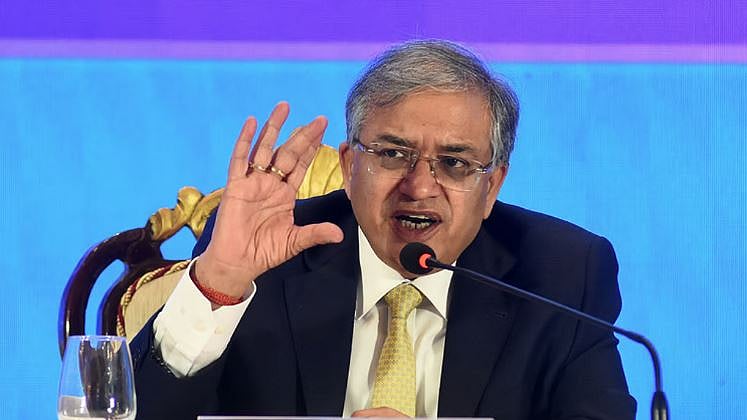
Despite the objections of the two Election Commissioners, the Chief Election Commissioner did not unilaterally take decisions related to the Special Intensive Revision (SIR) of the voters’ list; all decisions were taken unanimously, the Election Commission has filed an affidavit in the Supreme Court.
An English newspaper reported that there was a sharp difference of opinion between Chief Election Commissioner Gyanesh Kumar and Election Commissioners Sukhbir Singh Sandhu and Vivek Joshi in the SIR matter. The newspaper said that Gyanesh Kumar had unilaterally taken several important decisions related to the SIR.
In this matter, in the petition filed by Rakeshkumar Singh in the Supreme Court, it is stated that under the Chief Election Commissioner and Other Election Commissioners (Appointment, Conditions of Service and Term of Office) Act, 2023, the work of the Election Commission should, as far as possible, be carried out by consensus. If there is any difference of opinion between the Chief Election Commissioner and the Election Commissioners on any matter, the decision on that matter should be taken on the basis of what the majority says.
Under Article 324 of the Constitution, the Election Commission, as a body, has been vested with the power to take decisions collectively. What authority does the Election Commissioner have to exercise this power independently? It was requested that the Chief Election Commissioner be directed to explain on what authority he is acting in that manner.
In the affidavit filed in the Supreme Court by Deputy Election Commissioner Bhanu Prakash Yeduru in response to this petition, it is stated that despite the objections of the two Election Commissioners, the Chief Election Commissioner did not unilaterally take decisions related to SIR. All decisions related to SIR were taken unanimously.
When a file is under consideration, the notes, questions, and suggestions recorded on it by the Chief Election Commissioner or the Election Commissioners do not by themselves become the decision of the Election Commission.
A file is first sent to an Election Commissioner. Then, it is sent to another Commissioner, and finally it is sent to the Chief Election Commissioner. This is the procedure for making decisions.
Decisions taken in accordance with the law...
Decisions related to SIR were taken only under Section 18 of the Chief Election Commissioner and Other Election Commissioners (Appointment, Conditions of Service and Term of Office) Act, 2023.
It was reported that both Election Commissioners objected to the change requiring, in Form 6 to be filled out for registering as a new voter, details on whether the person’s parent or grandparent’s name had appeared in the previous SIR.
Authority lies only with the Central Government
In fact, through its SIR orders, the Election Commission did not change that form. Under the Voter Registration Rules of 1960, only the Central Government has the authority to make changes to that form.
Because of the way the affidavit section was displayed in the online application, it may appear that Form 6 was changed. Since Oct. 21, it has been split into two sections: Form 6 and the SIR affidavit.
If the voter’s details cannot be matched by comparing them with the previous electoral roll, they do not usually need to come in person for that purpose.
Booth-level officers will collect the required documents from their homes and upload them on the ECINet platform for the Electoral Registration Officer’s (ERO) review.
Except during the times when the ERO issues orders, no person’s name can be added to or removed from the ECINet platform at other times.
Not suitable for hearing
This petition has been filed entirely on the basis of a news item published in a newspaper. The petitioner has not verified those facts through the Election Commission. Therefore, it has been stated that this petition is not suitable for hearing.