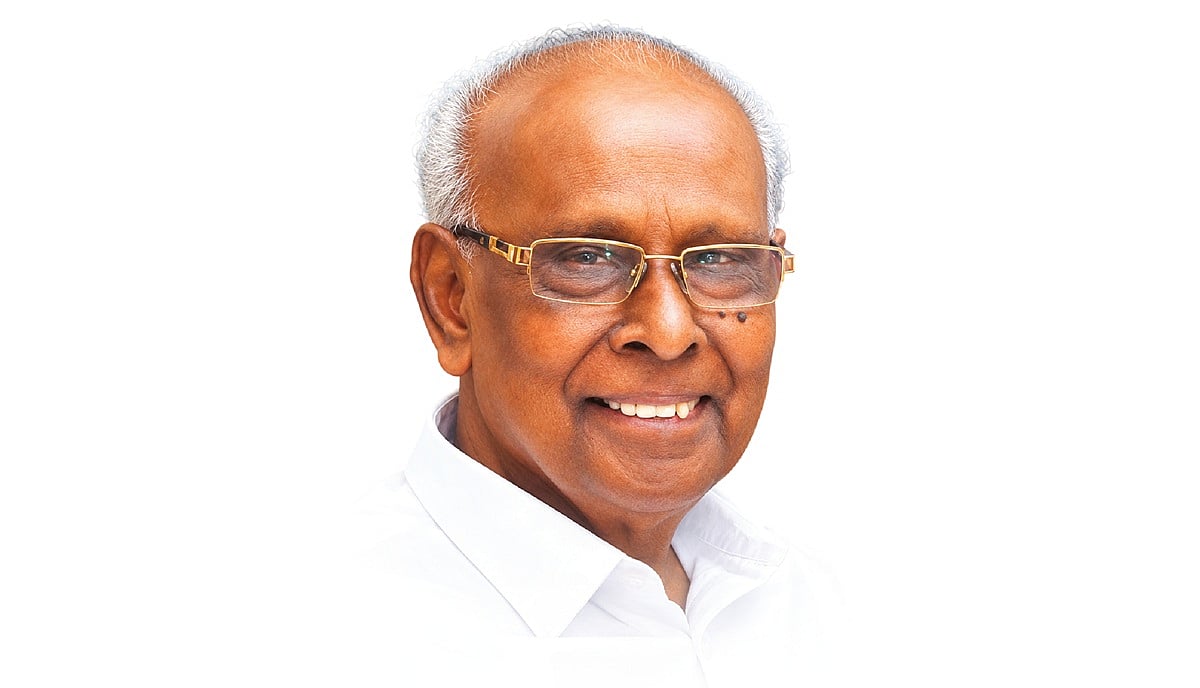
Solomon Papaiya, who lived for 90 years, devoted his entire life to the Tamil language, Tamil literature, and Tamil social thought. A scholar, Tamil elder, and recipient of awards including the Padma Shri and Kalaimamani, Solomon Papaiya was deeply devoted to Mahakavi Bharathiyar. His passing on September 11, the memorial day of Bharathi, leaves us deeply saddened.
As we remember his fame and greatness, I must also mention my own connection with him. When I was a child, I went with my father and sat on the floor to listen to his speech. Later, while studying at Madurai American College, I won second place in the intercollegiate speech competition and received the prize from his hands.
Later on, I also got the opportunity to speak on the same team as him at debate forums. Not only did I have the honor of speaking with him on debate stages, but when the North American Tamil Sangam Federation (FeTNA) invited him to the United States in 2003, I went along with him as well. I had the rare opportunity to travel with him for four weeks.
During those days, we took turns speaking on stage and received an enthusiastic welcome from large crowds. Even during night journeys there and in the hotel rooms where we rested, he would wonderfully sing Bharathiyar’s songs. He also naturally had a special talent for singing songs.
He is not only an orator, but also an excellent writer. He has written the biography of Pattukkottai Kalyanasundaram. In it, he has also drawn the portrait of Pattukkottaiyar, suitable for the cover. His handwriting is as beautiful as print. He has written many books, including commentaries on the Tirukkural and the Purananuru.
In those days, one had to travel to the pattimandram only by bus. He would gather everyone in the group, take them by bus, wait for the bus again after the pattimandram ended, and return to Madurai only at dawn. Even so, he would never fail to go to his college duties in the morning. Those times I traveled with him gave me wonderful experiences. Everyone who spoke with him in the pattimandrams emerged as a person of unique individuality.
I also remember another incident involving him with gratitude. The first time I brought Sir to our town to speak at a public forum, the event organizers paid everyone, including Sir, but not me. They said, “He is from our town; we’ll give him many more opportunities.” To that, Sir smiled and said, “He is indeed a boy from your town, and you can certainly give him many opportunities; that’s fine. But doesn’t he have to live? Don’t you need to make arrangements for that? So, just as you give him opportunities, please also provide proper financial support.”
When the villagers hesitated a little, sir did not hesitate; he took a portion from the amount given to him and gave it to me, saying, “Brother, keep it... you will do well!” and blessed me wholeheartedly. Even today, I remember that blessing with great joy, and with emotion I think that all the earnings I have made in my life have come only through the power of his blessing. He was a man with the broad-mindedness to want others to live well.
Rather than confining the stage to a literary event within a limited boundary, Solomon Pappaiya’s contribution was immense in taking it from Pattimandram to audiences across the world. His distinctive speaking style, which prompted people to think with humor, has served as an excellent guide for many generations of speakers to come.
Although he received many of the highest honors from the central and state governments, he regarded the love of ordinary people who praised him as the greatest recognition. He was one who strongly voiced the humanistic idea that people should look at everyone equally, transcending differences of religion, caste, and economic status.