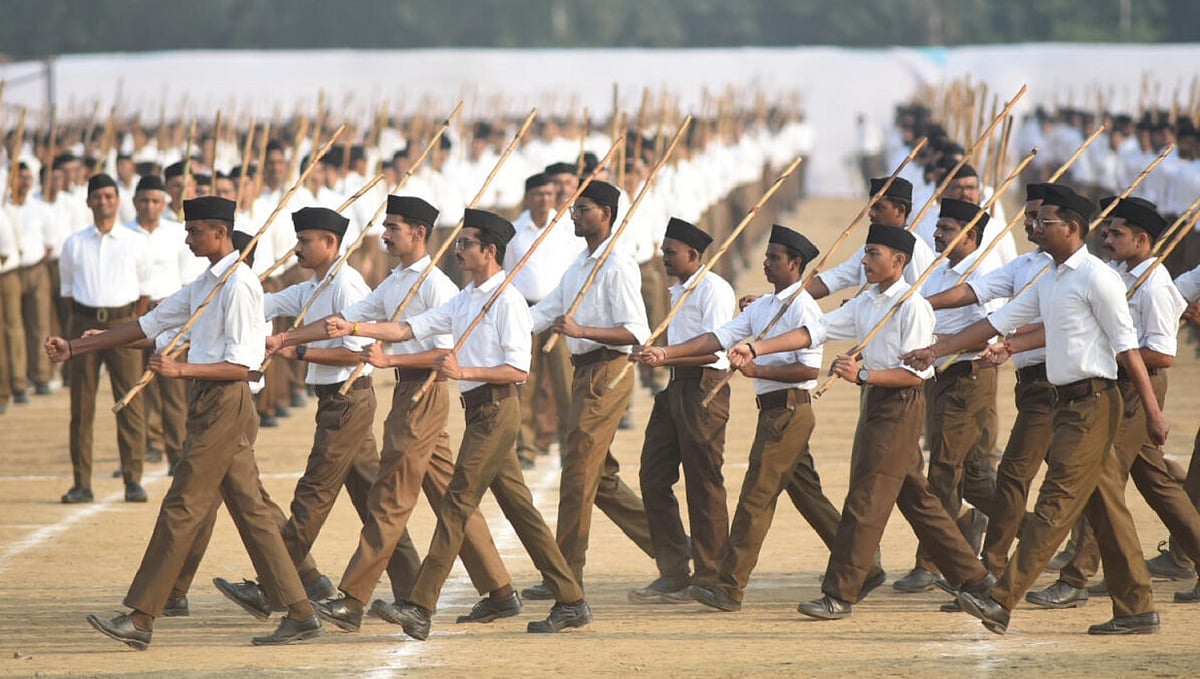
Founded with the motto, “Patriotism, self-discipline, and social service are the strength of the nation,” the Rashtriya Swayamsevak Sangh (RSS) has reached a remarkable height in its 101st year.
RSS members take pride in saying that it has broken away from its early image as an “organization for Hindus” and has evolved into a “movement for everyone” — one that reaches out first in times of disaster, rises above caste divisions, and today stands hand in hand with people of other religions as well.
The seed sown in a small ground in Nagpur in 1925 has today grown into a towering banyan tree. The RSS was founded on Vijayadashami in 1925 in Nagpur, Maharashtra, by Dr. Keshav Baliram Hedgewar.
Challenges and perceptions over the years
The RSS is widely perceived, even among secular people and minorities, as an organization that operates within a specific cultural boundary and as a communal organization. Because of this, the organization has faced numerous challenges over the past century.
During the country’s times of disaster, especially during national calamities such as floods and earthquakes, RSS volunteers have been among the first to carry out field work, transcending caste and religious boundaries. The organization’s members say that the reality is that RSS has brought about a positive change in people’s perception over the past quarter century.
Today, RSS has grown into one of the country’s most important socio-political forces. It currently conducts 88,949 daily ‘shakhas’ in 55,683 locations.
The organization’s structural work in education, healthcare, tribal development, and rural development is also undeniable. In 100 years, the RSS has faced bans three times. Although it has been criticized by various quarters, the debate still remains in the public sphere today over whether it has gone beyond that to become a national movement that includes all sections of society.
Origin and purpose
Hedgewar was a supporter of Bal Gangadhar Tilak and a political disciple of B. S. Moonje. He joined the British anti-revolutionary group ‘Anushilan Samiti’ as a member and became associated with it. It was the secret operational methods of this organization that he later used to create the RSS.
After reading Vinayak Damodar Savarkar’s book ‘Essentials of Hindutva,’ Hedgewar became deeply inspired. After meeting Savarkar in person at Ratnagiri prison in 1925, he founded the RSS with the aim of ‘strengthening’ the Hindu community.
Hedgewar believed that during British rule, Indian society was fragmented and lacked self-discipline and unity. The RSS was founded not only to oppose British domination, but also to train Indians—especially Hindus—in physical fitness, mental strength, patriotism, and discipline, and to build a strong national community.
Hedgewar’s most important innovation was the ‘Shakha’. It is a regular training session that includes physical exercises, drills, ideological classes, and collective activities.
The freedom struggle, difficult times
In its early years, the RSS organization was accused by the Congress and secularists of isolating itself from the freedom struggle. After independence, following the assassination of Mahatma Gandhi by Nathuram Godse, and the accusation that the RSS organization had an indirect connection to the killing, the organization was banned and later cleared of wrongdoing, but it left an unhealed scar on the organization.
During the Emergency in 1975, when the Babri Masjid was demolished in 1992, and during the Gujarat riots in 2002, the RSS faced allegations of being complicit in inciting communal violence, and bans were imposed on it.
Social work and changing dimensions
To reduce the RSS to merely an intolerant communal organization is to ignore its broad and multifaceted social contributions. The organization’s supporters strongly argue that RSS volunteers played a major role in protecting and rehabilitating refugees during the Partition riots.
Vidya Bharati schools and its educational initiatives through Ekal Vidyalaya—such as promoting literacy among tribal communities, organizing health camps, and setting up blood donation camps to serve the people—have been praised.
Over the past quarter century, public perception of the RSS has changed. Under the organization’s chief, Mohan Bhagwat, the RSS adopted a notably softer tone and publicly affirmed the place of Islam in India. His statement, “Islam came to India and will remain in India,” was reassuring.
Moreover, as a warning to hardline religious extremists, his insistence that “stop searching for a Shivling under every mosque” is a notable shift.
In particular, when RSS chief Mohan Bhagwat visited the United States in August 2025, he said while speaking, “Excluding Muslims is contrary to India.”
The RSS insists that the term “Hindu Rashtra” should be toned down and that it should instead be a civilizational ethos that includes everyone. Congress and secularists criticize Mohan Bhagwat’s speech as a highly strategic attempt to make everyone accept Hindutva.
The Perspective of the Next Generation
“The majority of young people under the age of 35 in India will judge the RSS based on its actions. Setting aside RSS chief Mohan Bhagwat’s moderate rhetoric, some people engage in violence and hatred in the name of Hindutva.
If Mohan Bhagwat’s words are true, this generation expects them to be put into practice. Otherwise, young people may come to their own conclusions. A movement that prides itself on shaping the virtues of India’s youth may lose credibility with the younger generation that will determine its second century,’ say social and political observers.