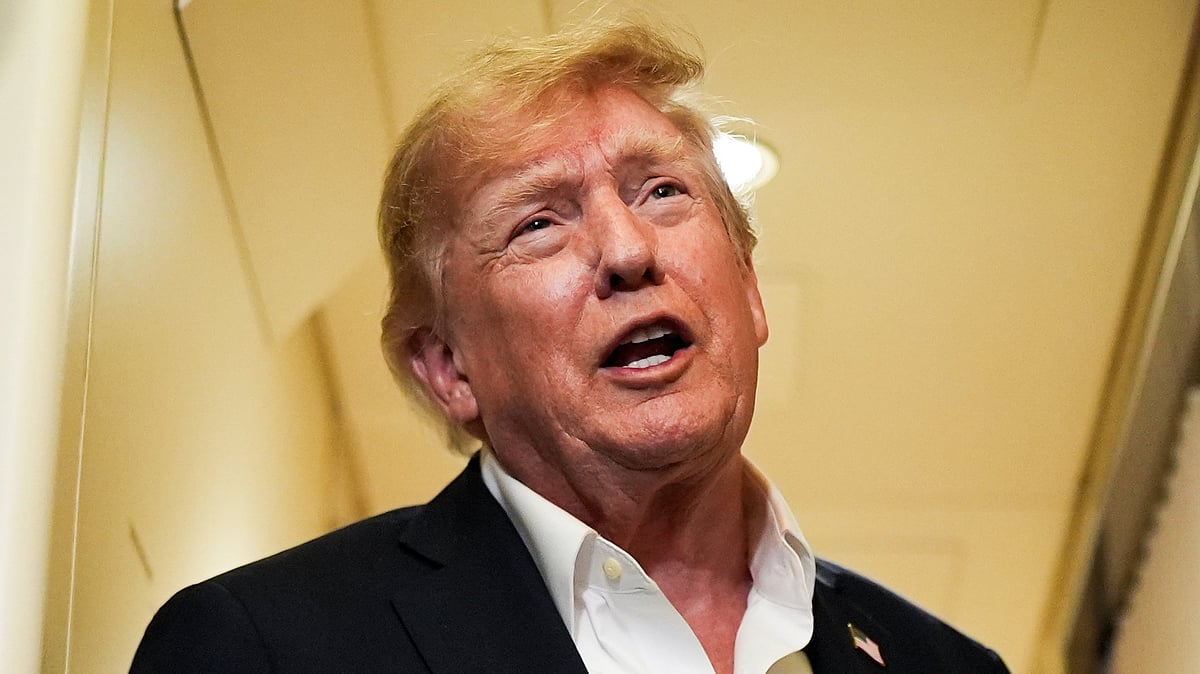
Washington: U.S. President Donald Trump has announced the cancellation of the restrictions and tariffs imposed on oil and gas purchases under the 'Russia and Iran Sanctions Act.' He noted that this decision was taken in view of the United States' 'national interest.'
The upper house of the U.S. Parliament (Senate) approved a bill to impose a 100 percent tariff on countries including India and China that purchase Russian crude oil.
This law was announced to come into effect from Oct. 18. As a result, allegations arose that countries including India and China, which buy crude oil from Russia, would be affected the most.
In this situation, U.S. President Donald Trump has announced the отменation of the restrictions and tariffs imposed on oil and gas purchases under the 'Russia and Iran Sanctions Act.' He noted that this decision was taken in consideration of America's 'national interest.'
In the executive order issued on Friday evening, Trump said that the such sanctions, restrictions, and tariffs specified in the "Lindsey Graham" law are hereby being removed.
Trump also said that granting such an exemption in the current situation is in the national interest of the United States.
That is, since it would be contradictory for the United States to buy diesel from Russia and then impose a 100 percent tariff on countries like India and China on the grounds that they buy crude oil from Russia, he has temporarily suspended the previously announced 100 percent tariffs to be imposed under the 'Lindsey O. Graham' law on countries that buy crude oil from Russia.
Behind this, it is also seen as an effort to reduce fuel prices in the United States. This will also be a temporary benefit for India.
That is, the changes in oil prices over the next few days and the United States’ next-stage trade policies will determine whether long-term benefits can be achieved.
Under the 'Lindsey O. Graham Russia and Iran Sanctions Act,' the upper house of the U.S. Congress (the Senate) authorized Trump to impose severe sanctions on Russia and to levy higher tariffs on the world’s largest buyers of Russian oil and gas, including China and India. It is noteworthy that the sanctions also included certain companies and individuals associated with Russia.