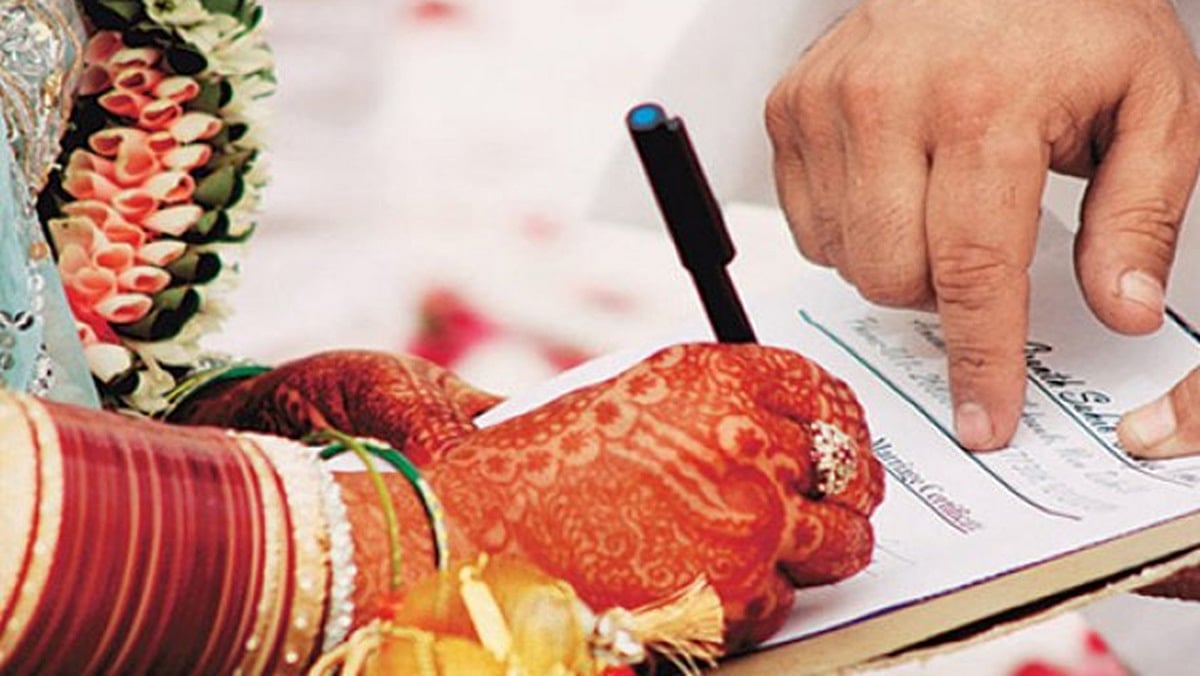
Chennai: “Registering the marriage of people belonging to two different religions under the Hindu Marriage Act is not legally valid,” have ruled judges of the Madras High Court.
A marriage between a woman belonging to the Hindu religion and a young man belonging to the Christian religion was solemnized in Chennai on Feb. 20, 2009, and has been registered at a sub-registrar’s office under the Hindu Marriage Act.
However, claiming that the marriage was conducted by deceiving him and against his will, and that since he is a Christian the marriage is invalid under the Hindu Marriage Act, the young man concerned filed a case in the Chennai Family Court.
After the Family Court dismissed the case, he appealed against it in the Madras High Court. The case was heard by a bench comprising Judges C.V. Karthikeyan and S. Ravikumar.
The order issued by the judges at that time was as follows: The Family Court refused to accept the young man’s claim that he had married, and that the petitioner, who belongs to the Christian faith, had documents showing that he was baptized in 1998 and 2006.
It is customary for a person who is already a Christian to be baptized again when joining another Christian church. According to Section 5 of the Hindu Marriage Act, both the husband and wife who marry must be Hindus.
Accordingly, when people belonging to two different religions marry, if the marriage is registered under the Hindu Marriage Act, it is not legally valid. Furthermore, Section 7-A, which recognizes self-respect marriages conducted in Tamil Nadu, does not apply to such marriages.
Even in a self-respect marriage, both parties must be Hindus. The sub-registrars must verify the authenticity of the details provided at the time of marriage registration.
If a Hindu and a Christian wish to marry, they must follow the legal procedures applicable to such marriages under the Indian Christian Marriage Act and the Special Marriage Act.
In this case, it is distressing that the marriage was declared invalid only after about 16 years from the date it was registered.
To prevent such problems from arising in the future, they ordered the High Court registry and the Tamil Nadu government to issue this judgment as a circular to all sub-registrars and family courts across Tamil Nadu.
They also declared the petitioner’s marriage registration invalid under the law and ordered the family court’s judgment to be set aside.