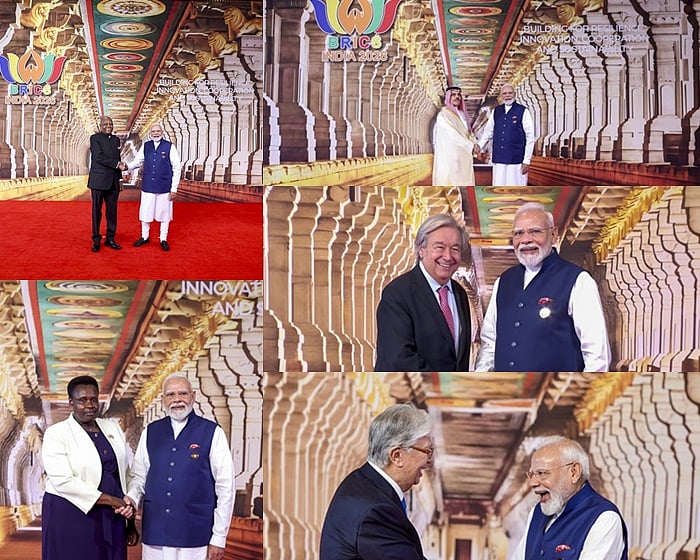
A summit of an international BRICS organization where leaders of the world’s nations gather in one place. In the backdrop of that conference, a grand stone-palace-like sight that amazes the whole world.
Long rows of pillars... intricate sculptural work on them... a view that seems to continue endlessly, so much so that if you stand at one end and look, you can’t even tell where the other end finishes...
It is nothing else...
The famous corridor of the Rameswaram Ramanathaswamy Temple, which showcases the architectural pride of the Tamils to the world!
The fact that this corridor is featured in the backdrop of Prime Minister Narendra Modi welcoming world leaders at the 2026 BRICS summit has now drawn everyone’s attention internationally. But behind this grandeur lies a history that is several centuries old...
The stone palace that stretches on endlessly!
When entering the Rameswaram Ramanathaswamy Temple, what first amazes devotees are its magnificent corridors. In particular, the outer corridor known as the third prakaram is unique.
About 1,212 pillars... each pillar is about 9 meters tall... when viewed from one end, with all those pillars arranged continuously in a straight line, it creates an illusion as if the pillars stretch on as far as the eye can see.
When one pillar ends, another pillar... and behind it, yet another pillar... as this scene continues, one wonders whether this is a walkway or an endless stone palace. This is the unique charm of the Rameswaram Corridor.
Behind a thousand pillars lies a history!
This grandeur was not created in a single day. The Ramanathaswamy Temple is not a temple built by a single king in a single period.
Over several centuries, the temple gradually expanded through the contributions of many rulers, including the Pandya kings and the Sethupathi kings.
In that history, the credit for creating this magnificent third corridor of Rameswaram goes to the Sethupathi kings.
Historical studies note that this corridor was built during the reign of Rebel Muthuramalinga Sethupathi in the 18th century.
This corridor, laid out to connect the four gateway towers, has raised platforms on both sides, on which thousands of pillars have been erected. Sculptural forms resembling lions seated atop the pillars can also be seen. The influence of the Vijayanagara kings’ architectural style can also be seen in these pillars.
Do you know how big it is?
If you put the grandeur of this corridor into numbers, it becomes even more astonishing. Adding together the temple’s various corridors, their total length is about 3,850 feet. That is, about 1.17 kilometers!
The four sides of the third prakaram stretch out for hundreds of meters.
Stone at every step...
Art in every stone...
A history in every pillar...
That is why the Rameswaram corridor is considered one of the largest temple prakarams in the world.
Not just a walkway!
A praharam cannot be thought of as merely a path that runs around a temple. These praharams are important for devotees to have darshan of the deity, to circumambulate the temple, for processions of the festival deities, and for various rituals and festival events.
In Rameswaram, that tradition has taken on a grand architectural form.
So here, it is not just architecture...
There is sculpture...
There is a tradition of worship...
There is a festival heritage... What makes the Rameswaram corridor unique is the coming together of all these elements.
Moreover, it is noteworthy that its ground-floor layout is designed in the shape of a chessboard.
A special place in spirituality too!
Not only in architecture... Rameswaram is also a world-famous pilgrimage destination in spiritual terms.
The Ramanathaswamy Temple, regarded as one of the 12 Jyotirlinga shrines, is also one of the important Char Dham pilgrimage sites of Hinduism.
Various beliefs associated with the Ramayana tradition are also intertwined with this sacred place.
The 22 theerthams in the temple are considered an important part of the Rameswaram pilgrimage.
Therefore, for devotees who come here, this is not just a temple...
History... spirituality... and architecture... all converging in one place.
The same sight that captivated world leaders in 2019!
This corridor in Rameswaram has not gained international attention for the first time now.
When Prime Minister Narendra Modi and Chinese President Xi Jinping met in Tamil Nadu in 2019, the Rameswaram temple corridor visuals drew international attention as a reflection of Tamil Nadu’s heritage.
At that time, Tamil Nadu’s thousand-year-old architecture became part of the backdrop to an important moment in world politics.
2026... Rameswaram returns to the world stage!
Time has passed... but the grandeur of that scene has not faded.
At the 2026 BRICS Summit, the same Rameswaram corridor has once again been showcased on the world stage.
In the backdrop of the scene where Prime Minister Modi welcomes world leaders, the magnificent pillars of the Ramanathaswamy Temple are featured.
In a way...
Rameswaram, which stood witness to the meeting of world leaders in 2019, has in 2026 become India’s cultural symbol for welcoming world leaders! The pride of Tamils on the world stage!
This scene has once again sparked a debate about Tamil Nadu’s traditional architecture.
Tamilisai Soundararajan, in her X post, noted that the corridor of the Rameswaram temple is not merely an architectural wonder, but also a symbol of Tamil Nadu’s deep spiritual heritage and the excellence of Tamil temple architecture.
She also said that this scene being featured in the presence of world leaders showcases Tamil culture and Tamil Nadu’s spiritual heritage on the global stage.
Tamil Nadu Governor Rajendra Vishwanath Arlekar also said that it is commendable that the Prime Minister is highlighting India’s ancient civilizational heritage on the world stage.
Tradition is our strength!
Centuries ago, that magnificent structure built with stone...
That temple of art, raised by more than a thousand pillars...
Today stands as India’s cultural identity before the leaders of nations around the world.
Time may change... governments may change... generations may change... but art carved in stone will endure beyond time.
A living testament to that... the endless corridor of the Rameswaram Ramanathaswamy Temple!
This stone palace, standing tall for centuries as proof of the architectural skill of Tamils...
Standing in the backdrop of the scene welcoming world leaders to BRICS today, it is telling the world, “This is not just stone... this is the history of the Tamils!”