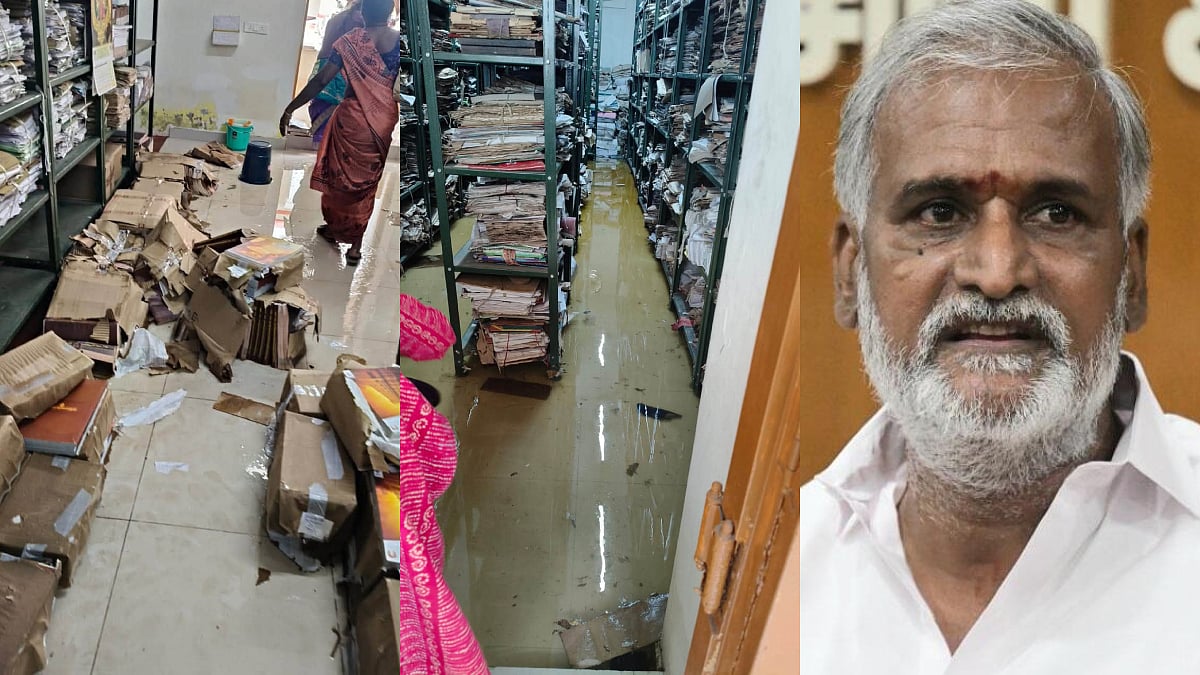
Chennai: “Because monsoon precautionary measures were not taken, rainwater entered the Hindu Religious and Charitable Endowments Department Commissioner’s office building, damaging rare documents, files, and books worth about Rs. 30,000,” DMK former minister Sekarbabu has alleged.
In a social media post he released on this, he said, “Your story is like throwing stones at a fortress while standing in a glass house. Because monsoon precautionary measures were not properly taken, rainwater entered the Hindu Religious and Charitable Endowments Department Commissioner’s office building, damaging rare documents, files, and books worth about Rs. 30,000.
Moreover, at yesterday’s press conference, a question for Hindu Religious and Charitable Endowments Minister Ramesh, who says, “There is no Rs. 400 crore fund.” How were consecration ceremonies conducted in 4,649 temples during the previous Dravidian Model government? How is it that consecration ceremonies are being held today in temples where the renovation works we announced and initiated were nearing completion? The consecration works at the Madurai Meenakshi Amman Temple stand as proof of this.
In faith-based initiatives, from schools and colleges to residences for senior citizens, we have implemented various schemes with proper financial management, opened them for public use, and set many milestones in the history of the Hindu Religious and Charitable Endowments Department.
For those who try to hide the light of the charitable works we have lit, even if a thousand lamps are lit, the truth will still appear dark. If the Minister does not know these details, let him ask the officials in his department and find out.
From the Department Secretary, Commissioner, Additional Commissioner, down to the Joint Commissioners, the very same officials who worked with us in planning the financial sources for temple renovation works and in implementing them are still in the department today. By asking them, one can learn everything — the projects undertaken during the previous administration, the financial arrangements made, and the progress of the works.
With the aim of increasing the revenue of temples, we converted several unused forms of gold into pure gold bars, invested them in banks of the Union Government, and used the income generated from them to carry out basic facilities and development works in the temples.
In particular, from 25 temples, 1,111 kilograms of gold in various forms that were of no use to the temples were converted into pure gold bars and deposited as a gold fixed deposit of Rs. 836 crore, generating an annual interest income of Rs. 18 crore. Furthermore, if the 296 kilograms of gold from 9 temples are also added, there is a possibility of generating more than Rs. 20 crore in annual revenue.
By preserving the cultural heritage of ancient temples that are more than a thousand years old, a source of funding was created for renovation works and revenue-generating projects. As evidence of this, for the first time in the history of the Hindu Religious and Charitable Endowments Department, in a notable manner, renovation works were carried out in 352 temples over 4 years at a total cost of Rs. 560 crore, comprising Rs. 425 crore in government funds and Rs. 135 crore in temple and donor funds, and consecration ceremonies were conducted for 96 temples.
From schemes to generate revenue by melting gold to the renovation works of temples, planned financial management is essential. When it was announced that a multi-level parking facility in Coonoor would be built using the financial resources of the Marudhamalai temple, and that the revenue generated from that parking facility could be used for the development of more than 32 small, non-revenue-generating temples in the surrounding area, those who mocked it as an unnecessary scheme have today announced a similar scheme in Kodaikanal.
When the DMK announced it then, it was an unnecessary scheme; when you announce it today, it becomes a people welfare scheme? Is this the change you speak of?
Moreover, it was only after the Dravidian model government came to power that measures were taken and completed to preserve ancient temple records and palm-leaf manuscripts, and to scan and digitize thousands of rare documents.
Even in 2024, during conditions such as rain and flooding, water did not enter the building, so why is water now seeping into the office itself? Shouldn’t explanations be sought from the concerned officials on this as well, and appropriate action be taken? Saying there is no money and shrugging it off cannot be the administration’s answer; taking responsibility for administrative shortcomings is the duty.
The financial resources we created, the renovation works we initiated, and the cultural traditions we safeguarded are all evidence of the projects that have been implemented. Continuing them and accounting to the people are the responsibility of the present government.
He has said, “The Hindu Religious and Charitable Endowments Department must act with the understanding that its foremost duty is to eliminate shortcomings, manage funds properly, complete the works, and also meet the basic needs of devotees.”