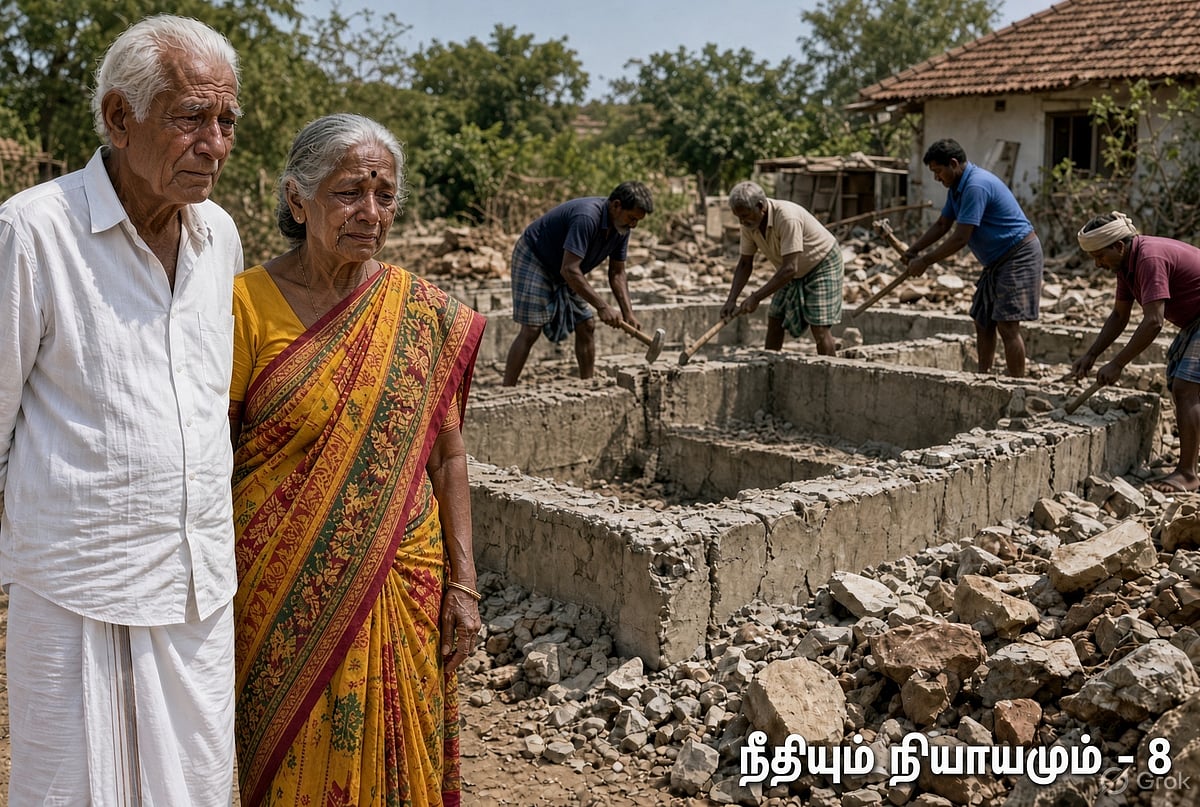
Subramanian is from Veeravalli village near Kulithalai. He is 85 years old. His body is like dried bamboo. A white veshti and shirt, uncreased by ironing. In his shirt pocket, a button phone attached to a neck strap. A gaze with the courage to question anything. A mind that harbors no ill will toward others. The right to proudly call himself a Gandhian. If Subramanian is standing in the office, it is 8:30 in the morning. He would stand at the entrance even before the office opened. By bus, he would have traveled 50 kilometers to reach Manapparai.
“Sir... the case is only tomorrow, right?”
“It’s okay, sir... I came thinking I’d see you and tell you before going,” he would say.
I was less than half his age. As a lawyer, the trust he placed in me was expressed as respect. Rather than hire a lawyer in his own town and conduct the case there, he had come looking for me. His case fell within the jurisdiction of the Kulithalai court. His house was only 10 kilometers from the court. In that same town, Subramanian could have appointed a lawyer for himself. His foresight prevented that. On the long journey toward justice, Subramanian showed no fatigue. If the case was to be heard in court tomorrow, he would be at the office by 8:30 this morning. Not for one adjournment, not for two. Until the case was over, he came to the office and left in that same way. Even if I said, “It’s enough if I inform you by phone,” he would refuse to accept it.
“No, sir... you have many cases. I only have one case, so I’m the one who should come and remind you,” he would say.
In my 22 years of experience as a lawyer, I have never seen another litigant like Subramanian. Nor will I ever see one again. Punctuality and foresight were the first lessons I learned from him. He lived a life that was very honest and rooted in righteousness. I never once asked him for legal fees. He would voluntarily give whatever he could.
Neethirajan and Neethiarasi were the names he lovingly gave his children. He lived his own life without ever straying from justice. He wished that others too should live that way. In his retirement, he had lost his wife. Though he did not accumulate wealth, he protected what he had without selling it. He lived believing that giving his children an education was enough, rather than leaving them property. He made that belief a reality in his own life. His children grew up and went to work in other towns. Subramanian did not want to leave his native village or his ancestral farmland. It was farmland along the highway, with a thatched house on one part of it. He lived with the help of his sister, Aaraayi. Building a concrete house was Subramanian’s lifelong dream. Using the savings he had carefully set aside, he began the work of building a small concrete house. He happily named his dream home “Gandhiyakam.” Within a week, the foundation work was completed. Watching his house rise majestically, Subramanian felt as though his youth had returned. He became as energetic as a 25-year-old. He would wake up at dawn and water the construction.
One day, he got up at dawn, watered the building, and was walking around looking after it. Four or five men came into the garden. Subramanian recognized their voices. They were the people who owned the land behind his garden. They had been coming and going through Subramanian’s land. They did not want him to build a house or stay there farming the garden. Before Subramanian could even ask why they were entering the garden before daybreak, they began smashing the foundation with crowbars. Subramanian tried to stop them. They pushed him away. Using a tractor, they completely destroyed the structure. In a desperate attempt to save her brother, Araayi ran here and there looking for help. No one came to help. The building was reduced to rubble. Day broke as well.
Subramanian is building a house on his own land. No one has the right to stop him. Yet the enemies were firmly convinced that they could prevent it. This belief is not limited only to those who came with the intention of seizing Subramanian’s land. There are people like this in every village. Behind such thinking lies a buried history spanning several hundred years. The suffering of those driven from their own land is filled throughout history. Some have fought to resist the plunder of their land. They have died. We worship them by erecting memorial stones. Those who cannot fight against the seizure of their land are displaced. They become refugees; they keep moving from place to place as nomads. Our country has become democratic. Democracy is nearing its centenary. But the land of the poor is always being targeted.
Each of us lives with the belief that the rule of law has taken root. Yet every dawn keeps telling us that it continues to adapt itself to power. “The strong become the mighty.” The bitter truth is that there is not enough room here for Gandhian ideals or Gandhian followers. Subramanian’s heart trembled and throbbed like a hen that has lost its chick to a hawk. He goes to the nearby police station and files his complaint.
“We’ll come and see... you just file the complaint and go,” says the police officer.
Subramanian, who had been waiting, thinking they would come now or come later, loses patience and runs back to the police station.
“Go to court and get an order... you can’t file a case right away,” says the policeman.
“Sir, that’s my land... my sister and I live there, and the patta and chitta are all in our names. They’re trying to grab my land. They demolished the house I was building. Please take action, sir,” says Subramanian.
“Hey, old man... we can’t take action for every little urgency of yours. You’ve already filed a complaint. Keep going. Come when we call,” the policeman warns, almost shooing him away and telling him to leave.
“Sir, I want to see the inspector,” says Subramanian.
“You can’t see him whenever you feel like it. Come in the morning,” the policeman sends him away.
Not knowing which morning that means, Subramanian wakes up every day and goes to the police station to wait, believing they will take action against the enemies today, then tomorrow. Nothing happens. Months passed. The enemies who had demolished the construction were roaming around the town. All the faith Subramanian had placed in this society crumbled one by one. Based on the complaint Subramanian filed, the police did not even register a First Information Report.
Subramanian files his petition as a case in the Madurai Bench of the Chennai High Court. The High Court issues instructions to the police. Several months after the incident had taken place, the first information report is registered. Even after that, there is no progress in the case. The accused have not been arrested. It was nearing a year since the structure had been demolished. One day, the police came. The accused’s friends also came. They drew a sketch. They talked among themselves; wrote things down; and left. Subramanian could not guess what was happening.
The fire of Gandhism that had been smoldering in Subramanian’s heart began to die down. A summons had arrived for Subramanian from the criminal magistrate’s court. The summons stated that the complaint was being dismissed because there was a mistake of fact in their complaint. It also said that if they had any objection, they could appear in person and state it. That was why the summons had been sent. In other words, the police have taken action to close the case, saying that Subramanian had demolished his own house and filed a false complaint against his enemies. The situation in which one has to wage a long struggle just to register a complaint is not something unique to this one Subramanian. That is the condition for everyone without power.
Here we can compare the mindset of the police with a contemporary case. In the case of Gem Veeramani, who was accused of sexually harassing girls, the police tried to close the case by submitting a report stating “Further Action dropped.” The POCSO court judge who heard the Gem Veeramani case refused to accept the police report and ordered a reinvestigation. It was in that reinvestigation that many truths came to light, shocking Tamil Nadu. The Gem Veeramani case has now become like the “Epstein” report that shocked the whole world, involving sexual harassment of girls. If the trial judge had accepted the police report and closed the case, justice and fairness for the suffering of many girls would have been buried deep underground. In the Gem Veeramani matter, it has been proven that justice can stand still and kill.
In many cases where the police have submitted a report to the court stating “Mistake of fact” or “Further Action dropped,” the courts have accepted the police report and dismissed the complaint. If a thorough investigation is conducted into many cases in which First Information Reports were registered and later dropped, many buried truths may come to light. One such example is the Gem Veeramani case.
Even the police report recommending that his case be dismissed did not worry Subramanian. What unsettled Subramanian was the police action of closing the case by saying that he himself had demolished the construction and filed a false complaint against his enemies. I was the person introduced to Subramanian by the High Court lawyer he contacted. After reviewing the documents Subramanian had, we prepared an objection report against the police action of dropping the complaint and a Private Complaint, and filed them in court on the specified date. The objection was recorded, and an inquiry was conducted into the private complaint. It was later converted into a Private Case. That case was taken up for hearing as a Calendar Case.
I had taken immediate steps to soothe Subramanian’s wounded heart, after he had been fighting for justice for more than a year. It was indeed a bold move. Even though it was my duty as a lawyer, the complainant also needed courage. In a country where merely asking the police for an explanation is enough to be branded as “talking back,” filing a case by naming the investigating police officer as an accused is no easy task. But Subramanian strongly wanted that. In Subramanian’s case, we filed a private case against those who demolished the construction, on charges including trespass, damaging the house with weapons, criminal intimidation, and using abusive language, and also named the investigating officer, the police sub-inspector, as an accused for not properly performing his duty.
Along with the enemies who demolished the house, the police sub-inspector who failed to perform his duty was also placed in the dock. Copies of the complaint were handed over to the accused, and the case was adjourned to another date for hearing. I came out of the court. For the first time, I saw such a radiant smile on Subramanian’s face.
“We’ve won, sir,” he said, rushing over and gripping my hands tightly. What greater honor could there be for a lawyer than that?
At the next hearing, the court questioned the accused. All the accused, including the police assistant inspector, denied the charges. The court recorded this. The case was adjourned for witness examination. Subramanian had come prepared to give testimony. On the assistant inspector’s side, his lawyer filed a petition seeking his discharge (Discharge Petition). Normally, a case adjourned with a 15-day interval was, on that day, adjourned to the next day. For the petition filed by the police assistant inspector seeking to be discharged from the case, Subramanian’s side requested time to file an appropriate counter-petition. Denying that request, the trial court ordered the police assistant inspector discharged that very day. Once a court issues an order, the complainant has no option but to appeal against it. Subramanian did not have the strength to appeal. Against the injustice done to him, Subramanian had sent a statement to the High Court. Later, the case proceeded against the other accused. Since there were no witnesses, the accused were acquitted. Subramanian’s dream home, ‘Gandhiyagam,’ also collapsed along with it. Not wanting to fight against the power center along with the accused, Subramanian’s children settled their lives in the city.
In Tamil Nadu, where nearly 8 crore people live, only 1.25 lakh police officers are on duty. They cannot provide security to the entire population. Most people are learning to live ethical lives on their own. Our literature has taught precisely such ethics. Beyond all this, many undesirable crimes are taking place in society. The police should stand with the victims. But in cases like Subramanian’s, the police always stand on the side of power, casteism, and money power. We do not have a system in which any victim can immediately file a complaint and obtain a First Information Report (First Information Report). This situation must change. The truth is that, within the current system, there is no visible possibility of that change happening anytime soon. In such a situation, victims should consider the option of directly filing a private complaint (Private Case) in court. Full justice may not be achieved through that. But they can protect themselves from further harm.
At the Ramleela complex in Haldwani, Uttarakhand, a public meeting attended by Congress party leader Mallikarjun Kharge was held on 8.8.2026. After that, on 10.08.2026, members of a right-wing organization that held a meeting at the same Ramleela complex performed a purification ritual on that stage. This sparked a major controversy across the country. A complaint was filed saying, “Since Kharge is a Dalit, the right-wing organizations carried out a purification ritual on that stage. Therefore, a case should be registered against those members under the Prevention of Atrocities Act.” However, the police did not register a case. At a press conference held in New Delhi, Rahul Gandhi insisted, “An FIR should be registered against the members of the right-wing organization.” Only after that was a case registered. At the same time, Amit Kumar, a member of the Valmiki community, filed a complaint against Rahul Gandhi, saying, “Members of the Dalit community also took part in the purification ritual. But he is creating social tension by painting it in a casteist hue.” Based on that complaint, a case was also registered against Rahul Gandhi. Delaying the filing of a complaint, or filing complaints against both sides, is one of the rotten practices of our police force that buries justice.
Before authority, our own Subramanian is just the same. Congress party leader Mallikarjun Kharge, who ruled the country, is just the same. If needed, they will register a First Information Report. If not needed, they will make the complainant the subject of the complaint itself.
If the police refuse to register the victim’s complaint, under the new criminal procedure law, the ‘Bharatiya Nagarik Suraksha Sanhita-2023’, Section 223, the victim may directly file a private complaint (Private Case) in the criminal magistrate court. The court will send a summons to the accused, hear both sides, and if there is prima facie ground for the offence, take cognizance of the charge against the accused and proceed with the inquiry. A private complaint (Private Case) is a legal shield provided to the victim by law.
The voice for justice will resound...
The journey toward justice will continue...
Author: Lawyer, Social Activist
Tamilmani Arumugam, Advocate.
advocatetamilmani@gmail.com