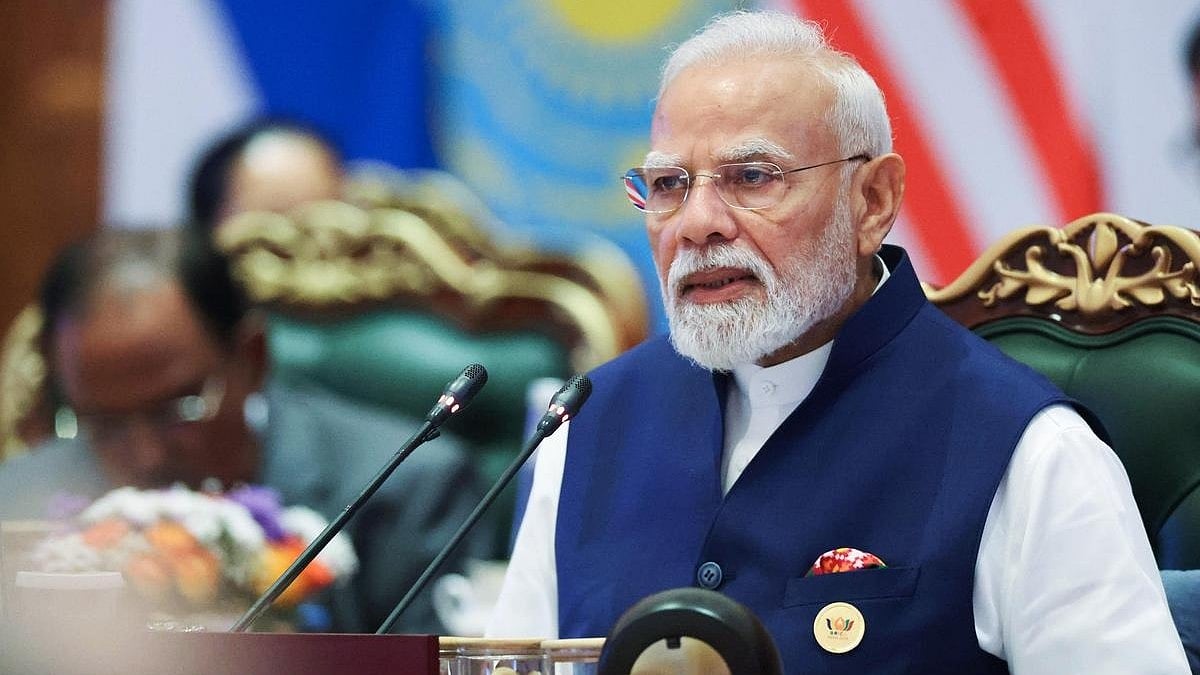
Amid global war tensions, trade disputes, and economic sanctions from Western countries, the 18th BRICS 2026 summit has concluded in Delhi.
This is not merely the ‘conclusion of an international summit’; rather, it is an event that proclaims India’s global dominance on the journey toward ‘Viksit Bharat,’ or developed India.
Through his policy of ‘strategic autonomy,’ Prime Minister Modi has ensured that India’s foreign policy will never be subject to the conditions of other countries. He has also elevated India as a focal point that determines global economic and security decisions.
Modi as a voice of conciliation: At a time when the superpowers and the Asian and European nations stand divided, Prime Minister Modi has emerged as a conciliatory voice that places peace and economic stability above global political conflicts.
By speaking up for a resolution to issues such as the rights of the Palestinian people, a ceasefire in Gaza, the Middle East war, and the Ukraine-Russia war, he has risen as a “leader of international stature.”
Sign of diplomacy: Although there was talk of a ‘BRICS currency’ as a counter to U.S. dominance and as an alternative to the dollar, no new currency was directly introduced in order to avoid the hostility of Western countries. At the same time, it was decided that trade among BRICS countries could be conducted using each country’s own currency. Through this, Modi has successfully reduced dependence on the dollar and demonstrated his diplomacy.
Modi advocated increasing the participation of Asian, African, and Latin American countries in the UN, the UN Security Council, the IMF, and the World Bank. His contribution in elevating developing countries from mere observers who accept decisions to “powers that shape global rules” is unparalleled.
Delhi Declaration accepted 100%: The ‘New Delhi Declaration 2026’, which covered more than 140 international issues, was adopted unanimously with 100 percent agreement, without any opposition.
In a situation where tensions persist between Saudi Arabia, Iran, and the United Arab Emirates, the fact that those countries set aside their differences and came onto the same platform is a victory for Modi’s diplomacy.
To get everyone to accept this resolution, negotiations were held under Prime Minister Modi’s leadership until 4 a.m. on Sunday.
A ‘check’ to Pakistan: A resolution was passed indirectly putting a ‘check’ on Pakistan against cross-border terrorism, providing shelter to terrorists, and financing them. Prime Minister Modi has strengthened India’s hand by bringing BRICS countries under one umbrella with the message that we will oppose terrorism in whatever form it comes.
Rights of African and Asian countries: Modi called for the contribution and voting rights of developing countries in the International Monetary Fund and the World Bank to be increased.
India’s investment opportunities on the African continent have expanded through the separate meetings held with the leaders of South Africa, Egypt, Burundi, and Nigeria.
Jim O'Neill, a former expert at Goldman Sachs, praised Prime Minister Modi, saying, “Prime Minister Modi has emerged as a desirable leader in both BRICS and the Western countries.”
Leadership that dispelled doubts: In 2024, BRICS had 6 countries, and after that, 5 more countries joined, expanding the organization. International political experts warned that BRICS could split as more members joined.
Many questioned whether countries with differing political systems and regional rivalries could be brought together under a single framework. In addition, there was growing external pressure over whether it would turn into an anti-Western battleground or devolve into a useless talking shop.
However, India’s leadership in 2026 stabilized the identity of that organization. Rather than turning BRICS into an anti-Western forum, presenting it as a dedicated, “non-Western, solution-oriented” platform for the Global South was a victory for Prime Minister Modi’s leadership style.
India - China and the Link to West Asian Countries: After 7 years, Chinese President Xi Jinping had come to Delhi. Setting aside the tensions that had prevailed along the border, Prime Minister Modi and Xi Jinping held talks with a long-term perspective on bilateral relations.
On India’s behalf, it was emphasized that differences of opinion should not turn into conflicts and that bilateral relations should be approached with a long-term perspective.
Instead of relying mainly on the United States in trade terms, Prime Minister Modi’s strategy of using China, which has Asia’s largest market, for exports has been successful.
Iran, UAE, Saudi Arabia connection: Bringing together the three countries of Iran, the United Arab Emirates, and Saudi Arabia, which are at odds in West Asia, under one umbrella and successfully hosting and concluding the conference was the biggest success of Modi’s leadership qualities.
Using its trusted relationships across the entire Persian Gulf region, India created a platform for important high-level discussions and built consensus.
The warm meeting between Prime Minister Modi and Iranian President Masoud Pezeshkian stood as evidence of this. This was followed by joint session consultations attended by a delegation from the United Arab Emirates led by Abu Dhabi Crown Prince Khalid bin Mohammed bin Zayed Al Nahyan, as well as representatives from Saudi Arabia.
India emphasized the need to maintain maritime security for trade in key waterways such as the Strait of Hormuz and the Red Sea, and to give priority to diplomatic negotiations over military conflict.
Breaking the suspicion that geopolitical conflicts in West Asia would derail the summit, Modi’s achievement was bringing regional rivals under one roof under Indian hospitality.
East-West balance & 15 bilateral meetings: India, as a key member across all platforms such as the ‘Quad’, ‘G20’ and ‘BRICS’, handles bipolar politics with balance. During the summit, at Hyderabad House, Prime Minister Modi held 15 bilateral talks with leaders of 11 countries, including Chinese President Xi Jinping, Russian President Vladimir Putin, and the Iranian President.
Through the 2026 BRICS summit, Prime Minister Modi has elevated India from the status of a “country facing problems” to that of a “country providing solutions to global problems.”
Bringing the world’s superpowers to the same table and creating the “New Delhi Declaration” centered on peace and development is proof of Prime Minister Modi’s mature diplomacy.