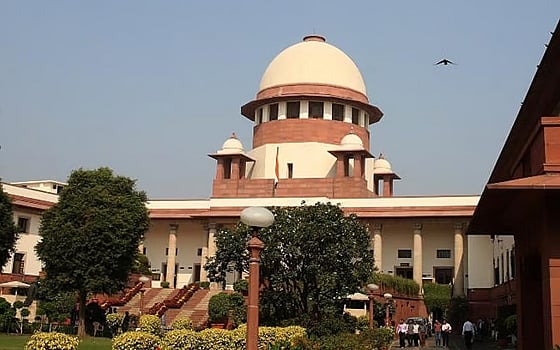
The Supreme Court on Monday issued notices to the Central Government and the Election Commission of India in a case seeking to curb the practice of elected representatives (MPs, MLAs) voluntarily resigning from their posts in order to join other parties or create planned political shifts.
A three-judge bench headed by Chief Justice Surya Kant directed them to respond to the appeal petition filed by advocate K. Sudhan.
Key point of the petition: This petition has been filed challenging the judgment delivered by the Madras High Court in September 2026.
After the 2026 Tamil Nadu Legislative Assembly election, six Members of the Legislative Assembly from the AIADMK in Tamil Nadu (Sathyabama, Maragatham Kumaravel, Isakki Subbiah, C. Vijayabaskar, M.R. Vijayabaskar, and S. Jayakumar) voluntarily resigned from their posts and joined the ruling party, the ‘Tamilaga Vettri Kazhagam’ (TVK). Following this, the Public Interest Litigation (PIL) filed by K. Sudhan was dismissed by the Madras High Court.
The petitioner argues that a people’s representative abandoning his voters and switching to another political party within just a few weeks after the election is harmful to representative democracy. The petitioner also states in the petition that by-elections held because of such circumstances cause unnecessary expenditure of public funds.
Reliefs sought by the petitioner
To prevent such planned resignations, the petitioner requests that the following measures be taken:
Guarantee for election expenses
A Member of Parliament/Legislative Assembly who voluntarily resigns should be required to pay an amount equivalent to the public funds needed to conduct the by-election.
Five-year cooling-off period
The petitioner seeks that Members of Parliament/Legislative Assembly who resign early for such reasons should be disqualified from contesting state assembly elections or parliamentary elections for the next five years.
Court’s position and legal issue
The Madras High Court noted that, under the Constitution of India and the Representation of the People Act, a representative’s right to resign from office is protected. The Madras High Court dismissed the petition, stating that the court cannot on its own create new disqualification rules or financial penalties, as changing such rules is a matter subject to Parliament’s policy decision.
The appeal filed against this came up for hearing on Monday before a bench comprising Chief Justice of India Surya Kant and Justices Joymalya Bagchi and V. Mohana.
At that time, the petitioner’s side requested that the case be adjourned for a week, as additional documents related to by-election expenses needed to be filed. In particular, it was stated that the details of the expenses for the by-elections would also be included in the case.
Following this, in this case, the judges issued notices to the Central Government, the Election Commission of India, the Secretary of the Tamil Nadu Legislative Assembly, the Chief Secretary of Tamil Nadu, and to Sathiyabama, Maragatham Kumaravel, Isakki Subbiah, C. Vijayabaskar, M.R. Vijayabaskar, S. Jayakumar, and others who won from the AIADMK and later resigned from their MLA posts and joined the Tamilaga Vettri Kazhagam, and adjourned the case to November 16.