In India itself, the honor of enacting the Public Libraries Act for the first time belongs to the Madras Presidency.
Tamil Nadu has a long-standing tradition in library movement and in fostering a reading culture.
The book procurement system was created with the aim of ensuring a livelihood not only for readers but also for writers and publishers.
Where did the problem begin?
From 2009 onward, selected Tamil books were purchased by libraries in quantities of up to one thousand copies. This was a huge boost to the Tamil publishing industry.
However, in the period after 2011, various complaints began to emerge regarding book procurement.
Complaints arose that some publishers were operating in groups, cultivating close ties with officials and obtaining procurement orders, and that for this they had to pay bribes of up to 30 percent.
In the 2020 period, some books that had been published many years earlier were reissued under new names and in new formats, and were purchased for libraries.
Despite complaints being filed by some publishers with evidence, no action was taken. If these allegations had been properly investigated then, some of today’s problems could have been avoided.
The new form of the problem
During the 2022–24 period, no books were purchased at all. When asked, officials said, “In 2021, books worth nearly Rs. 180 crore were purchased. So the pending dues must be cleared before new purchases can be made.”
It was precisely because books for three years were hurriedly bought in a single year that fake books entered the libraries. It was against this backdrop that the Tamil Nadu government introduced a transparent book procurement policy in 2024.
Through this, publishers who had not previously had the opportunity to supply books to government libraries, as well as authors who publish books independently, were able to bring their works to the government’s attention.
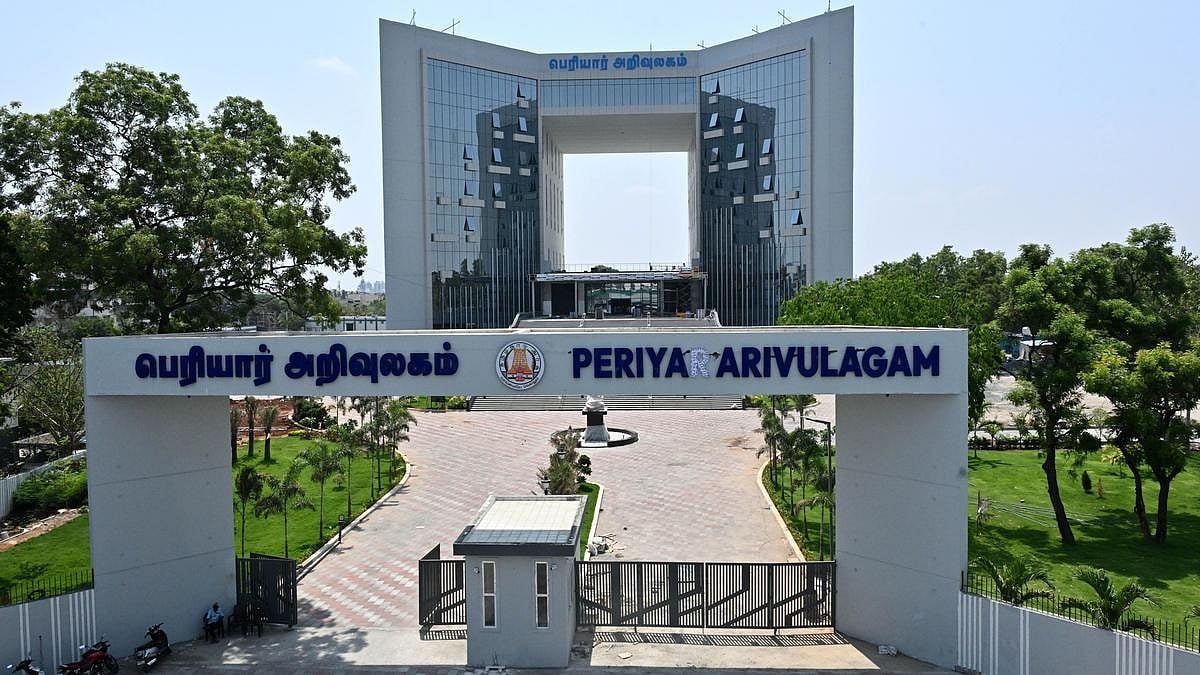
This scheme not only established the proper procedure for purchasing books, but also greatly reduced corruption. It is in this context that writer Perumal Murugan has exposed the irregularities that took place in the purchase of books for the Coimbatore Periyar Library.
When examining the controversies that have arisen around this, it becomes clear that there are no proper guidelines for book procurement for the new special libraries.
Libraries are built at a cost of several crores of rupees, and only a few months before they are opened do the arrangements for purchasing books begin to be intensified. If books are requested from publishers within a very short period, a situation will arise in which they can provide only what they have in stock.
What is the alternative?
When the foundation stone for a new library is laid, the number and categories of books required for it can be planned in advance, and a public announcement can be issued asking for the books to be supplied within the next year or two.
This will also give publishers enough time, and libraries will be able to properly select the books they need.
Clear answers, based on documents, should be provided to questions regarding the selection process in the purchase of books for the Coimbatore Periyar Library, the role of the recommendation committees, and the final list of books purchased.
It is not the right approach to reduce this issue to a political one. The 2024 judgment delivered by the Madurai Bench of the Madras High Court also emphasizes this need: “Notices regarding book procurement should be published on the website; details and cover images of the selected books should be made available for public viewing; objections and opinions should be invited; complaints regarding irregularities should be investigated.”
What the government must do immediately
A free and independent inquiry committee should be formed, headed by a retired judge and comprising a retired senior police officer, educators, librarians, writers, publishers, journalists, and readers.
The committee should examine the quality of books purchased over the past ten years, whether the same book has been repeatedly bought under different names or editions, whether there has been bias in purchase orders, and whether irregularities have occurred, and publish the report publicly.
Likewise, if suspicious books are found in libraries, arrangements should be made for readers to inform the inquiry committee of all their details. Whoever has committed the offense must be brought before the law.
Any government that wishes to provide corruption-free, honest administration should not limit itself to criticizing the previous government. It must identify administrative shortcomings and permanently eliminate them.
Corruption in other sectors drains the government’s finances. But irregularities in libraries destroy the people’s very intellectual wealth. The impact of this will reach the next generation as well.
- olivannang@emeraldpublishers.com