
The controversy began last year over the demand to light a lamp on the pillar atop Thiruparankundram Hill. VCK, CPI, and other TVK alliance parties have been repeatedly saying that Hindutva organizations are plotting to disrupt harmony in Tamil Nadu. In this situation, a case was filed in court this year seeking permission to light a lamp on the hill pillar at Thiruparankundram. The case went all the way to the Supreme Court. In court, the Tamil Nadu government had clearly stated, "It is not a lamp pillar; it is a survey stone." It is also said that archaeological department researchers have confirmed that it is not a lamp pillar.
In this situation, since there could be tension in Thiruparankundram on the occasion of Karthigai Deepam, the Madurai District Collector ordered a 144 prohibitory order to be imposed in Thiruparankundram. A case was filed in the Madurai High Court seeking to revoke this order. This case came up for hearing before single judge G.R. Swaminathan. At that time, the judge said, ``If a lamp is not lit at the Deepa Thoon in Thiruparankundram as per the Supreme Court's order, contempt of court proceedings will be severe.
"The religious rights of devotees must be protected. In accordance with the Supreme Court's order, a lamp should be lit on the hilltop pillar. The Supreme Court has clearly stated in several orders that a review petition should not be filed in order to prevent the implementation of its order. If any advice contrary to the court's order is given by any other official, the District Collector should ignore it. It cannot be said that the court order need not be implemented on the grounds that a review petition has been filed against the Supreme Court's order," he had noted.
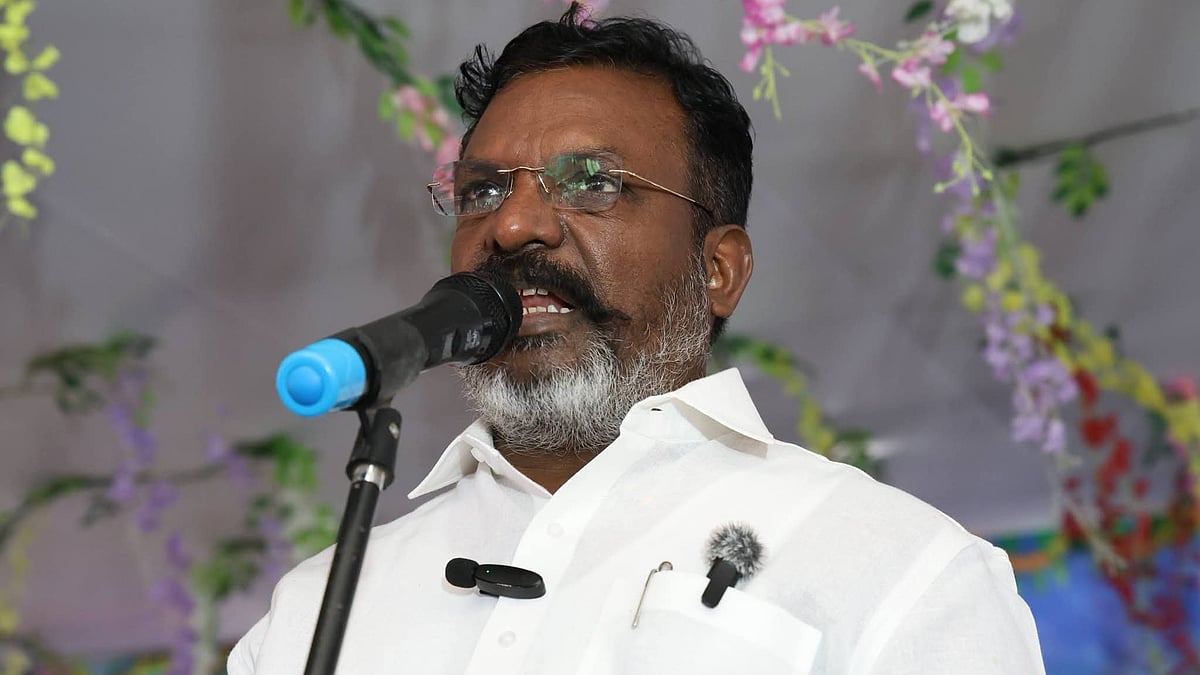
In this situation, VCK leader Thirumavalavan said on his X page, ``It is the district collector’s duty to implement the Supreme Court’s interim order. However, district collectors cannot act like judges. Judges are empowered to make decisions based on documents, evidence, proof, and testimony. But district collectors and police officers cannot function in that manner. They have to act while also taking into account the state government’s position.
The authority to issue orders to senior officials rests with the state government alone. Therefore, the state government must confront this boldly without fearing judicial terrorism. Keeping in mind the future of Tamil Nadu and the welfare of the people of Tamil Nadu, it must act steadfastly to uphold justice in Thiruparankundram." he noted.
Following that, CPM General Secretary Shanmugam had posted on his X page, "Honourable Judge G.R. Swaminathan has crossed the Lakshmana Rekha. The Honourable Chief Justice must intervene immediately."
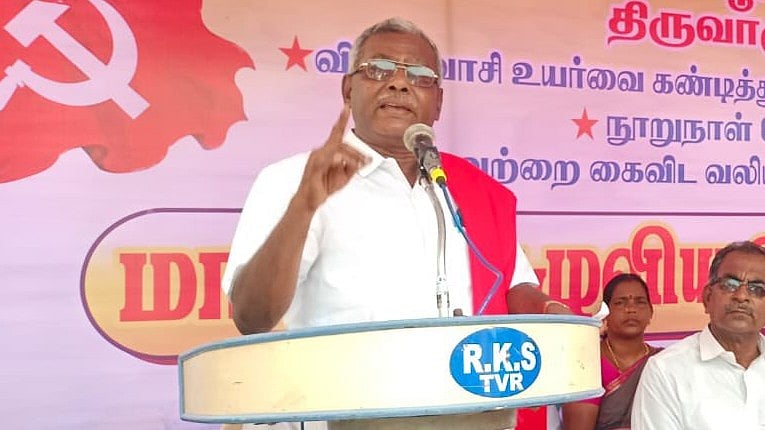
Following that, he has now released a video on his X page. In it, he also criticized, “How is it that only G.R. Swaminathan is a judge? How do temple-related matters or cases concerning Deepam keep going to him again and again? A case that had already been heard by him and then moved to a two-judge bench, with the Supreme Court having stayed that verdict, how can the same judge hear the same case again? People simply cannot understand any of this.”
As a continuation of this incident, at a press conference, lawyer Vanchinathan had demanded, “The Chief Justice should seek an explanation from High Court Judge G.R. Swaminathan, who met the District Collector alone in chambers. The Chief Justices of the High Court and the Supreme Court should investigate this matter and take appropriate action.”
As court proceedings have become a topic of discussion, we spoke with Viduthalai Chiruthaigal Katchi deputy general secretary and lawyer Ezhil Carolin. She said, ``Judges are human beings like us too. India is a democratic, free country where people of all communities and religions live. Therefore, judges should act keeping in mind the feelings and religious beliefs of others.

The term 'judicial terrorism' is put forward on the basis of the view that orders should not be issued in a way that affects ordinary, simple people. Some judges saying, 'This happened by the will of God,' and delivering judgments in modern times based on ancient scriptures, customs, or texts like Manusmriti should not be done. That is contrary to the nature of the judiciary. In this country, justice must be delivered only on the basis of the constitutional law created by the revolutionary Ambedkar.
With the Tamil Nadu government having filed an appeal in the Supreme Court regarding the Thiruparankundram issue, the verdict will be known soon. Rather than speaking about a particular judge, whoever from any religion comes to hold the office of judge, the Constitution is the foundation. One should not impose one’s religious beliefs on the people. There is no need for the judiciary to say, “This happened because of sins committed in the past.” Such one-sided tendencies are visible among some in the judiciary. If religious or biased judgments continue, there is a risk that the country’s democracy and peace will be undermined.
The judgments delivered by judges do not end with the events of that day. They are preserved as documents and become guides and references for future generations. Therefore, judges must deliver verdicts with great care so as not to harm any religious community mentally or physically. Every person may have an attraction toward a religion. But no one should be 'possessed by religion,'" he noted.
Junior Vikatan’s exclusive WhatsApp Group...
Click here to join... https://tinyurl.com/2b963ppb
Hello,
From BIG BREAKINGS to politics, society, crime, cinema, and more—nonstop updates and in-depth articles from all areas.
Attention-grabbing articles from Junior Vikatan magazine and digital, here instantly... https://tinyurl.com/2b963ppb