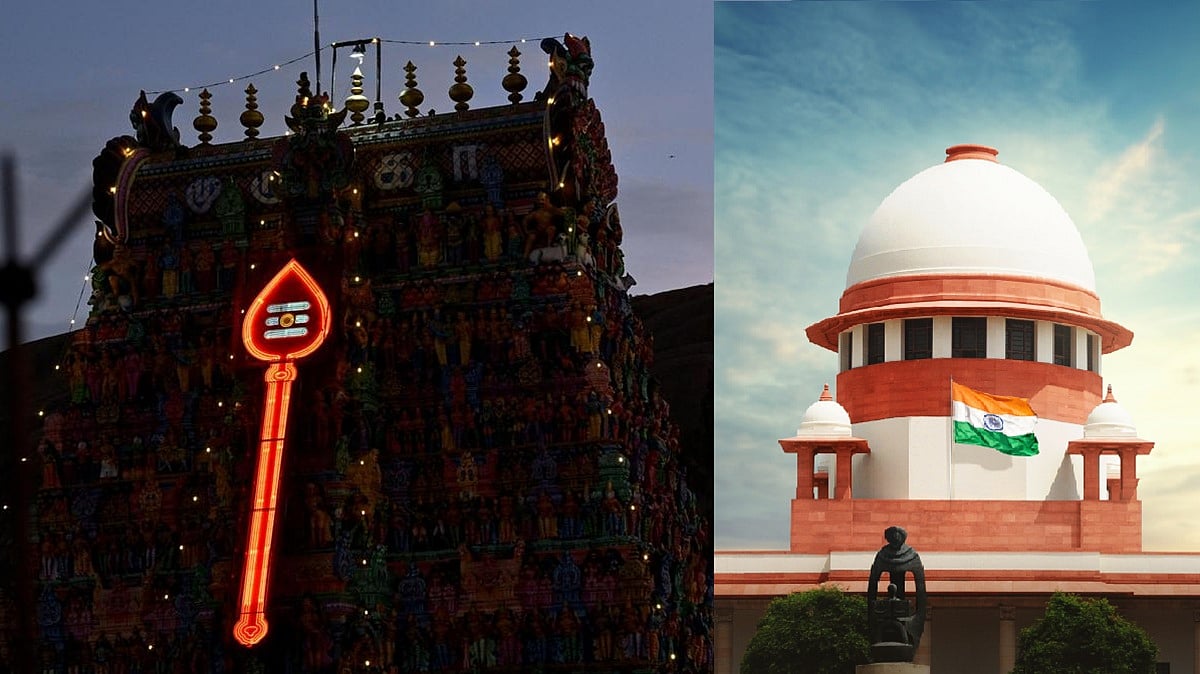
The cases filed seeking contempt proceedings against the Madurai District Collector, the Commissioner of the Hindu Religious and Charitable Endowments Department, and others for not implementing the Supreme Court’s order in the Thiruparankundram Deepam issue came up for hearing in the Supreme Court yesterday before a bench comprising Justices Aravind Kumar and Vipul M. Pancholi.
In addition, petitions seeking an order to light the lamp on the Deepa pillar today itself, despite the passage of time, were also taken up for hearing. From the arguments that took place in court at that time...
Judges: There will be no hearing today on the main case related to Deepam. Hearings will be held only regarding the contempt of court cases and the intervention petitions. We will not hear anything other than these two, so all counsel should not raise any arguments beyond this matter.
Senior counsel for the petitioner, Guru Krishnakumar: The entire responsibility for lighting the lamp on the Deepa pillar at the summit of Thiruparankundram hill was given to the District Collector. Even though the Supreme Court clearly stated that the District Collector should be the responsible authority in this matter, the Collector has deliberately failed to carry it out.
The trustees’ committee passed a resolution saying that, according to Agama rules and traditions, they refused to light the Karthigai Deepam on the lamp pillar. The trustees’ committee has no connection whatsoever with the lighting of the lamp, and even if the trustees had said so, the district collector is under no obligation to take it into account.
Is the trustees’ committee’s word greater than the Supreme Court’s order?
The trustee committee has a total of 5 members. Among them, Regina, who is included, does not belong to the Hindu faith, and another person is one who staged a protest saying that a lamp should not be lit on the pillar. Such people are the ones who have been included in this committee. The District Collector is accepting the decisions of the trustee committee members without verifying anything. The District Collector did not consult the Archaeology Department in a proper manner.
The temple priests have said that they were not informed of anything about the decision regarding the trustees. The current five trustees should not be allowed to continue in office. Contempt proceedings should be initiated against the Collector. Since the Karthigai festival will be held for 11 days, an order should be issued to light the lamp on the pillar again. We have also filed an interim petition in this regard.
Judges: In this matter, are you asking for criminal contempt proceedings? Or are you asking for civil contempt proceedings?
Senior Advocate Guru Krishnakumar: Both proceedings should be initiated.
Solicitor General of the Central Government on behalf of the Archaeology Department, Tushar Mehta: In this matter, one side says a lamp should be lit, while the other says a lamp should not be lit on the stone pillar. The trustees of the Thiruparankundram Subramania Swamy Temple are appointed by the government. They are not people of religious faith.
However, as far as our work in the Archaeology Department is concerned, the Supreme Court had already clearly stated what we should do. We were ready to implement it.
However, the Tamil Nadu police did not allow us to inspect the lamp pillar at the top of the hill. On the 24th, at 3:15 p.m., officials from the Archaeology Department went near the dargah. At that time, the senior Tamil Nadu police officers there told us not to proceed any further.
Later, around 4:15 p.m., when an attempt was made to go near the stone pillar, the police did not allow entry there either. As a result, it was not possible to reach the stone pillar or inspect the situation there. Following the information that the Madurai Bench of the Chennai High Court had issued an order at 5 p.m., the Superintendent of Police instructed the archaeology department officials to leave the hill.
However, the archaeology department personnel remained in the hill area. It was then revealed that, in accordance with the Supreme Court’s order, neither the Hindu Religious and Charitable Endowments Department nor any other concerned department had made any arrangements to light the lamp on the specified stone pillar. Following this, the archaeology department personnel returned to the foothills at around 7:45 p.m. without inspecting the stone pillar.
This entire course of action amounts to a very serious act of contempt of court. The review petition may have been filed merely as a tactic to avoid complying with the court order. At the same time, there are already several judgments stating that the mere pendency of a review petition does not exempt one from the duty to comply with the court’s order.
Therefore, before hearing the arguments of those accused of contempt of court, an order should be issued to light the lamp at the very place where it was ordered to be lit, and to remedy the contempt of court. The Central Reserve Police Force should be deployed throughout Thiruparankundram hill. An order should be issued to implement the Supreme Court judgment under the leadership of a retired High Court judge.
Petitioner V. Ramasubbu’s senior counsel Sai Deepak: Failing to implement the Supreme Court’s order on the pretext of the trustees committee’s report is a clear contempt of court. The Tamil Nadu government may say that there are some ambiguities in the Supreme Court’s order. That should not be accepted.
The Supreme Court has stated every line very clearly. Therefore, there is no need even to hear the arguments of the Madurai District Collector in this matter. What he has done is a blatant contempt of court. In the order issued by the Supreme Court on November 20, no authority was granted to the temple trustees to make decisions based on their own wishes. Therefore, the district administration and the state administration waiting for the trustees’ approval was an act that violated the Supreme Court’s order.
The trustees have said only at the last minute that they have religious rights under Articles 25 and 26 of the Constitution. However, they did not claim such a right in the proceedings currently under way in the Supreme Court.
The state government should have made it clear to the trustees that they were under a binding obligation to comply with the court order. If it was said that the trustees had the authority to make decisions independently and that the state administration was bound by their decision, then the trustees should also have separately filed a review petition.
The trustees were legally appointed by the state government; they are essentially government employees. Therefore, the state government cannot cite waiting for the trustees’ decision as a reason for not implementing the court order.
The board of trustees at Thiruparankundram was formed only a week before the Supreme Court’s order was issued. If that is so, then anticipating that such an order would come, only those who would oppose it have been included in the board of trustees.
The government seems to have thought that if it simply refrained from lighting the lamp for just one day this year, it could casually get past the Supreme Court’s order. Therefore, an order should be issued immediately to light the lamp on the specified lamp pillar. Solicitor General for the Central Government: This matter should not be treated merely as an issue concerning Tamil Nadu alone.
The Supreme Court must take firm action to ensure that this country functions on the basis of the law. The court’s actions should be such that everyone understands what kind of consequences will arise if its orders are not implemented.
Senior advocate Valliyappan and advocate Lakshman Raja, on behalf of the original petitioner Rama Ravikumar: Even before Deepa Thirunaal, Tamil Nadu ministers have said on various occasions that no lamp will be lit on the Deepa pillar. This makes it clear that they have no intention of implementing the Supreme Court’s order.
This is outright contempt of court. The month of Karthigai lasts until December 15. The tradition is to light lamps every day during this month. Based on that tradition, an order should be issued to light the lamp on the specified Deepa pillar at any time before December 15.
Senior counsel for the Madurai District Collector, Gopal Sankaranarayanan: The 3-day time granted to us by the Supreme Court ends today. However, the reason we filed the affidavit immediately was only to inform the court right away why the lamp was not lit on the lamp pillar.
Judges: Did you implement our order or not? Answer in one word.
Counsel for the Collector: Yes. We implemented it.
Judges: If that had been done, why would these contempt of court cases have arisen? In this matter, we are going to issue some important orders today itself.
Government counsel: The claim that we did not allow the archaeology department officials to go near the lamp pillar is false information.
We have submitted photographs as evidence that the archaeology department officials went to that place. The official who has now made the allegation and submitted a report is also included in them.
We have filed the notes regarding the consultation held with the Archaeology Department officials, as well as all details including when the consultation was held and how they were informed.
Therefore, the claim that the Archaeology Department was not consulted, that they were not allowed onto the hill, and that they were not permitted to inspect the lamp pillar is all false.
The Supreme Court’s permission to light the lamp was only a temporary arrangement; that permission was not granted in a way that recognized any traditional, religious, or property right.
We explain what responsibilities were assigned by the court to each official, including the District Collector and the Police Commissioner, and whether they were carried out.
The Supreme Court order states that only the group approved by the Devasthanam should light the lamp. It has been said that the District Collector should decide the members and number of the lamp-lighting group in consultation with the temple executive officer, the Archaeology Department, and the Madurai City Police Commissioner.
In order to implement the Supreme Court order, we had already begun the work even before receiving a copy of the judgment. All the details of what meetings were held on Nov. 20, 21, 22, 23, and 24, what discussions took place in them, what decisions were made, to whom letters were written and when, and what replies they gave have been submitted to the court as an affidavit with complete transparency.
Judges: But what did you do? It is your responsibility, as the District Collector, to carry out the order issued by the Supreme Court. But wouldn’t saying that the court order was not implemented based on the views of the temple administration, trustees, and others create a complicated situation amounting to a breakdown of the Constitution?
Counsel for the Collector: Traditions, Agama rules, and other practices must be followed in temples. Therefore, in temple matters, everything cannot be implemented in an administrative manner.
Take the Sabarimala case. There is an order in place that all women of all ages must be allowed. Was that implemented administratively?
Judges: We cannot accept this argument. On what basis did the trustee board meet?
Senior advocate for the temple administration, Jaideep Gupta: The trustees met on their own
Judges: No. They cannot meet on their own. For that, an official must issue a proper notice, and only then can they meet and take a decision. That is what your law says.
Counsel for the Executive Officer: The Executive Officer cannot interfere in the decisions taken by the trustee committee in the manner of a court.
Senior Advocate Abhishek Manu Singhvi, appearing for the Commissioner of the Hindu Religious and Charitable Endowments Department: Since the Supreme Court did not take a decision on merits in the matter of permitting the lighting of a lamp on the specified pillar, a way has been created for the trustee committee to itself make certain relaxations in the Supreme Court’s orders on the basis of traditions and Agama rules.
Judges: We did not say that. We only said that a lamp should be lit on the specified pillar as a temporary measure. Do not assume otherwise and try to change it.
Solicitor General Tushar Mehta: From the statements made by senior advocate Abhishek Singhvi, appearing on behalf of the temple administration, it is clear that they have deliberately failed to implement the Supreme Court’s order. Therefore, contempt proceedings should be initiated against them without any delay.
Government Advocate: I only said that I would follow the order of the Supreme Court; I did not say that I would light a lamp on that particular pillar. Because lighting the lamp is not my job. It does not fall within my authority either.
Judges: How many people come to worship at the dargah in a day?
Advocate for the Dargah Administration: Around 100 to 200 people come. We will obtain the proper explanation regarding this and inform you.
Judges: There is no reason for this question. We are asking only to find out the information. If anyone has tried to commit constitutional violations, we will not just sit and watch. No one can make the court’s order ineffective. This was the argument. The judges then issued several important orders.
Real tears? Crocodile tears?
When senior advocate Siddharth Luthra, appearing for the Madurai Police Commissioner’s side, argued, “Security was provided extensively in accordance with the Supreme Court’s order. Security was provided without any untoward incidents or any breakdown of law and order.
A total of 5,797 personnel were deployed for security, including 24 special company troops, 2,400 police personnel, 1,200 armed forces personnel, 332 home guard personnel, 61 DSPs, and 130 inspectors,” he said.
At that point, the judges interjected, saying, “We are examining this matter in detail. We will investigate and find out whether the tears you are shedding are real tears or crocodile tears.”