The United States and China have agreed to set up a new dialogue group to handle artificial intelligence (AI) technology issues and to strengthen emergency communication between the two countries’ militaries.
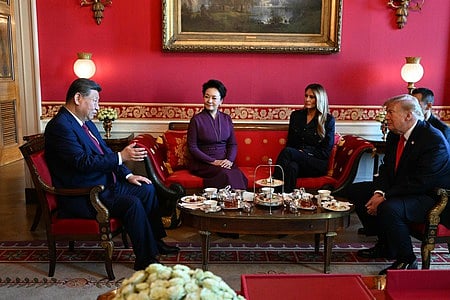
Chinese President Xi Jinping, who arrived in the United States last Wednesday for a three-day state visit, returned to Beijing on Friday after a series of major agreements, including activating bilateral trade and investment councils and reducing tariffs on goods worth $30 billion each.
In this context, both the United States and China issued separate statements on Saturday. According to them, the leaders have agreed to establish a bilateral framework to discuss the risks and benefits of AI technology.
The next meeting will be held in November, and a dedicated communication channel for handling AI-related emergencies will also be set up. In addition, it has been decided to sign a memorandum of understanding to strengthen emergency communication in order to prevent crises between the two countries’ militaries.
Similarly, the United States has said that the trade board for handling bilateral trade matters has come into operation starting this week. Although the trade war intensified last year, the leaders of both countries have agreed in the current talks to extend the suspension of the trade war for another two months.
The United States has said that, under the trade board, agreement has been reached on recommendations to provide tax concessions for security threat-free goods worth $3 billion each between the two countries. A special investment board has also been established to examine mutual investment opportunities and the barriers involved, and to find solutions to commercial issues.
Trump urged Xi Jinping to increase the production of refined petroleum products in order to stabilize global supply. The United States also welcomed China’s imposition of restrictions on the export of two more chemicals used in the production of the fentanyl drug, noting that arrests have recently been made in connection with this.
At the same time, China said it is taking steps to address U.S. concerns over shortages in the supply of rare earths and critical minerals and to restore exports to normal levels; it is noteworthy that last year China had imposed restrictions on exports of these rare earths in response to U.S. tariffs.
On international issues, both leaders expressed a shared view that Iran should honor its pledge not to develop nuclear weapons, and that no country should levy charges on international sea routes, including the Strait of Hormuz.
Next, both leaders have agreed to meet and talk again at the Asia-Pacific Economic Cooperation summit to be held in Shenzhen, China, this November, and later at the G20 summit to be held in Florida, the United States.
Although there have been no immediate shifts in the fundamental differences, these developments are considered significant. Experts have pointed out that creating institutional crisis-management mechanisms through the two countries’ militaries and working groups, rather than relying solely on the personal rapport of the leaders, will bring lasting stability to bilateral relations.