Madurai: Controversy and criticism have arisen over the fact that, unable to accurately estimate the number of devotees coming for the consecration ceremony of the Madurai Meenakshi Amman Temple, the government was given false information that 5 million people would attend, leading to senior IAS officers being appointed as monitoring officers unusually, and 6,500 police personnel and officials from outside the district being brought in.
The last consecration of the Madurai Meenakshi Amman Temple was held on April 8, 2009. After 17 years, it was conducted grandly and concluded the day before yesterday. Barricades were set up on the Masi and Avani Moola streets, and only 11,000 people, including donors who were issued ‘passes,’ VIPs, political party members, and devotees, were allowed in.
At the consecration ceremony, local devotees were disappointed that they could not participate because they did not get a “pass” and due to the police’s strict restrictions and controls. Unable even to go near the temple, devotees stood at various spots on the outer streets where the temple tower was visible and watched the consecration.
It is said that in the consecration ceremonies held in 1963, 1974, 1995, and 2009, there were no such strict restrictions or controls as there are now. Because of that, in past consecration ceremonies, local devotees were able to stand not only on the tower platforms but also on the Masi, Chithirai, and outer streets to have darshan.
Relatives and devotees from other states and districts gather every year for the Meenakshiamman Temple Chithirai festival and the consecration ceremony. In Madurai, during the Chithirai festival alone, as many as 500,000 devotees gather on the day when Kallazhagar enters the river.
Accordingly, the city corporation administration and the Hindu Religious and Charitable Endowments Department usually plan for a turnout of up to 1.5 million devotees and carry out the necessary basic facilities and safety measures for them.
However, based on the information provided by the corporation that, in the consecration ceremony held the day before yesterday, as many as 5 million devotees might gather in an unprecedented manner in history, the Director of Municipal Administration has informed the Tamil Nadu government.
Since the District Collector, the Corporation Commissioner, and the Police Commissioner are all new to Madurai, they may have failed to estimate the crowd gathering for the consecration ceremony. At the same time, they may have listened to the views of lower-level officials who know Madurai well and informed the government with accurate information.
Because all three departments failed to anticipate it and said that a very large number of devotees was likely to gather, the government appointed three senior IAS officers as monitoring officers, keeping in mind that a crowd crush like the one in Karur should not happen again.
6,500 police personnel were deployed for five-tier security. In an unprecedented move, 1,000 sanitation workers, deputy commissioners, assistant commissioners, and lower-level officials were brought in from the municipal corporations of Coimbatore, Salem, Tiruppur, Erode, Trichy, Tirunelveli, Sivakasi, Thoothukudi, and Dindigul for the temple consecration festival arrangements.
Moreover, allegations have been raised that due to unusual restrictions and security measures, local devotees were unable to participate in the consecration ceremony and were inconvenienced, and that the efforts of municipal officials and staff, who worked day and night, went to waste.
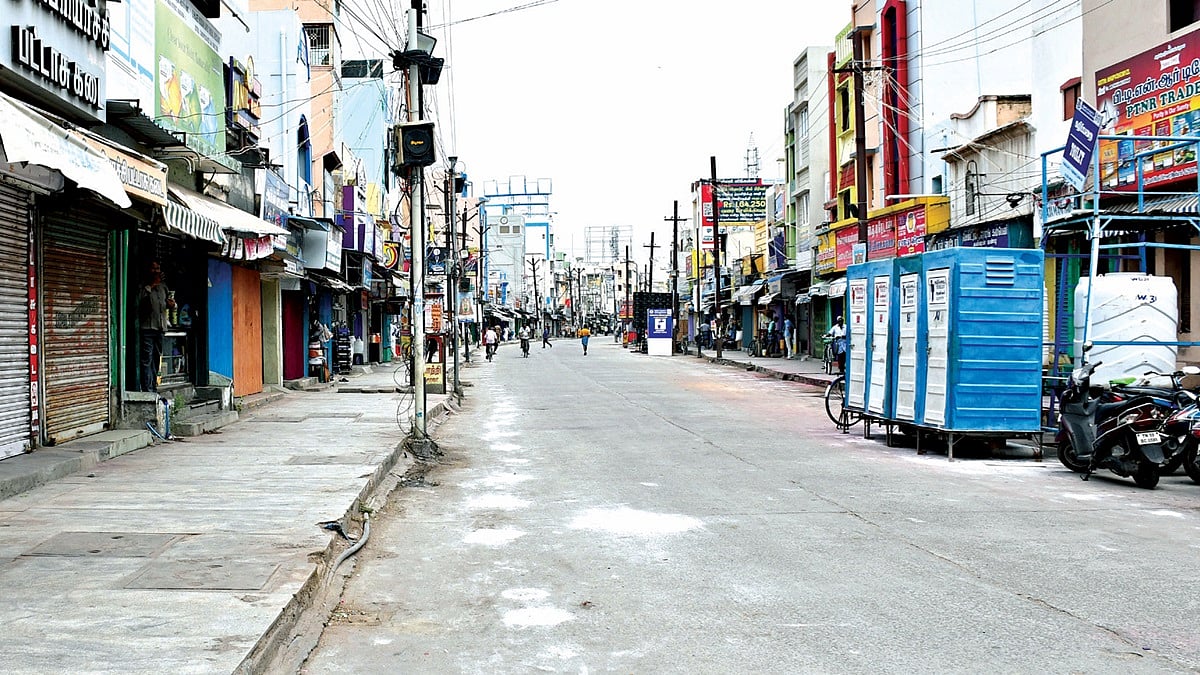
Regarding this, municipal officials said: Most of the temporary toilets arranged by the municipality for the consecration ceremony went unused. The 203 plastic drinking water tanks were not refilled for a second time. Due to the security restrictions, devotees did not come, and most of the 74 parking spaces remained empty.
Because it was said that up to 5 million devotees might come, inexperienced ministers and senior officials made various arrangements, including a control room, as they would during disaster periods.
From 3 p.m. on Sept. 16, Masi streets, Chithirai streets, and all major roads were barricaded by the police and declared restricted areas.
During festival times like the consecration ceremony, if shops are kept open, business will be brisk. But the large shops, small shops, tea stalls, vada stalls, and idli stalls on the Masi streets were shut, and with no vehicle traffic either, the area looked deserted like a lockdown. The government’s action was such that it deeply impressed the idea that no one could even go near the temple.
During the Chithirai festival season, it had been a matter of pride and history that everyone, from children to adults, could worship the deity without any hindrance on the Masi and Chithirai streets. VIPs should be able to view the consecration ceremony and return without difficulty.
No one should be allowed until then. If devotees were allowed into the streets surrounding the temple, including Chithirai Street, it would cause massive congestion and could lead to an untoward incident. To avoid this, 90 percent of the arrangements were centered around these two concerns.
As a result, most devotees were left disappointed, since they did not get complete access to anything—whether direct darshan of the gopuram, the sprinkling of holy water, or darshan of the presiding deity inside the temple. It was clearly visible that devotees were lamenting, saying that even the satisfaction they got every year during the Thirukalyanam was not available at the Kumbabishekam. They said this.