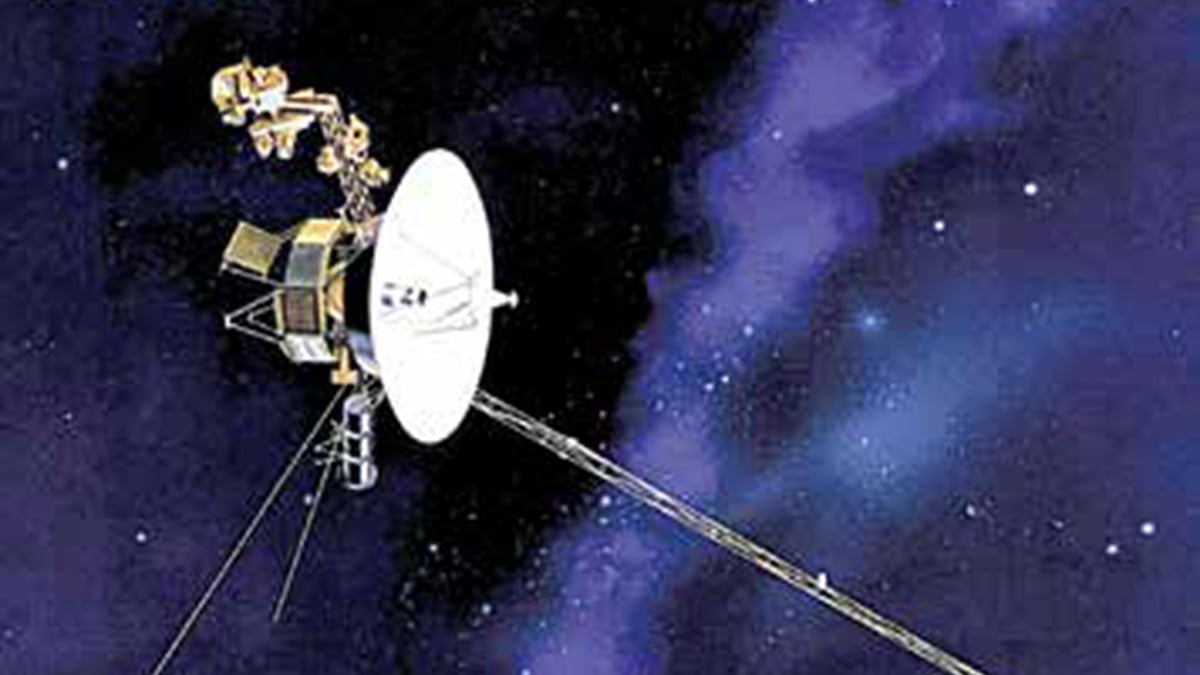
NASA, the American space research agency, said that the Voyager-1 spacecraft, launched about 50 years ago, yesterday reached a distance of 2.59 billion km from Earth, setting a record. This is a full day’s light travel distance.
The Voyager-1 spacecraft was launched into space on Sept. 5, 1977, from Cape Canaveral in Florida. Its twin, Voyager-2, had been launched slightly earlier, on Aug. 20. Both spacecraft were designed for the study of the outer planets.
Voyager-1 came close to only two planets during its journey: Jupiter and Saturn. It approached Jupiter on March 5, 1979. At that time, its camera captured eruptions from volcanoes on Jupiter’s moon Io. That was the first evidence of active volcanoes outside Earth. It came close to Saturn on November 12, 1980. It revealed the complex structure of Saturn’s rings and the dense nitrogen atmosphere of Titan, its moon.
After passing Saturn, Voyager 1 veered about 30 degrees away from the plane of the solar system and began its long journey outward. It crossed the boundary of the solar system, that is, the “heliopause” region where the solar wind collides with the interstellar medium, on Aug. 25, 2012. At that time, it was about 1.83 billion km from the Sun. At that moment, a human-made object left the solar system and entered interstellar space, setting a record.
If a phone doesn’t work properly, we toss it away. But the remarkable thing about the Voyager-1 spacecraft is that it is still operating even after about 50 years.
Its power needs are supported by three radioisotope thermoelectric generators (RTGs). The natural decay of plutonium-238 releases heat; this device converts that heat into electrical energy. It is believed that power generation will continue only until 2035. Even so, Voyager-1 will keep traveling. Long after the engineers who built it and the people who followed its journey are gone, it will continue on in the darkness between the stars.
After the next 40,000 years, it is predicted to pass near the star known as Gliese 445.
- Author: T.V. Venkateswaran, Professor, Mohali Indian Institute of Science Education and Research. (tvv123@gmail.com)
What is a light-day?
To measure distances in space, astronomers use the speed of light. Light travels at about 300,000 km per second. A “light-day” is the distance light covers in 24 hours. That is, about 2.59 billion km.
The Moon is, on average, 384,000 km away from us. Light takes only 1.3 seconds to reach there. The Sun is 150 million km away; its light takes about 8 minutes and 20 seconds to reach us.
By this calculation, Voyager 1 is currently at a distance that light can travel in a full day—that is, one full light-day away.
Voyager that ‘clicked’ Earth
On Feb. 14, 1990, at the request of astronomer Carl Sagan, the Voyager-1 spacecraft turned its camera toward Earth. In that image, taken from a distance of about 6 billion km, Earth appeared as a tiny dot suspended in a ray of sunlight. That photograph became famous as the “Pale Blue Dot.”
It reminded us that in this vast universe we are nothing but dust, and showed us how absurd the fights we pick over nation and religion are. All the people of the world are sailing in this small boat on the ocean called the universe. It also sowed the idea that it is our responsibility to protect this boat from being destroyed.