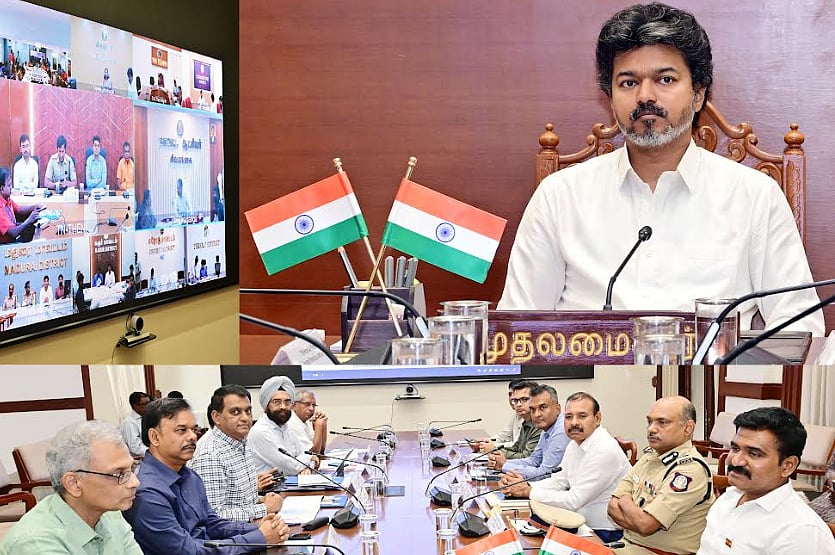
A review meeting was held under the leadership of Chief Minister Joseph Vijay regarding the precautionary measures to be taken in the southern inland districts and western districts in view of the northeast monsoon, as well as measures to prevent dengue fever.
The Tamil Nadu government issued the following press release regarding this:
Today (22.9.2026), under the leadership of Chief Minister C. Joseph Vijay, a review meeting was held at the Secretariat with District Collectors on the precautionary and disaster management measures to be taken in the southern inland districts and the western districts of Coimbatore, Dindigul, Erode, Karur, Madurai, Nilgiris, Sivaganga, Tenkasi, Theni, and Virudhunagar in view of the northeast monsoon, as well as on measures to prevent dengue fever.
In this review meeting, the Chief Minister instructed the District Collectors to take precautionary measures appropriate to the risk and location in the southern inland districts and western districts during the northeast monsoon season, and in particular to pay special attention to the risks in the hilly areas of the Nilgiris, Coimbatore, Dindigul, and Theni districts, such as landslides, soil slips, instability in hill slopes, and disruption to traffic due to soil and rocks sliding onto roads because of heavy rainfall.
Special Instructions for Hilly Areas
The Chief Minister instructed district collectors to continuously monitor all locations that could be prone to landslides, especially to intensify surveillance in hillside slopes, road cut sections, and places where danger has already been identified; to inspect vulnerable hillside slopes and road sections before and during heavy rainfall; and to take immediate action if signs of instability such as soil cracks, slippage, or water seepage are observed.
Furthermore, he instructed that slope stabilization works such as Soil Nailing, carried out in Kodaikanal in already identified areas, should be undertaken to expedite the completion of landslide prevention and hill slope stabilization works; that major roads and transport links in hilly areas should be continuously monitored; and that if road connectivity is cut off due to landslides or the sliding of soil, rocks, and debris, machinery, personnel, and the necessary equipment for immediate clearance should be kept ready in advance.
He instructed that personnel and equipment for rescue and evacuation operations should be pre-positioned in mountainous areas at risk, and that first-response rescue personnel should be identified, given the necessary training, and kept in a state of readiness.
Furthermore, he instructed District Collectors to inspect relief camps located near vulnerable areas and ensure that they are in a condition for immediate use; since telecommunications may be affected in hilly areas, to ensure that VHF devices and Satellite Phones are in working condition; and in critical vulnerable areas,
to conduct mock drills and evacuation exercises, and to ensure the rescue, evacuation, and road connectivity restoration measures to be taken during emergencies.
He instructed that immediate field action should be taken not only based on the district’s monsoon forecast, but also on heavy rainfall recorded locally and intense rainfall occurring over a short period.
Special attention based on landslide risk
According to historical data recorded since 1973, 490 landslide events have been recorded in Nilgiris district, 257 in Dindigul district, 238 in Coimbatore district, and 91 in Theni district. In addition, the risk assessment conducted identified 79 high/very high risk locations in Nilgiris district and 24 in Dindigul district.
Therefore, the Chief Minister instructed that disaster preparedness measures for hilly areas should be carried out based on a separate action plan, and that district administrations should pay special attention to identifying signs of landslides in advance, taking preventive measures, protecting road connectivity, evacuating people where necessary, and ensuring swift rescue operations.
At the same time, the Chief Minister instructed District Collectors to ensure that canals, waterways, tanks, surplus water channels, and stormwater drainage systems in the southern districts function without obstruction, and to take the necessary precautionary measures in identified flood-prone areas. He also directed that, for every identified vulnerable location, the officer responsible for implementing precautionary measures, the necessary advance preparations, and the emergency action plan must be ensured before the rains intensify.
He also instructed that the paddy procured in the districts should be monitored to ensure it is not damaged by rain, and that essential items needed during the rainy season should be safeguarded and kept ready in the identified camps in advance.
Measures to prevent dengue fever
He instructed District Collectors to identify, district-wise, the number of dengue and fever patients and the areas where the disease is spreading, and to ensure that mosquito larvae control (DBC) workers carry out house-to-house field inspections to identify and eliminate Aedes mosquito breeding sites, conduct mosquito control measures, raise public awareness, and maintain continuous monitoring in high-risk areas, in coordination with other departments associated with the Department of Public Health and Family Welfare. He also directed that extensive measures be taken to create awareness among the public to seek immediate medical advice for dengue fever and to educate them about methods to prevent mosquito breeding.
He also directed that government hospitals and primary health centers be ensured to be in a state of readiness to detect dengue fever at an early stage, refer patients for timely treatment, provide fluid therapy facilities, treat severe dengue patients, and carry out continuous medical monitoring.
At this meeting, Energy and Law Minister C.T.R. Nirmal Kumar, Chief Secretary Dr.
M. Saikumar, Additional Chief Secretary of the Municipal Administration and Water Supply Department Gagandeep Singh Bedi, along with department secretaries and senior government officials, participated.
District collectors from Coimbatore, Dindigul, Erode, Karur, Madurai, Nilgiris, Sivaganga, Tenkasi, Theni, and Virudhunagar districts participated via video conference.