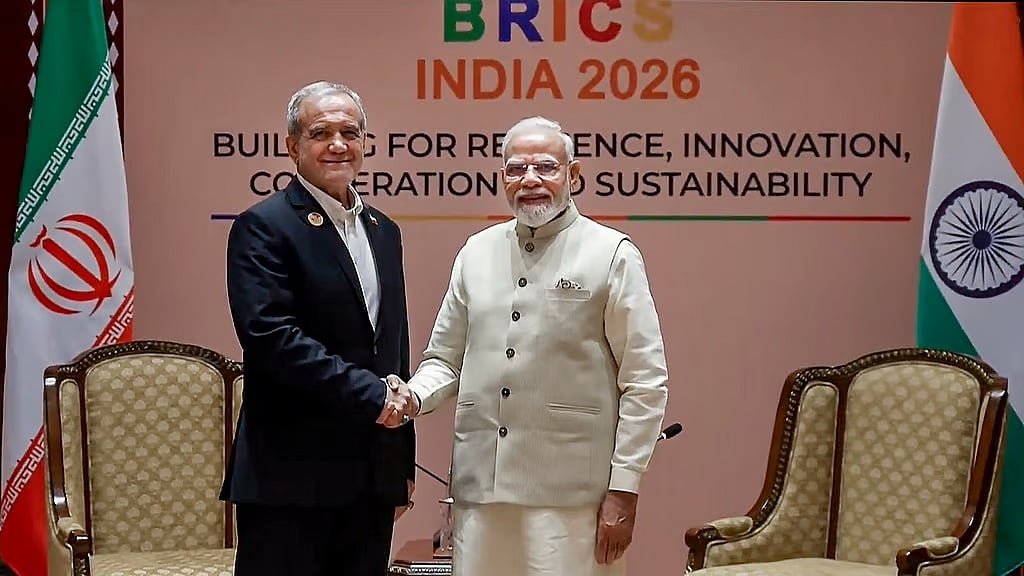
New Delhi: In the context of rising tensions in West Asia, Prime Minister Modi said that both sides discussed the friendship between India and Iran, as well as the need to advance this relationship with a long-term perspective.
Amid tensions in West Asia and the United States’ retaliatory measures, and as concerns have arisen over regional stability, maritime security, trade, and energy supplies, Prime Minister Narendra Modi and Iranian President Masoud Pezeshkian held talks in New Delhi. At that time, the leaders of both countries decided to pursue a long-term and “mutually beneficial” strategy in their bilateral relationship.
Iranian President Masoud Pezeshkian, who is in Delhi for the BRICS summit, met and spoke with Prime Minister Narendra Modi. The meeting, held as part of the summit, was the second meeting between the two leaders within two weeks. Earlier, the two leaders had also met and spoken during the Shanghai Cooperation Organisation summit held in Bishkek on August 31.
"From Bishkek to Delhi, productive discussions continue," Modi said after the meeting.
Modi said that both sides discussed India-Iran friendship and the need to advance this relationship with a long-term perspective.
"We spoke about India-Iran friendship. We believe we should move forward with a long-term strategy that benefits both sides," he said.
The escalating situation in West Asia also figured prominently in the talks. "The prevailing situation in the region was discussed. India continues to stand firm in its position on establishing lasting peace," Modi said.
According to official information, Modi reiterated India’s consistent position that all issues in the region should be resolved only through "dialogue and diplomacy."
He also pointed out that, in addition to ensuring maritime transport and freedom of trade, as well as the safety and welfare of seafarers, sustained efforts are needed to establish lasting peace and stability.
At the BRICS Business Forum, Pezeshkian called for increasing the use of national currencies in trade among BRICS member states.
He said that one of the most important measures is to maximize the use of national currencies in trade among member states, and emphasized that this should be accompanied by mechanisms for managing currency risks and implementing mutual settlements.
Pointing out that the current global financial system is vulnerable to political shocks because it focuses on only a few currencies, Pezeshkian called for the New Development Bank to become a key mechanism for financing infrastructure and energy projects in member countries through special credit facilities, local currency financing, and guarantee instruments to attract private capital.
As artificial intelligence is bringing about a fundamental shift in the global economy, BRICS should play a major role in shaping the digital economy. He said that this grouping should contribute not only as a mere consumer of technology, but also to intellectual production, digital standards, and the cybersecurity of critical infrastructure.