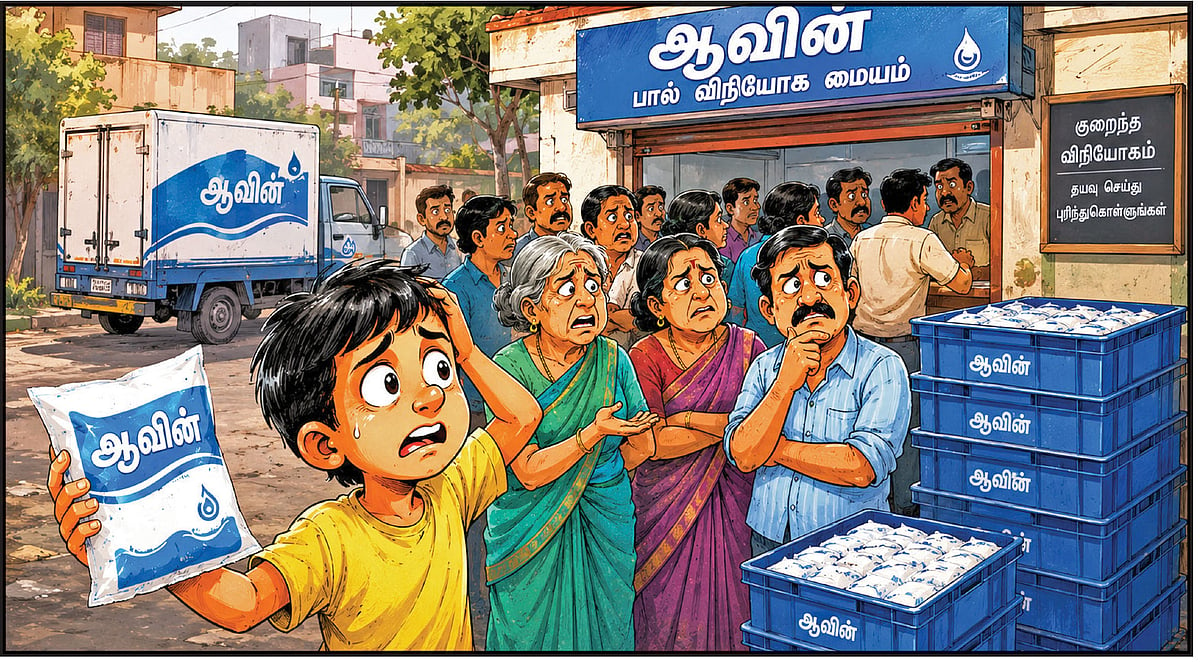
"Due to the Aavin management’s order to reduce milk distribution by another 10 percent, citing financial loss, our livelihoods are being affected, and there is also a situation where the public may face a milk shortage," say milk agents.
Regarding this, Tamil Nadu Milk Agents and Workers Welfare Association founder president Su.A. Ponnusamy said, "At a time when the Tamil Nadu government raised Aavin's milk procurement price last week, failing to raise the sales price accordingly and repeating the same mistake made during the previous DMK regime will cause Aavin multiple times more financial loss.
Because, even though the milk procurement price has been increased, the milk supply to Aavin has not increased; as a result, Aavin is continuing to produce milk packets by purchasing milk at a higher price from Nandini, the neighboring state cooperative milk company, and by procuring butter and milk powder from northern states. To control the severe financial loss incurred by Aavin, the Managing Director and General Managers have been issuing verbal orders to reduce Aavin milk sales across Tamil Nadu, creating an artificial shortage and bringing disrepute to the government.
In particular, in Kanyakumari district, the production and sale of Aavin full-cream milk were completely stopped a few weeks ago, and Aavin milk distribution has been drastically reduced in all districts, including Erode, Salem, Madurai, Tiruchi, Thanjavur, and Coimbatore.

Milk agents, who are struggling to continue supplying milk to the public as required, have lost their livelihood and are left helpless, unable to control expenses such as vehicle fuel for milk distribution, workers’ salaries, shop rent, electricity charges, and other costs.
Furthermore, while daily Aavin milk sales in the Chennai metropolitan area were above approximately 16.5 lakh liters, in a situation where milk distribution has already been reduced by more than 25 percent in just the past 6 months, a verbal order has now again been issued to cut distribution by up to another 10 percent, and it has been implemented from 15.09.2026.
While previous rulers had been using Aavin as a weapon for vote-bank politics, no effort has yet been made to bring about change and restore Aavin by hoping that Joseph Vijay would at least do so. Various suggestions were made by meeting the Dairy Development Minister Vijayalakshmi, providing data for it, and speaking to her, as well as by sending emails to the Chief Minister, but none of these efforts has been undertaken so far.
After 4 years, the milk procurement price for Aavin has been raised by up to Rs. 6 per litre, but a financial loss of several thousand crore rupees will not cripple Aavin. At the same time, since it is a cooperative institution operating with the state government's financial contribution, that loss will be passed on to the public in another form.
However, even if private dairy companies raise the milk procurement price, they may also have the opportunity to raise the selling price accordingly.
If the selling price of Aavin and private milk differs by Rs. 19 to 24 per litre, and if the milk selling price of private companies is raised further, the public will turn toward the lower-priced Aavin. In a situation where there is already a severe shortage, an additional shortage will arise, and the new government will be rewarded only with a bad name.
Therefore, if Tamil Nadu government's cooperative milk company Aavin is to be protected and uninterrupted milk supply to the public is to continue, it is imperative that the selling price be immediately revised in line with the increase in milk procurement price.
He said that delaying the increase in Aavin milk sales prices, because it would mean facing opposition from the opposition parties rather than having to win over public opposition, will only bring more and more disrepute to the TVK government among the public.